2026 Festival Guide: Chinese National Costumes Abroad

Europe’s Vibrant Chinese Cultural Festivals: A 2026 Overview
As Europe's multicultural tapestry continues to evolve, the continent's major cities have become epicenters for authentic Asian cultural celebrations. From the thunderous drum parades of London's Shaftesbury Avenue to the elegant lantern-lit streets of Paris's 13th arrondissement, experiencing the national costume of Chinese heritage communities has become a highlight of the European festival calendar. For cultural garment enthusiasts and respectful attendees, understanding the deep history, intricate construction, and proper etiquette surrounding these garments is essential. This 2026 guide bridges the gap between traditional Asian sartorial arts and the European festival landscape, offering a comprehensive look at how to engage with, source, and appreciate these living traditions.
Decoding the Garments: Beyond the Stereotypes
The term 'national costume' often flattens thousands of years of sartorial evolution into a single stereotype. In reality, the clothing seen at European Lunar New Year and Mid-Autumn festivals represents distinct historical epochs and regional variations. To truly appreciate the garments, one must understand their structural anatomy.
Hanfu (汉服): The Ancient Roots
Hanfu refers to the historical clothing of the Han Chinese, spanning from the Shang Dynasty (c. 1600 BCE) to the late Ming Dynasty (1644 CE). At European cultural heritage festivals, you will increasingly see younger diaspora members wearing meticulously reconstructed Hanfu. The defining characteristic of Hanfu is jiaoling youren (a cross-collar where the left side crosses over the right) and pingmian caizheng (flat pattern cutting). Unlike Western tailoring, which uses darts to mold fabric to the body's curves, Hanfu relies on wide, unbroken planes of fabric draped and secured with sashes. Authentic festival sets often feature Mamianqun (horse-face skirts) with deep, structured pleats and woven Zhuanghua (brocade) motifs.
Qipao (旗袍): The Modern Silhouette
Often mistakenly viewed as the sole traditional garment, the Qipao (or Cheongsam) is actually a product of 1920s Shanghai modernity. It represents a fascinating synthesis of traditional Manchu robe structures and Western darting techniques. A genuine, high-quality Qipao features a stiffened Mandarin collar (yuanling), intricate hand-knotted fasteners known as pankou, and strategic side slits (kaitou) for mobility. At upscale European gallery openings and formal festival galas, bespoke Qipao made from Xiangyunsha (a rare, mud-dyed silk from Guangdong that produces a distinctive crackled, leathery texture) are highly prized.
Tangzhuang (唐装): The Contemporary Festival Standard
The garment most frequently encountered by casual attendees at European Chinatown parades is the Tangzhuang. Despite its name implying 'Tang Dynasty' origins, it is a modern hybrid based on the Qing Dynasty Magua (riding jacket). Characterized by a center-front opening (duijin) and prominent pankou knots, it is the standard 'festival uniform' for community leaders and performers. While often mass-produced in synthetic blends for parade distributions, artisan versions utilize heavy silk jacquard and feature subtle, tone-on-tone weaving.
2026 European Festival Directory & Garment Spotlight
Knowing which garment dominates which event helps attendees understand the specific cultural context of the celebration. Below is a curated guide to Europe's premier events.
| Festival / Event | Location | Dominant Garment Style | Cultural Context & Best Time to Attend |
|---|---|---|---|
| Lunar New Year Parade | London, UK (Chinatown) | Tangzhuang & Lion Dance Regalia | Community-focused; vibrant, public-facing. Late Jan/Early Feb. |
| Mid-Autumn Lantern Gala | Paris, France (Musée Guimet) | Ming-style Hanfu & Qipao | Formal, artistic; focus on historical accuracy and textiles. Sept/Oct. |
| Dragon Boat Festival | The Hague, Netherlands | Active Hanfu (Duanhe) | Dynamic, outdoor; shorter tunics and practical skirts. June. |
| Silk Road Heritage Exhibition | Venice, Italy | Historical Silk Brocades | Academic; focus on textile trade and weaving techniques. Year-round. |
Sourcing Authentic Pieces in European Capitals
For European residents and travelers looking to acquire authentic garments for festival attendance, bypassing fast-fashion 'costume' shops is crucial for cultural respect and garment longevity. Here is a breakdown of sourcing hubs and current market prices.
- London (Mayfair & Chinatown): While Gerrard Street offers accessible, off-the-rack Tangzhuang (£45–£120), serious collectors visit bespoke tailors in Mayfair and Marylebone. A bespoke Qipao, hand-draped and finished with genuine jade or knotted silk pankou, typically ranges from £850 to £2,500. For Hanfu, specialized importers in Soho offer authentic Ming-dynasty reproduction sets (£180–£400) woven on traditional wooden looms.
- Paris (Belleville & 13th Arrondissement): Paris is home to several Wenzhou and Zhejiang diaspora boutiques. Here, you can find exquisite Yunjin (cloud brocade) jackets. Expect to pay €150–€300 for high-quality festival wear. The Musée Guimet frequently hosts pop-up artisan markets where master weavers from Suzhou sell directly to European collectors.
- Milan (Via Paolo Sarpi): Milan’s historic Chinatown blends Italian sartorial standards with Chinese textiles. Boutique tailors here often create fusion garments—pairing traditional Chinese silk jacquard with Italian wool tailoring—perfect for European winter festivals (€300–€600).
The Silk Road Legacy: Chinese Textiles in European Folk Dress
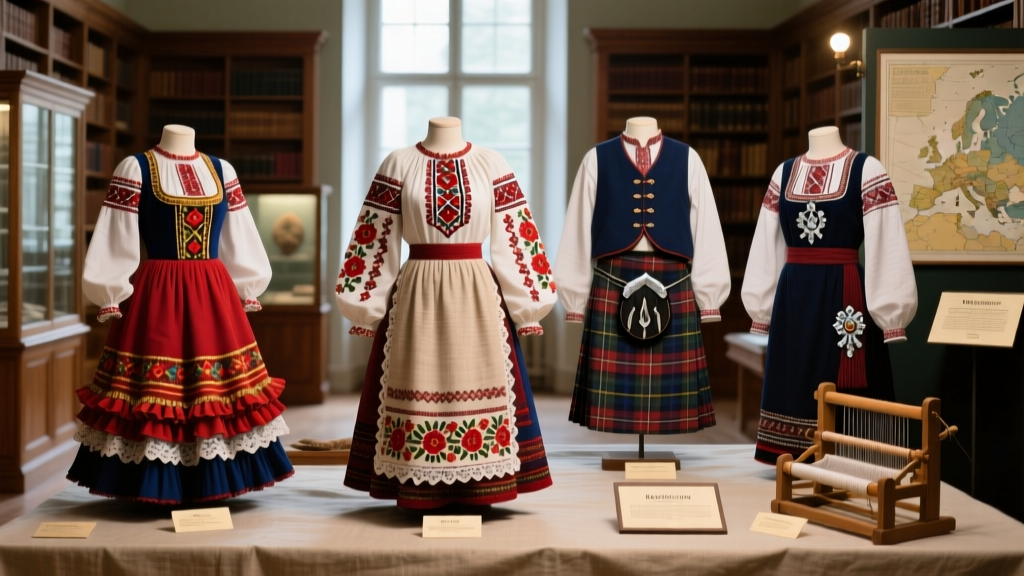
While this guide focuses on the national costume of Chinese communities, it is vital for readers of The Garment Atlas to recognize the profound historical impact of Chinese textiles on European folk dress. The categorization of these garments within a European context is not merely about modern diaspora; it is rooted in centuries of trade.
During the 17th and 18th centuries, Chinese damasks, silks, and embroidered motifs traveled the Silk Road and maritime routes, fundamentally altering European regional costumes. In Southern France, the obsession with imported silks birthed the Indiennes and influenced the vibrant, quilted petticoats of the Provençal folk costume. In Scandinavia, Chinese silk ribbons and floral brocades were highly prized and integrated into the Bunad and regional folk dress of the wealthy merchant classes, often repurposed as bodice panels or apron trims. Even the silver filigree work seen in Norwegian and Swedish folk dress was heavily influenced by the silver trade routes that connected back to Asian metalworking techniques. Understanding this shared textile history fosters a deeper appreciation when viewing Chinese garments at modern European heritage festivals.
Cultural Etiquette for European Attendees
Attending a cultural festival as a non-Chinese European requires a mindful approach to sartorial participation. The line between cultural appreciation and appropriation is defined by context, respect, and accuracy.
- Avoid 'Costume' Shops: Never purchase garments from Halloween or party supply stores. These items are often structurally inaccurate, use disrespectful motifs (such as mixing funeral colors with celebratory styles), and perpetuate caricatures.
- Understand the Motifs: Motifs carry deep meaning. The peony represents wealth and honor, while the bat (fu) symbolizes good fortune. Avoid wearing garments featuring the five-clawed dragon unless you fully understand its historical imperial exclusivity, though modern festival wear often relaxes these rules.
- Proper Wearing: If you are gifted or purchase a Hanfu or Qipao to attend a community festival, ensure it is worn correctly. For Hanfu, the left lapel must always cross over the right (youren). Crossing right over left is historically reserved for the deceased and is considered highly inauspicious.
- Engage with the Artisans: When attending festivals in London or Paris, take the time to speak with the weavers and tailors at the cultural booths. Asking about the Xiangyunsha dyeing process or the history of the Mamianqun pleats shows genuine respect for the craft.
Preserving the Threads of Heritage
The visibility of the national costume of Chinese heritage at European festivals is a testament to the resilience and pride of the diaspora. Institutions like the Victoria and Albert Museum in London and academic departments at SOAS University continue to document and preserve these sartorial traditions, ensuring that the structural brilliance of flat-pattern cutting and the chemistry of natural silk dyeing are not lost to fast fashion. As you step into the vibrant streets of a 2026 European Lunar New Year parade, look closely at the garments. You are not just seeing a costume; you are witnessing a living, breathing archive of human history, woven into the very fabric of Europe's modern cultural identity.