China Traditional Clothing: Regional Variants and Silk Road Trade

The Structural Philosophy: Flat-Cutting vs. European Tailoring
When analyzing China traditional clothing, one must first understand the fundamental divergence in structural philosophy between Eastern and Western garment-making. Traditional European folk dress and court attire historically relied on 3D draping, darting, and tailoring to contour the human body. In stark contrast, China traditional clothing is rooted in a flat-cutting technique (pingmian caifeng). Garments were constructed from straight pieces of woven fabric, minimizing waste and preserving the integrity of the textile's surface patterns. This approach prioritized the flow of the fabric, the symbolism of the motifs, and the layered elegance of the silhouette over anatomical constriction.
Hanfu: The Enduring Legacy of the Han Majority
The term Hanfu refers to the historical dress of the Han Chinese, spanning from the Yellow Emperor era (circa 27th century BCE) to the late Ming Dynasty (1644 CE). The defining characteristic of Hanfu is the jiaoling youren—a cross-collar that wraps over the chest, with the left lapel crossing over the right. This right-lapel closure became a profound cultural marker, historically distinguishing the civilized agrarian societies of the Central Plains from the nomadic tribes of the north, who typically wore left-lapel closures for ease of horseback riding.
The Mamianqun (Horse-Face Skirt)
Among the most iconic garments in China traditional clothing is the Mamianqun, or horse-face skirt, which gained immense popularity during the Ming Dynasty. Constructed from two overlapping panels of fabric, the skirt features flat, unpleated sections at the front and back (the 'horse faces') with heavily pleated sides. Artisans often utilized zhuanghua (woven gold and silver threads) to create elaborate motifs of dragons, phoenixes, and floral scrolls on the skirt's panels. Today, the Mamianqun has experienced a massive revival among younger demographics, blending historical accuracy with modern streetwear.
Regional Variants: Northern Pragmatism vs. Southern Elegance
China's vast geography and varied climate have necessitated distinct regional adaptations in traditional dress. The following table highlights the primary differences between Northern and Southern historical garments:
| Feature | Northern Variants (e.g., Beijing, Shandong) | Southern Variants (e.g., Jiangnan, Guangdong) |
|---|---|---|
| Primary Materials | Heavy silk brocades, padded cotton, wool, fur linings | Lightweight silk gauze, ramie, fine cotton, linen |
| Silhouette | Broad, layered, and voluminous to trap body heat | Flowing, slender, and breathable for high humidity |
| Color Palette | Deep, contrasting colors (crimson, indigo, black) | Pastels, water-tone hues, subtle embroidered motifs |
| Footwear | Thick-soled cloth boots, padded for snow and cold | Thin-soled silk slippers, wooden clogs in wet regions |
The Qipao: Manchu Origins and Shanghai Modernity
While Hanfu represents the ancient majority, the Qipao (or Cheongsam) represents a fascinating intersection of Manchu imperial rule and 20th-century Western influence. Originating from the qizhuang—the long, straight, one-piece robes worn by the Manchu Eight Banners during the Qing Dynasty (1636–1912)—the early Qipao was loose and concealing. It featured high Mandarin collars and pankou (intricate knotted frog fasteners).
During the 1920s and 1930s in Shanghai, the garment was radically reimagined. Tailors introduced Western darting, set-in sleeves, and side slits to create a form-fitting silhouette that celebrated the natural curves of the body. This modernized Qipao became the definitive symbol of Chinese modernity and remains the most globally recognized piece of China traditional clothing today, frequently worn at diplomatic events, weddings, and formal gatherings.
Silk Road Exports: Chinese Textiles in European Folk Dress
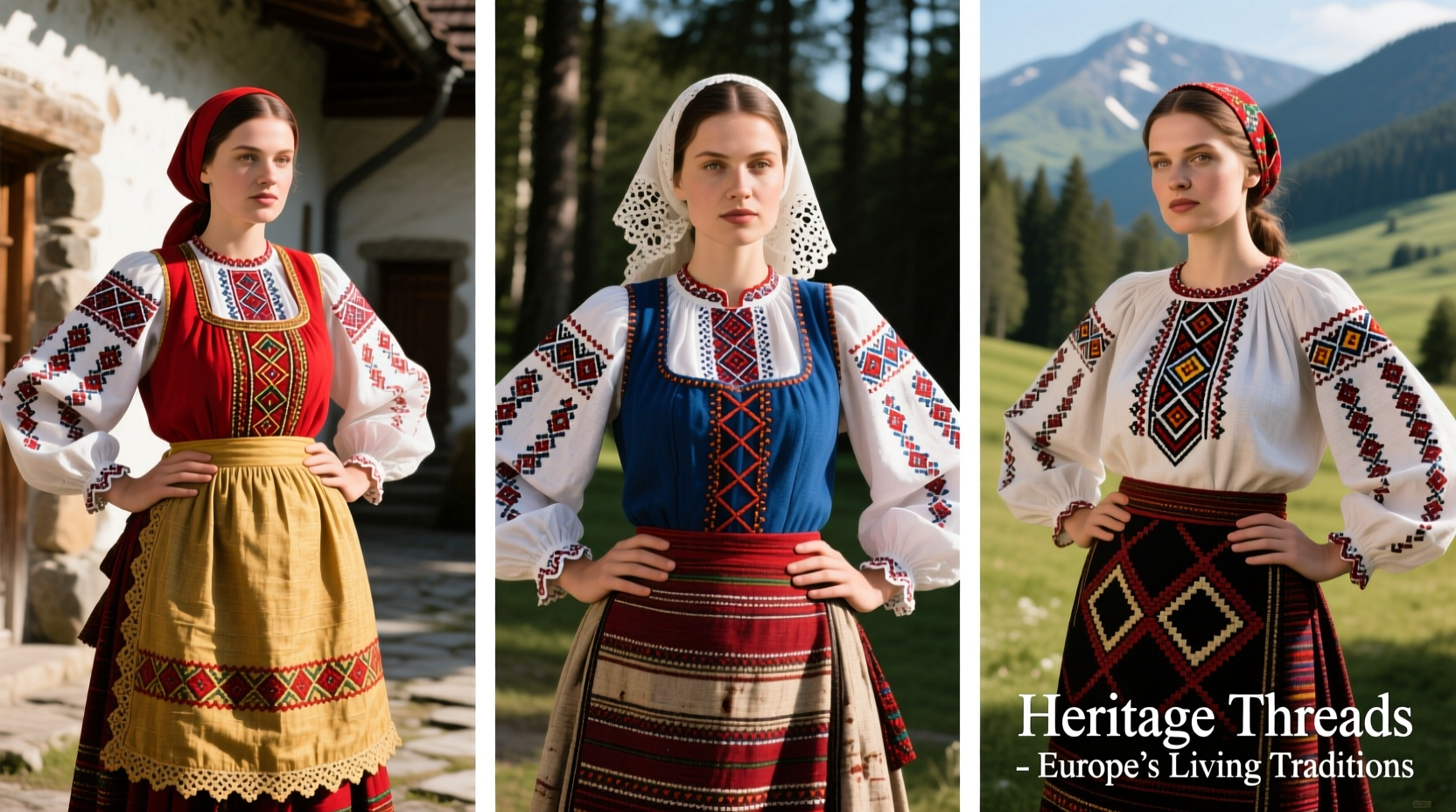
Though this encyclopedia primarily focuses on European folk dress, it is impossible to discuss the evolution of Eastern European and Russian traditional costumes without acknowledging the profound impact of China traditional clothing exports via the Silk Road. From the 13th to the 18th centuries, Chinese silk damasks, brocades, and kesi (cut-silk tapestries) were among the most prized commodities in Europe.
Influence on Russian and Nordic Folk Costumes
In Tsarist Russia, the kaftan and the sarafan (a traditional pinafore dress worn in northern regions like Arkhangelsk and Vologda) were frequently constructed from imported Chinese silks. The Boyar aristocracy and wealthy merchants used Chinese woven gold brocades to signal status. Over time, these imported textiles trickled down into regional folk dress, where Chinese floral and cloud motifs were integrated into local embroidery patterns. Similarly, the shuba (traditional Russian fur coat) was often lined with Chinese silk to provide a smooth, insulating barrier against the harsh winters, demonstrating a direct material lineage between Chinese weaving traditions and European folk survival garments.
Ethnic Minority Dress: A Contrast to Han Traditions
China is home to 55 officially recognized ethnic minorities, each possessing distinct sartorial traditions that contrast sharply with Han and Manchu styles. For example, the Miao (Hmong) people of Guizhou province are renowned for their extraordinary silverwork and intricate pleated skirts, which can require up to 20 meters of indigo-dyed cotton. The Yi people of the mountainous southwest utilize heavy wool to create the charwa, a striking, fringed cloak designed to withstand high-altitude chill. These minority garments often rely on cross-stitch embroidery, batik wax-resist dyeing, and appliqué techniques that serve as wearable historical records, preserving creation myths and genealogical data in the absence of written languages.
Acquisition Guide: Pricing and Authenticity
For collectors, historians, and cultural enthusiasts looking to acquire authentic China traditional clothing, understanding the market tiers is essential:
- Mass-Produced / Costume Grade ($30 - $80 USD): Typically made from polyester blends with machine-embroidered motifs. Suitable for casual festivals but lacks historical drape and breathability.
- Artisanal Hanfu & Mamianqun ($150 - $450 USD): Crafted from genuine mulberry silk, brocade, or high-grade linen. Features traditional flat-cutting, hand-finished seams, and accurate historical patterns sourced from museum archives.
- Bespoke Qipao ($400 - $1,500+ USD): Commissioned from master tailors (often in Shanghai or Hong Kong). Includes custom pattern drafting, premium silk jacquard, and hand-rolled hems with authentic pankou knotting.
- Antique / Vintage Qing Dynasty Robes ($2,000 - $15,000+ USD): Sourced via auction houses. Buyers must verify the condition of the silk (checking for 'shattering' due to historical metallic weighting) and the provenance of the embroidery.
Authoritative Sources and Further Reading
To deepen your understanding of China traditional clothing and its global textile impact, consult the following cultural institutions:
- The Victoria and Albert Museum (V&A) - The V&A houses an exceptional collection of Qing Dynasty court robes and Shanghai-era Qipaos, offering deep insights into the evolution of Chinese tailoring. Read their comprehensive guide on Chinese Dress and Textiles.
- The Metropolitan Museum of Art - The Met's Heilbrunn Timeline of Art History provides academic overviews of Chinese weaving techniques, including the highly complex kesi tapestry methods. Explore their Timeline of Chinese Textiles.
- UNESCO Silk Roads Programme - For a broader understanding of how Chinese silks influenced European, Central Asian, and Middle Eastern folk and court dress, the UNESCO Silk Roads archive offers unparalleled historical mapping and textile trade documentation.