Chinese vs European Folk Dress: Variants

The Concept of a National Costume vs. Hyper-Local Folk Dress
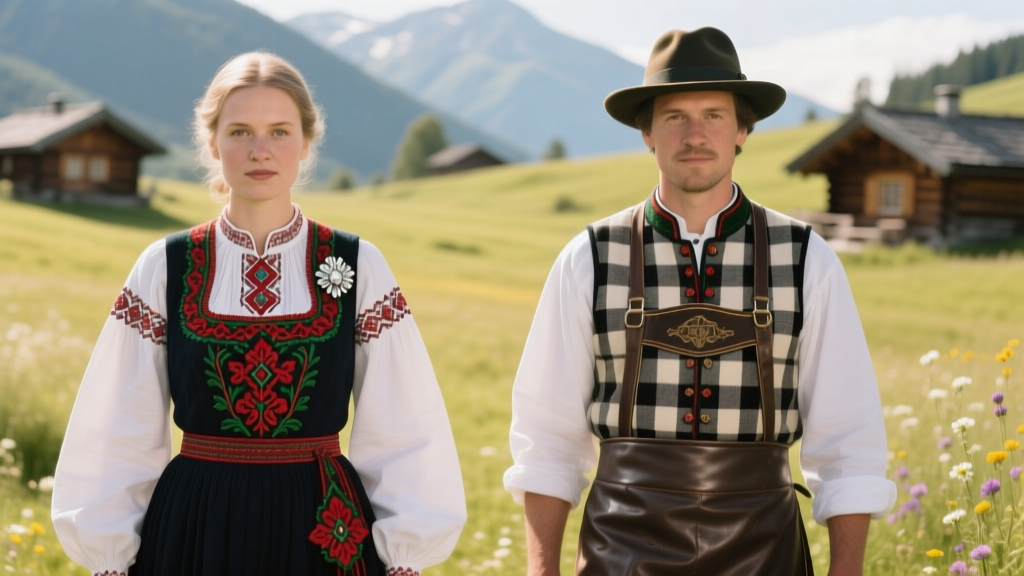
When textile historians and cultural anthropologists examine china's national costume in a global context, they are often looking at a macro-level identity expressed through garments like the Hanfu (traditional Han clothing) or the Qipao (Cheongsam). These garments represent a unified cultural philosophy, emphasizing harmony, fluid draping, and symbolic motifs. In stark contrast, European folk dress—encompassing the German Dirndl and Lederhosen, the Norwegian Bunad, and the Scottish Kilt—is inherently hyper-localized. European traditional costumes are micro-identities, designed to signal the wearer's specific village, marital status, and even religious denomination within a 20-mile radius.
This comparative analysis bridges the gap between East and West, exploring how the historical Silk Road facilitated a cross-pollination of textiles, while divergent tailoring philosophies shaped the regional variants we see in museums and cultural festivals today.
Materiality and the Silk Road Legacy
The most profound intersection between Chinese and European traditional dress lies in materiality. For centuries, Chinese silk was the ultimate luxury import in Europe, fundamentally altering the trajectory of European regional costumes.
Fabric Composition and Weaving Techniques
Traditional Chinese garments heavily utilize warp-faced weaves like Keisi (cut silk) and Song brocade. A premier example is Xiangyunsha (gambiered gauze), a complex silk dyed with river mud and yam juice, resulting in a waterproof, rustling fabric that can cost upwards of $400 per yard. Conversely, European folk dress is rooted in agrarian pragmatism. The foundation of Alpine Tracht is Loden (a water-resistant, fulled wool) and heavy linen. However, as silk trickled down the trade routes, it was incorporated into European folk dress as a marker of wealth. The elaborate silk ribbons adorning the coiffes (headdresses) of Breton women in France, and the imported silk damask used in the bodices of Russian Sarafans, are direct descendants of the Sino-European silk trade.
'The arrival of Chinese damasks and brocades in the 17th century did not merely dress the European aristocracy; it filtered down into the festive wardrobes of the peasantry, creating a hybrid material culture in regional folk dress.' — Victoria and Albert Museum, Asian Textile Collections
Structural Comparison: Flat-Pattern vs. Tailored Silhouettes
The most striking technical difference between China's national costume and European folk variants is the approach to the human form. Chinese traditional tailoring relies on flat-pattern cutting, while European folk dress embraces three-dimensional structuring.
The Philosophy of the Cut
The Hanfu, particularly the Shenyi (deep robe) or Ruqun (blouse and skirt), is constructed from rectangular panels of fabric woven on narrow looms. The fabric is cut in straight lines and folded, relying on the body to give the garment its final shape. This respects the integrity of the textile and avoids waste. The iconic cross-collar (jiaoling youren) and wide sleeves create a flowing, unstructured silhouette that obscures the body's contours, reflecting Confucian ideals of modesty and restraint.
European folk dress, born from the wider looms and tailoring traditions of the Renaissance and 19th-century rural revivals, is aggressively three-dimensional. The Bavarian Dirndl features a tightly fitted, boned bodice designed to sculpt the torso, while the Norwegian Bunad utilizes intricate pleating, smocking, and gussets to achieve a tailored fit. The European approach celebrates and shapes the physical form, whereas the traditional Chinese approach prioritizes the canvas of the fabric itself.
Regional Variants: A Cross-Cultural Comparison Matrix
To understand the nuances of these garments, we must break down their specific regional markers and construction elements.
| Feature | China's National Costume (Hanfu / Qipao) | European Folk Dress (Bunad / Dirndl / Kilt) |
|---|---|---|
| Silhouette | Fluid, A-line, or columnar; flat-pattern cut. | Structured, fitted bodices, flared or pleated skirts. |
| Fastening Systems | Knot buttons (pankou), sashes, and ties. | Hook-and-eye, metal clasps, silver brooches, buckles. |
| Primary Fabrics | Silk brocade, Xiangyunsha, ramie, cotton. | Fulled wool (Loden), heavy linen, worsted tartan. |
| Regional Markers | Embroidery motifs (dragons, peonies), collar shapes. | Thread color, metalwork design, specific tartan setts. |
| Authentic Price Range | $300 - $1,500+ (Custom silk / Hand-embroidered) | $800 - $5,000+ (Hand-woven wool / Silver filigree) |
Adornment and Symbolism: Embroidery vs. Metalwork
Both traditions utilize adornment to convey social standing, but the mediums differ vastly based on regional resources.
Chinese Silk Embroidery
In Chinese garments, the embellishment is woven or stitched directly into the textile. The four major styles of Chinese embroidery—Su (Suzhou), Shu (Sichuan), Yue (Guangdong), and Xiang (Hunan)—serve as regional identifiers. A Qipao featuring Su embroidery with delicate, photorealistic koi fish indicates a connection to the Jiangnan water towns, while heavier, gold-threaded Yue embroidery points to southern coastal wealth. The motifs are deeply symbolic: peonies for honor, bats for good fortune, and plum blossoms for resilience.
European Silver and Wool
European folk dress relies heavily on metalwork and woven geometry. In the Norwegian Bunad, the silver jewelry (sølv) is paramount. A woman from the Telemark region will wear heavily oxidized silver brooches with dangling spoon-shaped pendants, while a woman from Hardanger will wear intricate filigree crown-like headpieces. The Norwegian Museum of Cultural History notes that these silver pieces were historically a family's portable bank account, passed down through generations. Similarly, in Scotland, the regional variant is defined not by stitching, but by the precise thread count and color sequence (the sett) of the tartan, woven in the Highlands to denote clan and district allegiance.
Cultural Protocols and Modern Revival Movements
Both China and Europe are currently experiencing massive revivals of their traditional garments, though the cultural protocols for wearing them differ.
The Hanfu Movement vs. The Tracht Revival
The modern Hanfu movement, driven largely by Gen Z and millennial enthusiasts in China, seeks to reclaim pre-Qing dynasty clothing as everyday streetwear. It is common to see youth in cities like Chengdu and Xi'an wearing meticulously researched Mamianqun (horse-face skirts) paired with modern blouses. The protocol here is rooted in historical accuracy regarding the cross-collar (always right over left for the living; left over right is strictly reserved for the deceased).
In Europe, the wearing of Tracht and Bunad is heavily codified and often restricted to specific cultural events, weddings, or national holidays (like Norway's Constitution Day or Germany's Oktoberfest). Wearing a Dirndl requires adherence to the apron-bow code: tied on the left indicates the wearer is single, on the right means married or taken, in the center signifies virginity (historically), and in the back indicates widowhood or that the wearer is a waitress. Misinterpreting these codes in rural Bavaria or Austria can lead to genuine social faux pas.
Sourcing and Price Guides for Authentic Garments
For collectors, cultural practitioners, and museums, sourcing authentic pieces requires navigating a market flooded with mass-produced costumes. Here is a practical guide to acquiring genuine regional variants.
- Authentic Qipao (Shanghai / Beijing): Avoid mass-market polyester blends ($40-$90). Seek out bespoke tailors in Shanghai's Former French Concession or Beijing's Ruifuxiang silk shop. Expect to pay $600 to $2,000 for custom-fitted garments utilizing genuine Xiangyunsha or Song brocade, with hand-rolled hems and knotted pankou buttons.
- Authentic Bunad (Norway): A true Bunad is not bought off the rack; it is commissioned. Institutions like The Metropolitan Museum of Art have highlighted the immense labor in traditional textile creation. In Norway, local Husflid (handicraft) cooperatives measure and stitch the wool. Prices range from $3,000 to $6,000, with the mandatory silver jewelry adding another $1,000 to $3,000.
- Authentic Dirndl and Lederhosen (Alpine Regions): Skip the Oktoberfest party shops. True Tracht is sourced from heritage manufacturers like Lodenfrey in Munich or Steindl in Salzburg. A genuine Lederhosen made from deer leather, featuring hand-stitched Weissstickerei (white embroidery), will cost between $800 and $1,500. A high-end Dirndl with a hand-block-printed silk apron and horn buttons will range from $500 to $1,200.
Conclusion: A Shared Thread of Heritage
While china's national costume and European folk dress emerge from vastly different philosophical and geographical landscapes, they share a common thread: they are living archives of human ingenuity. Whether it is the mathematical precision of a Scottish tartan weave, the structural engineering of a Bavarian bodice, or the fluid, zero-waste flat-pattern cutting of a Han dynasty robe, these garments demand our respect. By understanding their regional variants, construction methods, and cultural protocols, we move beyond viewing them as mere costumes, and begin to appreciate them as the profound wearable heritage they truly are.