Buying European Folk Costumes: 2026 Sizing Guide
The Anatomy of Authenticity: Commercial vs. Couture Tracht
When investing in genuine european folk costumes, buyers frequently encounter a stark divide between mass-produced festival wear and historically accurate, artisan-crafted garments. The global resurgence of heritage dress has led to a saturated market, making it imperative to understand the structural and material differences between commercial approximations and authentic regional attire. True folk dress—whether a Bavarian Tracht, a Norwegian Bunad, or a Scottish Highland kilt—is not merely a costume; it is a living textile tradition governed by strict regional protocols, specific fabric weights, and bespoke tailoring methods.
According to the Bayerisches Nationalmuseum, authentic Alpine tracht is defined by its historical continuity, utilizing specific natural fibers and hand-finishing techniques that date back to the 18th and 19th centuries. In this comprehensive 2026 buying guide, we break down the exact sizing matrices, fabric compositions, and investment tiers required to source and wear European folk dress with cultural respect and sartorial precision.
Regional Sizing Matrices and Measurement Protocols
Unlike contemporary fast fashion, which relies on standardized, forgiving stretch fabrics, traditional European garments are structured, tailored, and unforgiving of incorrect measurements. Sizing protocols vary drastically across regions, reflecting the unique silhouette and cultural purpose of each garment.
The Bavarian Dirndl and Lederhosen
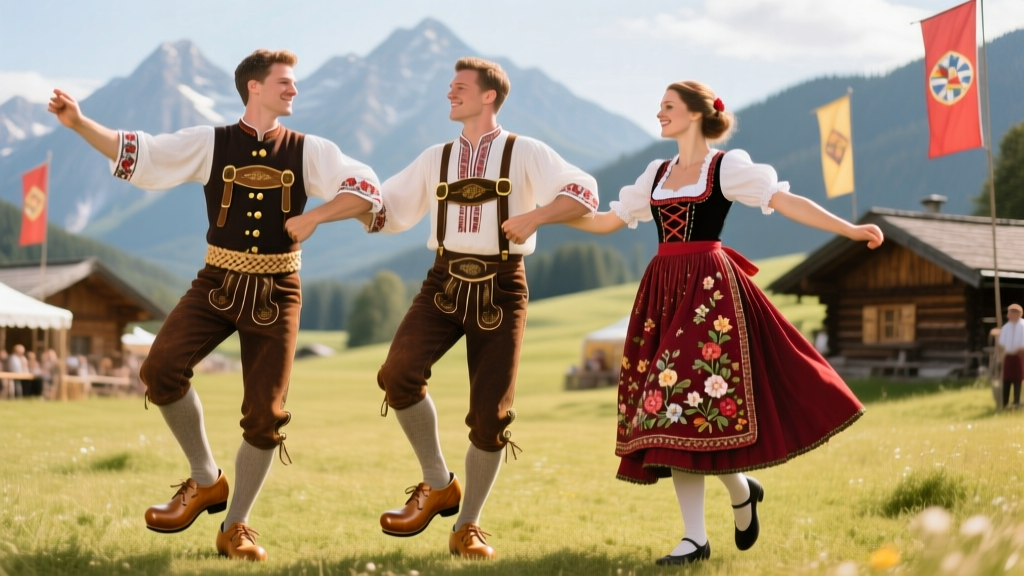
The German and Austrian Dirndl consists of four distinct components: the Mieder (structured bodice), Bluse (blouse), Rock (gathered skirt), and Schürze (apron). Commercial dirndls are typically sold in standard European sizing (EU 34 to 44). However, an authentic artisan dirndl requires bespoke measurements of the underbust, natural waist, and bust apex to ensure the Mieder provides the traditional corset-like support without restricting breathing.
- Bodice (Mieder): Must be tailored to sit flush against the ribcage. Authentic versions use internal boning and cotton-linen blends, avoiding synthetic polyester linings.
- Skirt (Rock): Traditional length falls precisely to the mid-calf (approx. 70-80 cm from the waist). The waistband should feature cartridge pleating rather than modern gather stitching to distribute the heavy cotton or wool fabric evenly.
- Apron (Schürze) Etiquette: The placement of the apron bow is a strict cultural code. Tied on the left indicates the wearer is single; on the right, married or taken; in the center, traditionally a virgin (though often worn by young girls today); and at the back, a widow or a waitress.
For men, authentic Lederhosen are crafted from brain-tanned deer or chamois leather (Hirschleder). Sizing requires precise measurements of the thigh and waist. Genuine leather will stretch up to half a size with wear, so artisan saddlers recommend buying them snug.
The Norwegian Bunad
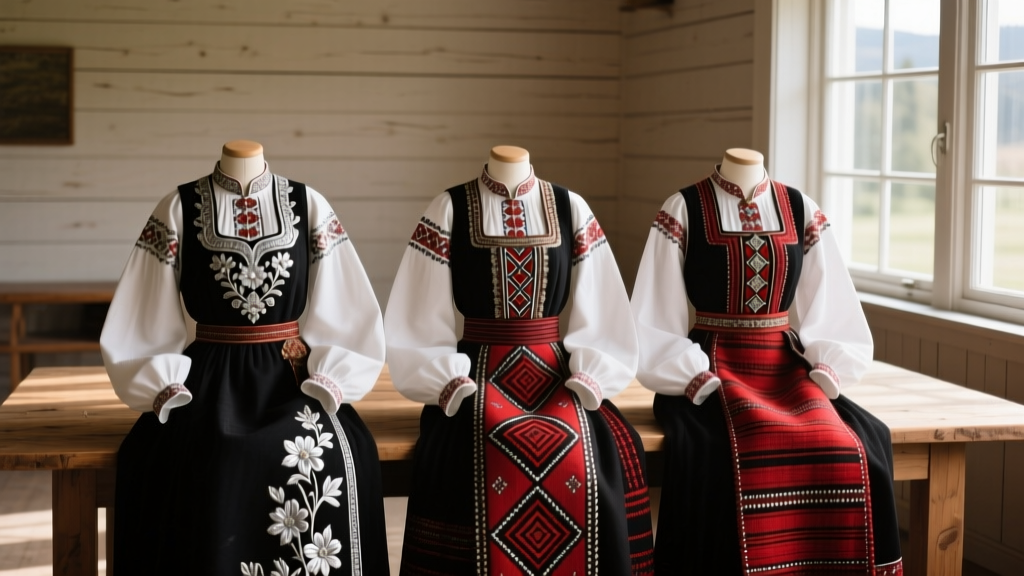
The Norwegian Bunad is arguably the most strictly regulated folk costume in Europe. Governed by the Norsk Folkemuseum and the Bunad- og folkedraktrådet (Council for Bunad and Folk Costume), a true bunad is not bought off the rack. It is a deeply personal garment tied to the wearer's specific ancestral valley or municipality (e.g., Hardanger, Hallingdal, or Telemark).
Sizing for a bunad is entirely bespoke. The wool skirt or dress is heavily pleated and tailored to the wearer's exact height and waist, often featuring hidden seam allowances to accommodate weight fluctuations over a lifetime. The bodices are reinforced with heavy linen canvassing and adorned with region-specific hand-embroidery. Furthermore, the accompanying silver jewelry (sølv), including filigree brooches and cufflinks, must be sourced from certified Norwegian silversmiths to maintain the garment's heritage status.
The Scottish Highland Kilt
The Scottish kilt is a masterpiece of tailoring, requiring a complex wrapping mechanism that standard skirts cannot replicate. According to The Scottish Tartans Authority, an authentic kilt is constructed from 8 yards of worsted wool tartan, though 5-yard versions exist for casual wear.
- Waist Measurement: Unlike trousers, a kilt is worn high, with the waistband sitting precisely at the navel, not the hips.
- Length (Fall): The hem must fall exactly to the middle of the knee cap when the wearer is kneeling on the floor.
- Pleating: Authentic kilts feature either 'pleating to the sett' (continuing the tartan pattern across the back) or 'pleating to the stripe' (aligning a dominant vertical stripe). The pleats are hand-stitched and pressed with heavy canvas interfacing to ensure they swing properly during movement.
Investment Tiers: Pricing Authentic Garments
Understanding the financial commitment required for authentic European folk costumes is crucial for buyers. The price reflects not only the premium natural materials but also the hundreds of hours of skilled artisan labor. Below is a comparative matrix detailing the 2026 market rates for genuine heritage garments.
| Garment | Region | Core Materials | Artisan Price Range | Sizing Method |
|---|---|---|---|---|
| Dirndl (Full Set) | Bavaria / Austria | Cotton, Linen, Horn buttons | €600 - €1,200 | EU Standard or Bespoke |
| Lederhosen (Knee-length) | Alpine Regions | Brain-tanned Deer Leather | €800 - €1,500 | Bespoke / Tailored |
| Bunad (Wool Dress + Silver) | Norway | Heavy Wool, Linen, Sterling Silver | €3,500 - €6,000+ | Strictly Bespoke |
| Highland Kilt (8-Yard) | Scotland | 16oz Worsted Wool Tartan | £450 - £850 | High-Waist Bespoke |
Fabric Weight, Weave, and Seasonality
Material authenticity is the primary indicator of a garment's quality. Mass-produced costumes frequently substitute natural fibers with synthetic blends, resulting in garments that trap heat and lack the proper drape.
Loden and Heavy Wools: In Alpine and Nordic traditions, outer garments are woven from Loden or heavy Melton wool. A genuine Norwegian bunad skirt utilizes wool weighing between 500g and 700g per square meter. This extreme weight is necessary to create the deep, structured pleats that characterize the silhouette and to provide insulation against harsh Scandinavian winters.
Worsted Wool Tartan: For Scottish kilts, the gold standard is 16oz or 13oz worsted wool woven at historic mills in the Scottish Borders, such as Lochcarron or Marton Mills. The 'sett' (the repeating thread count pattern of the tartan) must be perfectly aligned. Lighter 'poly-viscose' tartans are strictly relegated to fashion skirts and are culturally inappropriate for formal Highland dress.
Linen and Hemp: The undergarments—such as the Dirndl Bluse or the traditional Scottish linen shirt (léine)—should be crafted from high-thread-count European flax linen. This provides breathability and historical accuracy, as cotton was not widely available to rural European peasants until the late 19th century.
Sourcing from Certified Artisans and Cooperatives
To guarantee authenticity, buyers should bypass generic online marketplaces and source directly from regional artisan cooperatives and certified tailors. In Germany, look for members of the Trachten-Innung (Guild of Traditional Costume Tailors). These master tailors (Trachtenschneidermeister) undergo years of apprenticeship to learn the specific embroidery stitches and leather-tooling techniques required for regional tracht.
For Norwegian bunads, authorized dealers are listed through local Husflidslag (Norwegian Folk Art and Craft Association) chapters. Purchasing through these cooperatives ensures that the embroidery is done by hand by local artisans, and that the profits support the preservation of rural Norwegian craft traditions. Similarly, authentic Scottish kilts should be commissioned from members of the Kiltmakers' Association in Edinburgh or the Highlands, ensuring the garment is hand-stitched in Scotland rather than outsourced to overseas factories.
Alteration Rules and Cultural Etiquette
Because these garments are deeply tied to cultural identity, altering them requires specialized knowledge. A standard tailor may ruin a kilt by pressing the pleats incorrectly or using the wrong thread tension. Kilt alterations require taking apart the inner canvas and re-pleating the heavy wool, a process that can only be done by a trained kiltmaker.
When wearing European folk costumes, respect for the culture is paramount. The Norwegian bunad, for instance, is considered formal national dress, equivalent to a tuxedo or evening gown, and is worn for weddings, confirmations, and Constitution Day (May 17th). It should never be mixed with modern casual accessories. Similarly, Highland dress has strict rules regarding the pairing of tartans, the type of hose (socks), and the appropriate footwear (ghillie brogues). By understanding the intricate sizing, material requirements, and cultural protocols, collectors and enthusiasts can build a wardrobe that honors the profound heritage of European folk dress.