Xiashang Hong King Cheongsam: Substyles & Guide

The evolution of the traditional Chinese dress—known as the qipao in Mandarin and the cheongsam in Cantonese—is a masterclass in sartorial adaptation. Among the most highly prized and historically significant regional variations for collectors and bespoke enthusiasts is the xiashang hong king cheongsam. This specific substyle represents a fascinating mid-century bridge between the refined elegance of 1930s Shanghai and the cosmopolitan, subtropical pragmatism of post-war Hong Kong.
For cultural garment historians and modern wearers alike, understanding the xiashang hong king cheongsam requires looking beyond the surface-level silhouette. It demands an appreciation of migratory tailoring guilds, specialized summer-weight textiles, and the delicate balance between Eastern flat-cutting philosophies and Western structural tailoring. This comprehensive guide explores the anatomical nuances, historical context, and 2026 market valuations of this extraordinary hybrid garment.
The Genesis of the Shanghai-Hong Kong Sartorial Bridge
To understand the 'Hong King' designation, one must examine the geopolitical shifts of the late 1940s. As political upheaval swept through mainland China, an exodus of master tailors from Shanghai relocated to Hong Kong, particularly around 1949. These artisans brought with them the sophisticated Haipai (Shanghai style) tailoring techniques that had defined the golden age of the qipao.
However, the humid, subtropical climate of Hong Kong and the fast-paced, international lifestyle of its residents necessitated a structural evolution. The elite tier of Hong Kong-based tailoring houses—often operating under prestigious monikers that were romanized in mid-century boutique labels as 'Hong King' or similar variations—began adapting the traditional silhouette. The term xiashang in this context refers specifically to the specialized summer-weight constructions and breathable textile selections these tailors pioneered to make the garment viable for year-round wear in southern China.
According to archives preserved by the Hong Kong Heritage Museum, this migration fundamentally altered the trajectory of Cantonese bespoke fashion, merging Wu-dialect tailoring terminology with Cantonese sartorial sensibilities to create a distinct regional substyle that dominated the 1950s and 1960s.
Anatomical Breakdown: Pure Shanghai vs. The Hong King Hybrid
The xiashang hong king cheongsam is defined by subtle but crucial deviations from its Shanghai predecessor. While mass-market reproductions often blur these lines, authentic regional variations adhere to strict tailoring protocols.
| Construction Element | 1930s Shanghai (Haipai) | 1950s Hong King Hybrid (Xiashang) |
|---|---|---|
| Collar (Yingzi) | High (5-7cm), heavily stiffened with multiple layers of interlining. | Lower (3-4.5cm), softly structured for breathability and comfort in humidity. |
| Darting & Fit | Minimal darting; relied on side-seam tapering and the natural drape of silk. | Introduction of concealed Western bust and waist darts, maintaining the pingmian (flat plane) illusion. |
| Hemline & Slits | Calf-length with moderate side slits for walking. | Slightly shorter (below knee) with higher, reinforced slits for dynamic urban movement. |
| Lining | Often fully lined in silk or cotton for winter/autumn wear. | Unlined or half-lined using lightweight silk crepe to maximize airflow (the 'Xia Shang' summer standard). |
The Architecture of the Collar and Pankou
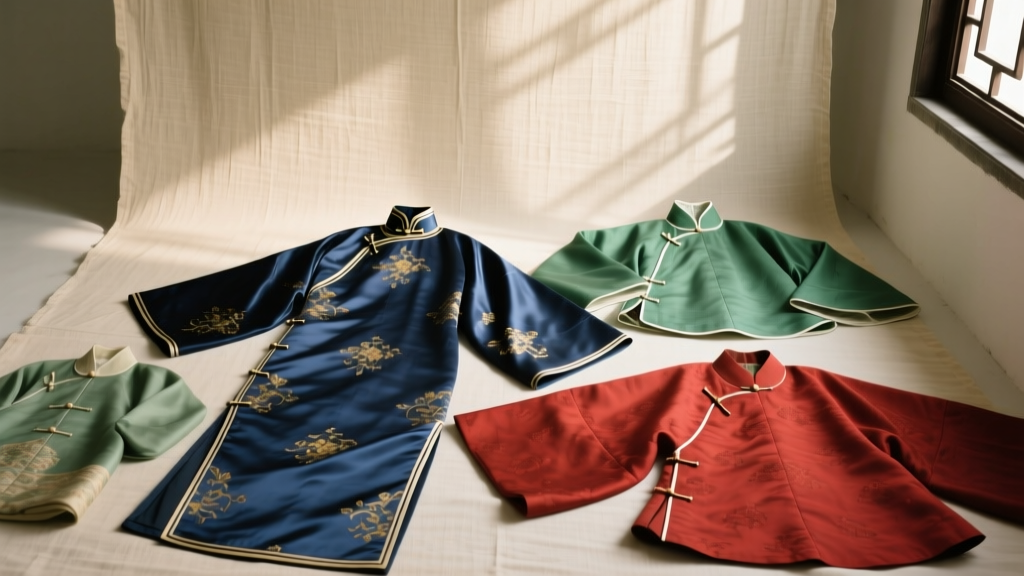
The most immediate identifier of the xiashang hong king substyle is the collar architecture. Traditional Shanghainese collars were designed to frame the face rigidly, often forcing an upright, formal posture. The Hong King tailors recognized that this was unbearable in July heat. They engineered a softer yingzi using a single layer of horsehair canvas or lightweight buckram, allowing the collar to gently hug the neck without chafing.
This structural softening was balanced by an intensification of the pankou (frog fasteners). While Shanghai garments often featured simple, functional knotting, the Hong King aesthetic elevated the pankou into intricate, hand-knotted floral or geometric motifs. Master tailors spent hours crafting these fasteners from bias-cut silk strips, filled with cotton thread for durability. Today, the presence of authentic, hand-rolled pankou is a primary authentication metric for vintage collectors, as documented in the Victoria and Albert Museum's Asian textile archives.
Fabric Sourcing: Mastering the 'Xia Shang' Summer Weights
The 'xiashang' element of this cheongsam substyle is inextricably linked to textile innovation. A true summer-weight xiashang garment relies on fabrics that possess natural thermoregulating properties.
Xiangyunsha: The Crown Jewel of Southern Silk
No discussion of the Hong King summer cheongsam is complete without Xiangyunsha (gambiered Canton gauze). Originating from the Guangdong province, this textile is a marvel of organic chemistry and traditional craftsmanship. The silk is repeatedly dyed in the astringent juice of the Dioscorea cirrhosa (a type of yam) and then coated with iron-rich river mud from the Pearl River Delta. A chemical reaction between the tannins and the iron creates a distinctive dual-toned fabric: a glossy, dark brown-black on one side, and a matte, earthy terracotta on the reverse.
For the xiashang hong king cheongsam, Xiangyunsha is the ultimate material. It is naturally cooling, quick-drying, antibacterial, and develops a beautiful, supple patina over time. Because the dyeing process requires intense sunlight and specific mud compositions, authentic Xiangyunsha is strictly seasonal and highly regulated, making vintage pieces from the 1950s incredibly rare.
Lightweight Brocades and Crepe de Chine
For formal evening variations, Hong King tailors utilized ultra-lightweight silk crepe de chine and sheer, unlined organzas. Unlike the heavy, metallic-threaded brocades favored in northern China for winter festivals, the southern substyle favored subtle, tone-on-tone damask weaves that caught the light without adding thermal weight to the garment.
2026 Collector's Market: Valuation and Authentication
As interest in archival Asian fashion continues to surge, the xiashang hong king cheongsam occupies a highly lucrative niche in the vintage and bespoke market. Whether you are sourcing from estate auctions in Hong Kong or commissioning a contemporary recreation, understanding current valuations is critical.
- Authentic Vintage (1950s-1960s): True mid-century pieces bearing the labels of prestigious Hong King tailoring houses, particularly those crafted from Xiangyunsha or featuring hand-knotted pankou, command between $2,500 and $6,500 USD. Provenance and condition of the silk (checking for dry rot or shattering) heavily influence the price.
- Contemporary Bespoke Recreations: Commissioning a modern master tailor in Hong Kong or Shanghai to recreate the xiashang hong king specifications (using concealed darting and traditional summer-weight silks) typically ranges from $1,800 to $4,500 USD, depending on fabric sourcing and the complexity of the frog fasteners.
- Mass-Market 'Vintage-Inspired': Factory-produced garments that mimic the silhouette but lack the structural nuances (using machine-made pankou and polyester blends) retail for $80 to $250 USD. These hold no collector value and fail to represent the cultural lineage.
Authentication Tip: Examine the interior seams. Authentic Hong King tailoring utilizes a technique called 'Guo Bian' (wrapping the edge), where the raw edges of the silk are meticulously hand-rolled and blind-stitched into the seam allowance. If you see modern serger/overlock stitching inside a purported 1950s garment, it is a reproduction.
Cultural Protocols and Contemporary Styling
Wearing a xiashang hong king cheongsam today is an act of cultural preservation. It is essential to approach the garment with respect for its living history, avoiding the trap of treating it as a mere costume. The cheongsam is a dynamic, evolving garment that remains a staple of formal wear, academic dress, and cultural celebrations across the Sinosphere.
Styling for the Modern Wardrobe
The beauty of the Hong King hybrid is its inherent versatility, born from the necessity of navigating both traditional Chinese banquets and Western-style cocktail parties in mid-century Hong Kong.
- Footwear: Avoid theatrical, stereotypical accessories. The xiashang substyle pairs beautifully with minimalist, low-heeled leather mules, woven loafers, or classic pointed-toe pumps. The goal is to elongate the leg line without disrupting the garment's balanced proportions.
- Jewelry: Because the collar and pankou provide significant visual interest at the neckline, avoid heavy statement necklaces. Opt for jade stud earrings, a singular pearl drop, or a delicate gold cuff bracelet. Let the textile and the tailoring speak for themselves.
- Outerwear: For cooler evenings, drape a tailored, unstructured linen blazer or a lightweight cashmere shawl over the shoulders. The Hong King silhouette was designed to accommodate the movement of modern life, and layering should enhance, not restrict, that mobility.
Preserving a Living Heritage
The xiashang hong king cheongsam is more than a vintage curiosity; it is a testament to the resilience and adaptability of Asian artisans. The master tailors who fled Shanghai did not merely replicate their past in Hong Kong; they innovated, blending Eastern philosophies of the body with Western structural techniques to create a garment perfectly suited to a new world.
For those studying the Metropolitan Museum of Art's extensive Asian textile collections or seeking to commission their own bespoke piece, the key lies in honoring the details. From the soft drape of the summer-weight silk to the meticulous geometry of the hand-knotted fasteners, the xiashang hong king cheongsam remains a pinnacle of 20th-century sartorial engineering, offering a masterclass in how tradition can gracefully evolve without losing its soul.