The Velvet Cheongsam: A Deep Dive into Silk Craftsmanship
The Allure of the Velvet Cheongsam: Beyond the Surface
When discussing the evolution of 20th-century Chinese fashion, the velvet cheongsam (widely known in Mandarin as the qipao) occupies a space of unparalleled luxury and structural complexity. While summer iterations of the garment often utilize breathable silks like xiangyunsha (gambiered Canton gauze) or lightweight satins, the winter velvet cheongsam represents a masterclass in textile engineering and bespoke tailoring. Originating in the cosmopolitan hub of 1930s Shanghai, the velvet qipao was the sartorial armor of the elite, favored by socialites, writers like Eileen Chang (Zhang Ailing), and cinematic icons.
However, crafting a velvet cheongsam is not merely a matter of cutting a heavy fabric into a familiar silhouette. It requires a profound understanding of pile direction, traditional weaving methods, and specialized finishing techniques. In this deep dive, we explore the intricate craftsmanship, historical textile variations, and modern commissioning frameworks that define this magnificent garment.
Zhangrong and Lanhua Rong: The Architecture of Chinese Velvet
To understand the velvet cheongsam, one must first understand the textiles that define it. Traditional Chinese velvet, known as Zhangrong (漳绒), traces its origins to the Ming Dynasty in Zhangzhou, Fujian province. Unlike European voided velvets, traditional Zhangrong is characterized by a continuous, dense silk pile woven over a satin silk base. According to archival textile research preserved by the China National Silk Museum, the weaving process involves inserting brass or bamboo rods into the shed to create loops, which are then sliced to form the plush pile. This results in a fabric with a heavy, liquid drape and a luminous depth of color that synthetic alternatives simply cannot replicate.
The Innovation of Burnout Velvet (Lanhua Rong)
By the 1920s and 1930s, Shanghai's booming textile mills introduced a revolutionary variation: Lanhua Rong (烂花绒), or burnout velvet (devoré). This technique utilizes a fabric woven with a blend of silk (the base) and rayon or cotton (the pile). A chemical paste is applied in intricate floral or geometric patterns, dissolving the rayon pile while leaving the sheer silk satin base intact. The result is a breathtaking, semi-transparent velvet that became the defining fabric of the Republican-era winter cheongsam. The interplay of light against the opaque velvet pile and the translucent satin base creates a dynamic, shifting visual effect that elevates the garment to wearable art.
Architectural Tailoring: Constructing the Winter Qipao
Tailoring a velvet cheongsam presents a unique set of challenges that separate master artisans from standard seamstresses. The primary adversary of the velvet tailor is the 'nap'—the directional orientation of the pile.
Nap Direction and Pattern Matching
Silk velvet reflects light differently depending on the angle of the pile. In traditional cheongsam tailoring, the nap is almost universally cut 'down' (falling toward the hem) to ensure a smooth, sleek silhouette and to prevent the fabric from trapping dust and moisture. However, this requires the tailor to cut all pattern pieces in a single direction, resulting in significant fabric waste. A master tailor must also meticulously match the nap across the side seams and the distinctive overlapping front panel (dajin), ensuring that the color remains perfectly uniform across the entire garment.
The Art of Gunbian (Piping) on Pile Fabrics
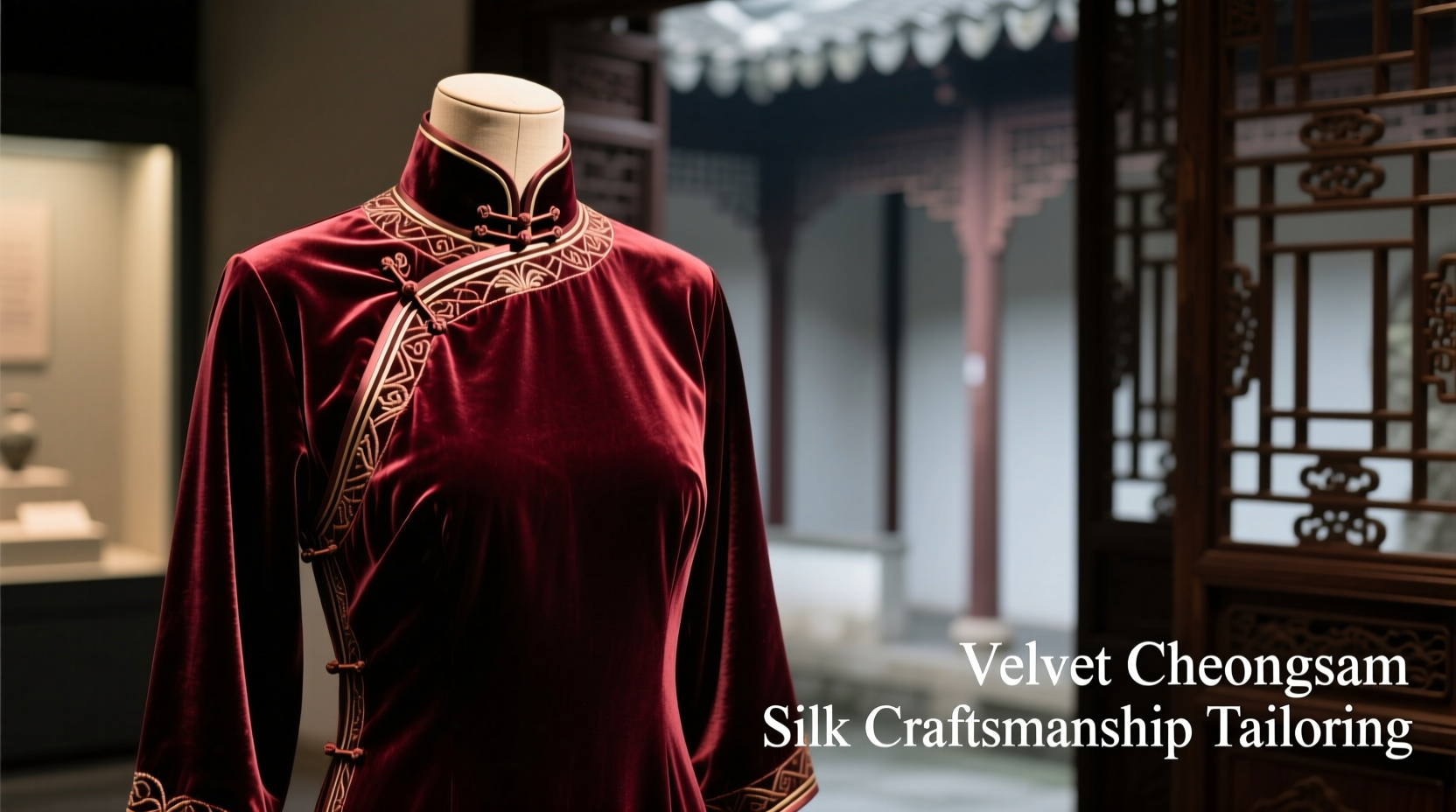
The gunbian (绲边), or piping, is the skeletal framework of the cheongsam, providing structural integrity to the collar, cuffs, and hem. Applying piping to velvet is notoriously difficult. The shifting nature of the pile can cause the bias tape to slip or pucker. Artisans solve this by utilizing a specialized 'walking foot' on their sewing machines or by hand-basting the silk crepe bias tape with microscopic stitches before machine sewing. For high-contrast velvet cheongsams, tailors often employ 'double piping' (shuang gun) or insert a thin metallic thread (xian gun) to catch the light and separate the heavy velvet from its borders.
Engineering the Pankou (Frog Buttons)
Standard soft-knot frog buttons (pankou) are insufficient for the heavy tension of a winter velvet qipao. The thick pile creates immense pressure at the collar and chest closures. Therefore, master tailors construct 'hard' or wired pankou. These involve wrapping silk satin tightly over a core of copper wire or thick cotton cord, allowing the buttons to hold rigid, architectural shapes—such as plum blossoms, swallows, or geometric knots—that can withstand the garment's weight without collapsing.
Material Selection: A Tailor’s Comparison Framework
When commissioning a velvet cheongsam, selecting the correct textile is paramount. Below is a comparative framework used by bespoke tailors to match the client's needs with the appropriate velvet classification.
| Velvet Classification | Composition & Weave | Drape & Characteristics | Est. Cost (Per Meter) | Best Application |
|---|---|---|---|---|
| Traditional Zhangrong | 100% Silk pile on silk satin base | Heavy, structured, deeply luminous, historically accurate | $180 - $350 USD | Heirloom pieces, formal winter weddings, historical reenactment |
| Burnout (Lanhua Rong) | Rayon/Viscose pile on silk base | Fluid, semi-sheer patterns, requires specialized lining | $90 - $160 USD | Evening wear, 1930s Shanghai vintage styling, cocktail events |
| Modern Stretch Velvet | Silk/Rayon blend with 2-5% Spandex | Forgiving drape, comfortable, less prone to crushing | $50 - $110 USD | Modern daily wear, travel-friendly qipaos, contemporary cuts |
| Cotton/Rayon Velveteen | Cotton base with rayon pile | Stiff, matte finish, highly durable, lacks silk luster | $30 - $60 USD | Academic wear, vintage reproduction on a budget, colder climates |
Sourcing and Commissioning: Where to Find Master Artisans
Acquiring an authentic, bespoke velvet cheongsam requires navigating specific tailoring hubs. While ready-to-wear options exist, the true beauty of the garment is realized through made-to-measure craftsmanship.
- Hong Kong's Shanghai Tailors: Following the 1949 diaspora, many master Shanghainese tailors relocated to Hong Kong. Establishments like WW Chan & Sons or the tailors located within the Mirador Mansion in Tsim Sha Tsui maintain the strict, flat-pattern cutting techniques of the 1950s. A bespoke velvet qipao here typically ranges from $1,200 to $3,000 USD, inclusive of premium silk velvet and hand-sewn finishing.
- Shanghai's South Bund Fabric Market: For a more accessible entry point, the South Bund Soft Spinning Material Market offers dozens of stalls specializing in qipao tailoring. Buyers must be vigilant, as many vendors will attempt to pass off synthetic polyester velvet as silk. Always perform a burn test on a swatch or demand a burnout velvet (which inherently requires a silk base). Commissioning costs here range from $400 to $900 USD, depending on the fabric selected and the complexity of the pankou.
- Hangzhou and Suzhou Artisans: As the historical centers of Chinese silk production, these cities house cooperatives that weave custom Zhangrong. Sourcing fabric directly from these cooperatives and bringing it to an independent tailor ensures absolute textile authenticity.
Preserving the Pile: Care and Archival Storage
The maintenance of a velvet cheongsam is as demanding as its creation. Silk velvet is highly susceptible to 'crushing'—permanent flattening of the pile caused by pressure or moisture. Historical garments preserved in institutions like the Metropolitan Museum of Art's Asian Art department demonstrate how well-cared-for silk velvet can retain its luster for over a century.
Cleaning Protocols: Never attempt to wash a silk velvet cheongsam at home. Water spots will permanently ruin the pile's light-reflecting properties. The garment must be dry-cleaned by a specialist familiar with pile fabrics and structural pankou.
Steaming and Ironing: Ironing velvet directly will crush the pile instantly. Artisans use a 'velvet board'—a specialized pressing surface covered in fine wires that supports the pile while the base fabric is steamed. For home care, use a handheld garment steamer from a distance of at least six inches, allowing the steam to gently lift the fibers, then brush lightly with a soft-bristled silk brush in the direction of the nap.
Storage: Never fold a velvet cheongsam, as the creases will become permanent. Store the garment on a wide, padded wooden hanger to support the shoulders, encased in a breathable, unbleached cotton garment bag. Avoid plastic covers, which can trap humidity and cause the silk base to degrade or mildew.
Conclusion: A Living Heritage
The velvet cheongsam is far more than a nostalgic nod to 1930s Shanghai; it is a living testament to the intersection of Chinese textile innovation and meticulous sartorial architecture. Whether woven on traditional looms in Zhangzhou or tailored in a bustling Hong Kong atelier, the velvet qipao demands respect for its materials and the hands that shape it. By understanding the nuances of Zhangrong, the structural necessity of wired pankou, and the precise mechanics of the nap, wearers and collectors can ensure this magnificent tradition continues to thrive in the modern wardrobe.