Traditional Types of Chinese Dresses: A Historical Guide

When Western audiences hear the phrase "Chinese dress," the mind often immediately conjures the image of the form-fitting Qipao. However, reducing China’s vast sartorial heritage to a single 20th-century silhouette overlooks millennia of complex textile history, regional diversity, and profound philosophical symbolism. China is home to 56 recognized ethnic groups, each with distinct clothing traditions. Yet, when exploring the primary types of Chinese dresses that have shaped global fashion and cultural identity, four distinct categories emerge: the ancient Hanfu, the Manchu-derived Qipao, ceremonial bridal wear, and the modern Tang suit.
This historical guide explores the construction, cultural protocols, and contemporary revival of these iconic garments, offering both academic depth and practical insights for collectors and enthusiasts.
Hanfu (汉服): The Foundation of Han Chinese Sartorial Identity
Hanfu refers to the historical clothing system of the Han ethnic majority, spanning from the legendary Yellow Emperor (circa 27th century BCE) to the early Qing Dynasty (1644 CE). Far from a single "dress," Hanfu is a comprehensive system governed by strict rituals, cosmology, and social hierarchy. According to textile archives at the Victoria and Albert Museum, historical Han garments were defined by flat-pattern cutting, which utilized the entire width of the silk loom without darts or tailoring, creating a flowing, unstructured drape that respected the integrity of the woven fabric.
The Philosophy of Jiaoling Youren
The most defining characteristic of traditional Hanfu is Jiaoling Youren (cross-collar, right lapel). The left side of the garment crosses over the right and is tied at the waist. Historically, wrapping the garment left-over-right was considered the mark of civilization and life, while right-over-left was reserved for the deceased or non-Han nomadic tribes. This subtle structural detail carried immense cultural weight, famously summarized by Confucius, who credited the preservation of Han culture to the maintenance of this specific collar alignment.
Key Garments: Ruqun and Mamianqun
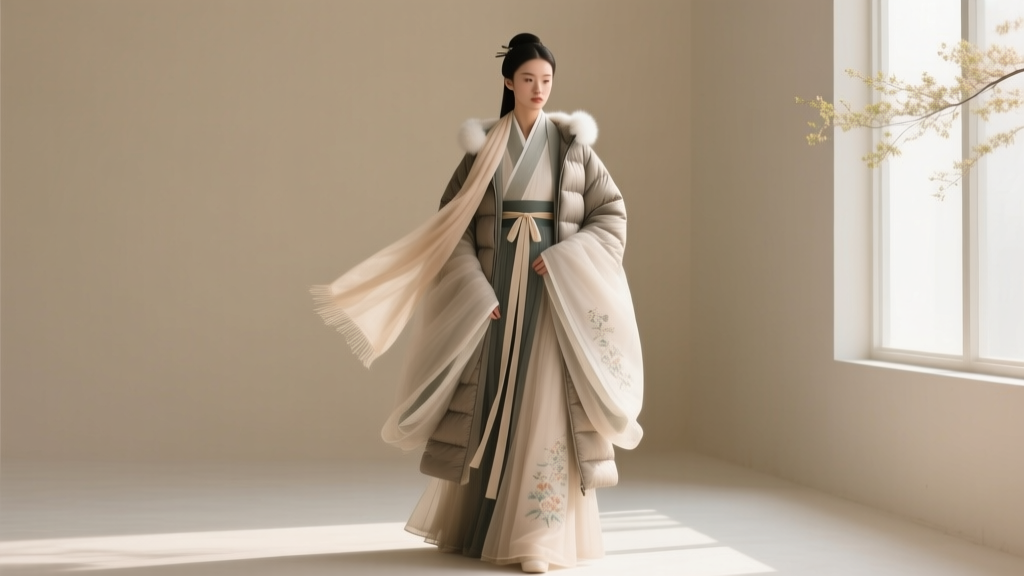
For women, the Ruqun (a short jacket paired with a long, flowing skirt) remains one of the most enduring styles. In recent years, the Mamianqun (horse-face skirt) has experienced a massive revival among modern Hanfu enthusiasts. Originating in the Song and Ming dynasties, the Mamianqun features two flat, overlapping front and back panels with heavily pleated sides. This ingenious construction allowed for modesty while riding horses or walking, while providing a wide canvas for elaborate woven brocade motifs like dragons, peonies, and cloud collars.
The Qipao (旗袍) and Cheongsam: Evolution of a Silhouette
The Qipao (known in Cantonese as the Cheongsam) is arguably the most globally recognized of all Chinese dresses. Its origins lie in the Qizhuang (banner robes) worn by Manchu women during the Qing Dynasty. These early robes were loose, straight, and entirely concealed the wearer's figure, featuring high collars and long, wide sleeves.
The 1920s Shanghai Renaissance
The modern Qipao was born in the cosmopolitan hub of 1920s Shanghai. Influenced by Western tailoring and the feminist movements of the Republic era, young women and socialites began modifying the traditional Manchu robe. They introduced Western darting, set-in sleeves, and higher side slits (Kaiqi) to allow for greater mobility and to subtly accentuate the natural silhouette. The garment was fastened using Pankou (intricate knotted frog fasteners), which served both a functional and highly decorative purpose.
Jingpai vs. Haipai: A Tale of Two Tailoring Traditions
As the Qipao spread, two distinct regional tailoring schools emerged. The Metropolitan Museum of Art's Heilbrunn Timeline notes that regional variations in Chinese textiles often reflect broader socio-political divides, and the Qipao is no exception.
| Feature | Jingpai (Beijing Style) | Haipai (Shanghai Style) |
|---|---|---|
| Silhouette | Relaxed, straight, modest, flat-cut | Form-fitting, darted, tailored to the body |
| Cultural Vibe | Traditional, aristocratic, conservative | Modern, cosmopolitan, commercial |
| Embroidery | Heavy, elaborate, often covering large areas | Subtle, localized, focusing on fabric patterns |
| Collar Height | Often higher and stiffer | Variable, often lower for a softer look |
Xiuhefu (秀禾服) and Qungua (裙褂): Bridal and Ceremonial Dress
When discussing types of Chinese dresses, bridal wear demands special attention. Modern Chinese weddings frequently feature a wardrobe change that includes a Western white gown and a traditional Chinese dress, usually either the Xiuhefu or the Qungua.
The Cantonese Qungua
The Qungua is a two-piece jacket and skirt ensemble originating from Guangdong province. It is renowned for its Kua embroidery—a dense, three-dimensional gold and silver thread technique stitched onto heavy red silk. The density of the embroidery is a direct indicator of the garment's value and the bride's family status. A master artisan can spend up to a year hand-embroidering a single high-tier Qungua, utilizing motifs of dragons and phoenixes (Longfeng) to symbolize marital harmony and imperial grace.
The Xiuhefu Phenomenon
Conversely, the Xiuhefu is a relatively modern invention. Loosely based on Ming Dynasty Hanfu, it was popularized in the early 2000s by the television drama Orange Turned Red, in which the protagonist, Xiuhe, wore a distinct loose-fitting jacket and pleated skirt. Today, Xiuhefu is favored for its comfort, softer aesthetic, and A-line skirt, which is more forgiving and easier to move in during lengthy tea ceremonies.
The Tang Suit (唐装): A Modern Synthesis of Tradition
Despite its name, the Tang Suit has no direct connection to the Tang Dynasty (618–907 CE). The modern Tang Suit is actually derived from the Magua (riding jacket) worn by Manchu men during the late Qing era. The term "Tang" refers to "Chinatown" (Tangrenjie), as early Westerners associated the overseas Chinese diaspora with the Tang dynasty.
The contemporary iteration of the Tang Suit was catapulted to global fame during the 2001 APEC Summit in Shanghai, when world leaders were photographed wearing matching silk brocade jackets. Characterized by a Mandarin collar, frog buttons, and a relaxed fit, the Tang Suit is today primarily worn by older generations during the Lunar New Year or by children during festive occasions, rather than as everyday formal wear.
Sourcing Authentic Chinese Garments: A Buyer’s Guide
For collectors, brides, or cultural enthusiasts looking to purchase authentic Chinese dresses, understanding the market tiers is crucial to avoid mass-produced, culturally inaccurate costume pieces. Research from institutions like the Harvard Art Museums highlights the importance of material authenticity in historical garments. Here is a practical pricing and sourcing framework:
- Mass-Market Qipao ($40 – $120 USD): Typically made from polyester blends with machine-printed floral patterns. The collars are often fused with stiff interfacing, and the Pankou buttons are purely decorative (with hidden zippers). Suitable for costume parties, but lacks cultural and structural integrity.
- Authentic Hanfu Revival Brands ($100 – $400 USD): Brands like Minghuatang or Shisanyu offer historically accurate replicas using woven jacquard, Song brocade, and accurate flat-pattern cutting. Look for garments that specify historical dynasty references (e.g., "Ming Dynasty Aoqun").
- Bespoke Haipai Qipao ($500 – $2,500+ USD): True Shanghai-style Qipao requires a master tailor. The fabric should be high-grade mulberry silk, Xiangyunsha (mud-dyed Cantonese silk), or silk velvet. The hem should be hand-rolled, and the floral motifs on the fabric must align perfectly across the seams and Pankou fasteners.
- Hand-Embroidered Bridal Qungua ($3,000 – $15,000+ USD): Graded by embroidery density (e.g., Xiaowufu, Dawufu, Guahuang). A true Guahuang (fully covered in goldwork) is an heirloom investment piece that can take over 10,000 hours of hand-stitching.
Preserving the Thread of History
Understanding the different types of Chinese dresses requires looking past the superficial aesthetics and appreciating the engineering, philosophy, and history woven into every seam. Whether it is the cosmic alignment of a Hanfu collar, the cosmopolitan tailoring of a Shanghai Qipao, or the meticulous goldwork of a Cantonese bridal jacket, these garments remain living testaments to China’s enduring cultural narrative. As global interest in traditional Asian garments continues to grow, prioritizing historical accuracy and supporting master artisans ensures these textile traditions will survive for generations to come.