Chinese Dresses: Hanfu and Qipao

When exploring the vast lexicon of Asian sartorial history, few categories are as dynamic and misunderstood as traditional Chinese dresses. Far from being a single monolithic garment, the traditional wardrobe of China is a complex tapestry of dynastic evolution, regional tailoring techniques, and deeply codified social markers. Navigating the market for chinese dresses traditional in design requires an understanding of these distinct silhouettes, from the flowing, cross-collared lines of antiquity to the structured, body-conscious tailoring of the 20th century.
This comprehensive comparison breaks down the three most prominent categories of Chinese heritage dress—Hanfu, the Qipao (Cheongsam), and the Mamianqun—examining their construction, cultural protocols, and modern market realities.
The Hanfu Revival: Decoding the Cross-Collar Silhouette
Hanfu (汉服) refers to the historical dress of the Han ethnic group, spanning from the legendary Yellow Emperor (circa 27th century BCE) to the mid-17th century. The defining characteristic of orthodox Hanfu is the jiaoling youren (交领右衽)—the cross-collar that wraps left over right, with the right lapel hidden beneath. This specific directional wrap is a profound cultural marker; wrapping right over left (zuoren) was historically reserved for the deceased and certain non-Han nomadic tribes.
Dynastic Variations in Cut and Drape
Unlike Western tailoring, which relies on darts and seams to sculpt fabric to the body, traditional Hanfu utilizes flat-pattern cutting. The fabric is cut in straight lines and relies on the drape, gravity, and the wearer's movement to create the silhouette.
- Tang Dynasty (618–907 CE): Characterized by the Qixiong Ruqun (chest-high skirt), this style features high-waisted, flowing skirts tied above the bust, often paired with sheer, wide-sleeved shawls (pibo). It reflects the cosmopolitan, prosperous nature of the era, utilizing lightweight silks and vibrant, contrasting colors.
- Ming Dynasty (1368–1644 CE): The silhouette shifted toward modesty and structure. The Aoqun (jacket and skirt) became prevalent, featuring longer, lined jackets with stand-up collars and intricate zhuanghua (brocade) weaving. The sleeves were often voluminous, ending in tight cuffs to protect the hands from the cold.
Authentic Hanfu construction avoids shoulder seams, utilizing a continuous piece of fabric folded over the shoulder to maintain the unbroken flow of the textile, a technique documented extensively by the China National Silk Museum in their archival research on ancient loom technologies.
The Qipao Dichotomy: Haipai Modernism vs. Jingpai Conservatism
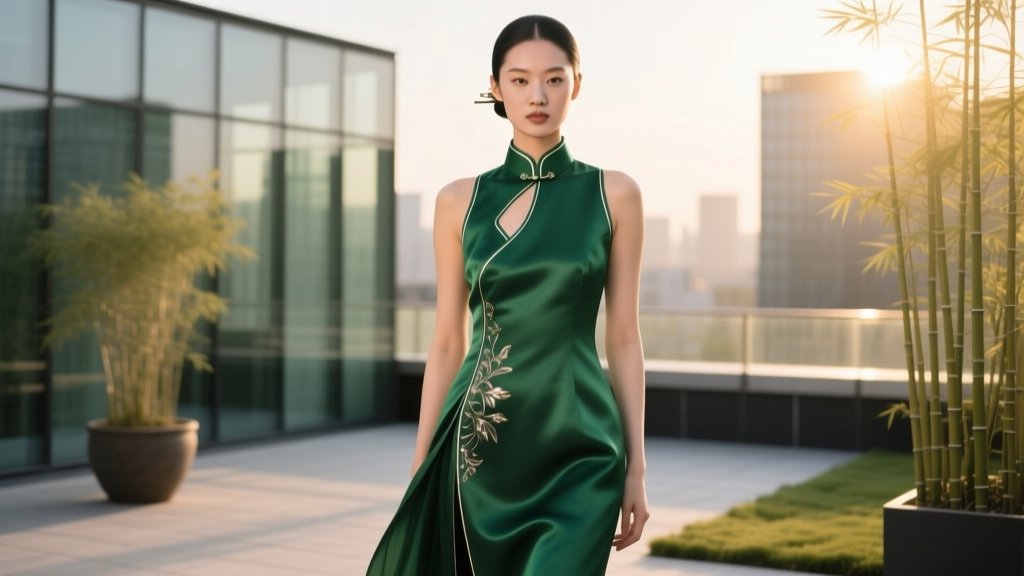
While Hanfu represents ancient antiquity, the Qipao (旗袍)—often referred to in the West as the Cheongsam—is a product of 20th-century modernity. Originating in the 1920s, the Qipao evolved from the loose, tubular robes of the Manchu elite during the Qing Dynasty into a tailored, form-fitting garment that became the national dress for Chinese women by the 1930s.
However, treating the Qipao as a single style ignores the fierce regional dichotomy that defines its construction: the Haipai (Shanghai style) and the Jingpai (Beijing style).
Haipai (Shanghai Style): The Sculpted Silhouette
Born in the cosmopolitan hub of 1920s Shanghai, the Haipai Qipao integrated Western tailoring techniques. Artisans introduced bust darts, waist suppression, and set-in sleeves to create a body-conscious silhouette. The side slits (kaiqi) were raised higher to allow for mobility and to reveal glimpses of the leg, reflecting the liberated spirit of the 'New Woman' of the Republican era. Fabrics ranged from imported Art Deco printed cottons to luxurious crepe de chine.
Jingpai (Beijing Style): The Heritage Brocade
Conversely, the Jingpai Qipao maintained a more conservative, traditional approach. Favored by aristocrats and intellectuals in the capital, this style featured a looser, A-line fit with lower side slits and wider sleeves. Jingpai tailors heavily favored traditional zhi jin (brocade) and xiangyunsha (gambiered Canton gauze), prioritizing the intricate surface design of the textile over the structural manipulation of the fabric. The pankou (knotted buttons) on Jingpai garments are often highly elaborate, featuring floral or auspicious motifs that serve as the garment's primary decorative focal point.
Mamianqun: The Architectural Pleats of the Horse-Face Skirt
No discussion of traditional Chinese dresses is complete without addressing the Mamianqun (马面裙), or 'horse-face skirt.' While it originated in the Song and Liao dynasties, it reached its zenith during the Ming Dynasty and has recently experienced a massive resurgence in contemporary 'new Chinese style' fashion.
The Mamianqun is a wrap skirt constructed from two overlapping panels of fabric. The front and back feature flat, unpleated sections (the 'horse faces'), while the sides are heavily pleated using trapezoidal fabric inserts. This ingenious architectural design allows the skirt to remain flat and modest when standing, while the pleats fan out dramatically to accommodate walking, horseback riding, and sitting.
Historically, the flat panels were heavily embroidered with auspicious motifs, such as the mang (python) or floral scrolls, while the pleated sections remained relatively plain. According to textile archives at The Palace Museum, Ming dynasty empresses wore Mamianqun woven with real gold threads (zhijin), a technique that required specialized drawlooms and months of labor for a single garment.
Comparative Matrix: Construction, Occasion, and Investment
To assist collectors, cultural practitioners, and enthusiasts in making informed decisions, the following matrix compares the core attributes of these three distinct garment families.
| Garment Type | Historical Peak | Key Construction Feature | Best Occasion | Average Price Range (USD) |
|---|---|---|---|---|
| Hanfu (Ming Aoqun) | 14th - 17th Century | Flat-pattern cutting, cross-collar right lapel, no shoulder seams. | Lunar New Year, Hanfu movement gatherings, tea ceremonies. | $60 (Synthetic) - $450+ (Mulberry Silk) |
| Haipai Qipao | 1920s - 1940s | Western darts, set-in sleeves, high side slits, form-fitting. | Cocktail parties, weddings, formal evening banquets. | $120 (Ready-to-wear) - $1,500+ (Bespoke) |
| Jingpai Qipao | 1920s - Present | Looser A-line fit, traditional brocade, elaborate Pankou knots. | Academic events, diplomatic functions, conservative formal wear. | $150 - $800 (Artisan woven) |
| Mamianqun | 14th - 17th Century | Wrap skirt, flat front/back panels, trapezoidal side pleats. | Daily 'New Chinese' styling, museum visits, cultural festivals. | $45 (Polyester) - $350 (Jacquard/Silk) |
Sourcing Authentic Textiles: A Buyer’s Framework
The global market is currently saturated with 'costume-grade' interpretations of Chinese heritage dress. For buyers seeking authentic, culturally respectful garments, understanding textile composition is paramount.
Identifying Heritage Silks
When investing in a high-end Qipao or Hanfu, look for specific heritage weaves rather than generic 'silk' labels. Xiangyunsha (Gambiered Canton Gauze) is a highly prized, intangible cultural heritage fabric from Guangdong province. It is dyed using the juice of the薯莨 (Dioscorea cirrhosa) yam and coated with iron-rich river mud, resulting in a distinctive crackled, leather-like texture on one side and a glossy black finish on the other. Genuine Xiangyunsha garments typically start at $300 USD and require specialized dry-cleaning protocols.
Similarly, buyers should seek out Song Brocade (Songjin) for Ming-style Hanfu jackets. Unlike the heavier, stiff brocades of the Qing dynasty, Song brocade is renowned for its soft drape and intricate, multi-colored geometric patterns, a subject of extensive study by institutions like the Victoria and Albert Museum in their analysis of East Asian textile trade.
The Protocol of Wearing
Cultural respect extends beyond purchasing into the act of wearing. When donning Hanfu, ensure the collar is strictly left-over-right. When wearing a Mamianqun, the flat 'horse face' panel must be centered perfectly at the front and back; wearing it off-center disrupts the architectural symmetry intended by the Ming tailors. Finally, while the Qipao is highly adaptable to modern wardrobes, pairing it with appropriate undergarments (such as a traditional silk slip or modern shapewear) is essential to maintain the sleek, unbroken line of the side slits and hemline.
By understanding the profound differences between the ancient drape of Hanfu, the tailored modernity of the Qipao, and the structural genius of the Mamianqun, enthusiasts can engage with traditional Chinese dresses not merely as fashion trends, but as living, breathing artifacts of Asian material culture.