Chinese Costume: Symbolism & Meaning Decoded

The term traditional Chinese costume encompasses millennia of sartorial evolution, yet to view these garments merely as historical fashion is to miss their primary function. For centuries, clothing in China served as a legible text—a visual language that communicated the wearer’s cosmological alignment, social rank, moral philosophy, and regional identity. From the flowing sleeves of the Hanfu to the structured collars of the Qipao, every seam, color, and motif was deliberately engineered to reflect the harmony between humanity and the universe.
The Philosophy Woven In: Cosmology and the Hanfu Silhouette

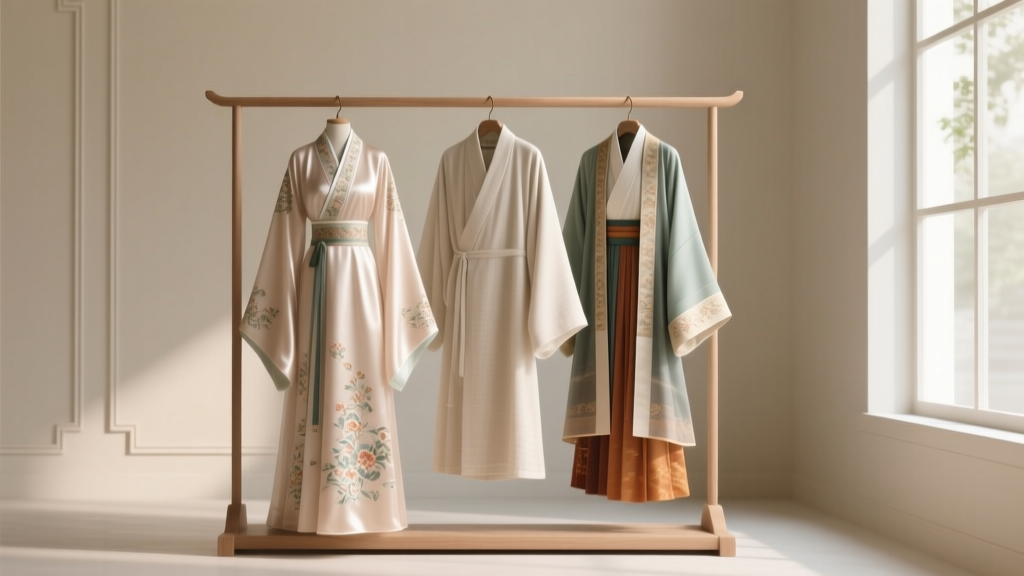
The foundational garment of Han Chinese civilization is the Hanfu. Its structural anatomy is deeply rooted in ancient Chinese cosmology, specifically the concepts of Tian Yuan Di Fang (Heaven is round, Earth is square) and the balance of Yin and Yang.
The most defining feature of the Hanfu is the jiaoling youren (crossed collar, right lapel). The left side of the robe crosses over the right. In traditional Chinese philosophy, the left represents Yang (life, the sun, and the east), while the right represents Yin (death, the moon, and the west). Wrapping the left over the right symbolizes the triumph of life over death and the adherence to civilized order. Conversely, wrapping right over left (zuoren) was strictly reserved for dressing the deceased or was associated with neighboring nomadic tribes, whom ancient Han scholars considered 'uncivilized.'
Another critical silhouette is the Shenyi (deep robe). Unlike earlier styles that separated the upper garment (yi) and lower skirt (chang), the Shenyi stitches the two together. This structural unity symbolizes the inseparable bond between Heaven (the upper garment) and Earth (the lower skirt), reflecting the Confucian ideal of holistic moral integrity. Furthermore, the sleeves are cut generously and rounded to represent the vault of heaven, while the collar is squared to represent the earth, literally dressing the wearer as the axis mundi—the conduit between the celestial and the terrestrial.
Chromatic Hierarchies: Decoding Color in Imperial and Folk Dress
Color in the traditional Chinese costume was never arbitrary. It was governed by the Wuxing (Five Elements) theory and strict sumptuary laws that dictated who could wear what, particularly during the Ming (1368–1644) and Qing (1644–1912) dynasties. According to artifacts preserved at The Palace Museum in Beijing, the misuse of imperial colors was considered an act of treason.
The Wuxing (Five Elements) Color Matrix
| Element (Wuxing) | Direction | Season | Sacred Color | Garment Application & Symbolism |
|---|---|---|---|---|
| Wood (Mu) | East | Spring | Green / Cyan | Worn by scholars and lower officials; symbolizes growth, renewal, and the azure dragon of the East. |
| Fire (Huo) | South | Summer | Vermillion / Red | High-ranking military and civil officials; represents joy, vitality, and the Vermillion Bird. |
| Earth (Tu) | Center | Transitional | Bright Yellow | Strictly reserved for the Emperor (Ming Huang); symbolizes the center of the universe and absolute authority. |
| Metal (Jin) | West | Autumn | White | Associated with mourning and funerary rites; represents the White Tiger and the cessation of life. |
| Water (Shui) | North | Winter | Black / Dark Blue | Early imperial robes (Qin dynasty) and scholars; symbolizes wisdom, the abyss, and the Black Tortoise. |
While the elite were bound by these rigid chromatic laws, commoners and folk dress often utilized red for weddings and festivals to ward off evil spirits (xié), and indigo blue for daily labor, derived from accessible plant dyes.
Bestiary of the Loom: Motifs, Puns, and Mythological Embroidery

Embroidery on a traditional Chinese costume functions as a system of auspicious semiotics. Motifs are rarely purely decorative; they are visual puns and talismans designed to invoke specific blessings.
- The Bat (Fu): The Chinese word for bat (fu) is a homophone for 'good fortune.' A hemline embroidered with five bats encircling a longevity character represents the Wu Fu (Five Blessings): longevity, wealth, health, virtue, and a natural death.
- The Peony (Mudan): Known as the 'King of Flowers,' the peony represents feminine beauty, wealth, and honor. It is frequently paired with the phoenix on bridal Qipaos and wedding Hanfus.
- The Gourd (Hulu): With its many seeds and winding vines, the gourd symbolizes fertility, a sprawling lineage, and the accumulation of generational wealth.
- The Dragon (Long): The ultimate symbol of imperial power and Yang energy. However, the number of claws is a critical differentiator. As noted by the Metropolitan Museum of Art's Heilbrunn Timeline, the five-clawed dragon was exclusively for the Emperor and his immediate heirs, while princes and high nobles were restricted to the four-clawed Mang (python) or three-clawed variants.
Rank Badges (Buzi) of the Ming and Qing Dynasties
Perhaps the most literal translation of clothing into social data was the Buzi, or rank badge, sewn onto the surcoats of Qing dynasty officials. These square embroidered panels instantly communicated a bureaucrat's exact position in the imperial hierarchy. Civil officials wore birds (e.g., the Red-Crowned Crane for the 1st rank, representing longevity and high moral character), while military officials wore beasts (e.g., the Qilin or Tiger, representing martial prowess and courage). To wear a badge above one's station was a severe criminal offense.
Evolution of Meaning: From Qing-Era Qipao to Modern Tang Suits
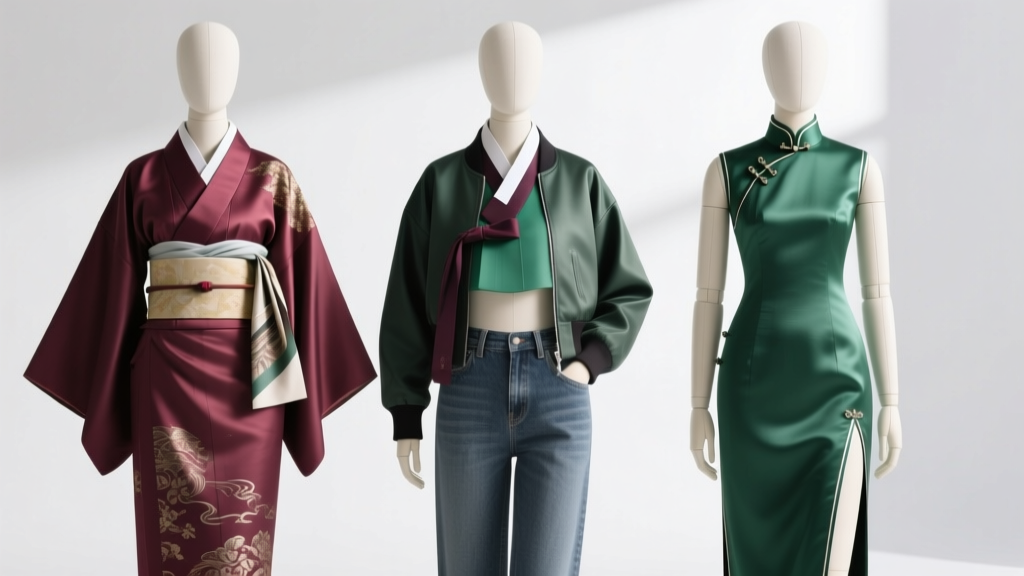
As China transitioned into the 20th century, the symbolism of the traditional Chinese costume shifted from imperial hierarchy to social modernity. The Qipao (or Cheongsam), originating from the loose, columnar robes of Manchu banner women, was radically reimagined in 1920s Shanghai.
Fitted with Western-style darts, set-in sleeves, and high side slits, the modern Qipao became a symbol of female emancipation and urban sophistication. It retained traditional silk brocades and auspicious embroidery but applied them to a silhouette that celebrated the natural female form, breaking away from the modesty-enforcing layers of Hanfu. According to textile analyses by the Victoria and Albert Museum, the Qipao represents a masterful synthesis of indigenous Chinese textile traditions and cosmopolitan tailoring.
Conversely, the modern 'Tang Suit' (Tangzhuang) is a relatively recent invention. Popularized globally during the 2001 APEC summit in Shanghai, it blends the Manchu riding jacket (magua) with Western shoulder pads and tailored fits. While it lacks the deep cosmological roots of the Hanfu, it has evolved into a modern symbol of pan-Chinese cultural pride, frequently worn during Lunar New Year and diaspora celebrations.
A Collector’s Guide to Authentic Symbolic Garments

For collectors, historians, and cultural enthusiasts looking to acquire an authentic traditional Chinese costume, understanding fabric composition and regional weaving techniques is paramount. The market is saturated with mass-produced polyester 'costumes' that strip the garments of their historical and tactile integrity.
Regional Silk Brocades to Look For
- Song Brocade (Songjin): Originating from Suzhou, this silk features subtle, matte geometric patterns and is highly prized for its understated elegance and durability. Ideal for authentic Hanfu outer layers.
- Yunjin (Cloud Brocade): Hailing from Nanjing, Yunjin incorporates real gold and silver threads, as well as peacock feather filaments. It is incredibly dense, heavy, and historically reserved for imperial dragon robes.
- Xiangyunsha (Gambiered Canton Gauze): A UNESCO-recognized intangible cultural heritage from Guangdong. This silk is dyed with yam juice and river mud, resulting in a crisp, rustling, water-resistant fabric that is highly breathable and deeply symbolic of Southern Chinese artisanal mastery.
Price Ranges and Sourcing Framework
| Garment Category | Material & Construction | Estimated Price Range (USD) | Best Sourcing Channels |
|---|---|---|---|
| Mass-Market Hanfu | Polyester blends, machine embroidery, standard sizing. | $40 - $120 | E-commerce platforms (Taobao, AliExpress); suitable for casual wear or cosplay, but lacks cultural depth. |
| Bespoke Artisan Hanfu | 100% Mulberry silk, Songjin brocade, hand-pleated Mamianqun, custom tailoring. | $300 - $1,500+ | Specialized Hanfu studios in Chengdu or Hangzhou; independent artisan cooperatives. |
| Vintage Qing Surcoats | Antique silk, couched gold thread, original Buzi rank badges. | $2,500 - $15,000+ | Verified auction houses (Sotheby's, Christie's) or specialized antique textile dealers. |
| Bespoke Silk Qipao | Heavy silk crepe, hand-rolled hems, custom Pan Kou (frog knot) closures. | $400 - $2,000 | Master tailors in Hong Kong or Shanghai's former French Concession district. |
When evaluating a traditional Chinese costume, always inspect the Pan Kou (knotted buttons). On high-quality garments, these are meticulously hand-rolled and stuffed with cotton or silk thread to maintain their three-dimensional shape, whereas mass-market versions use flat, machine-stitched loops. Furthermore, authentic silk should feel cool to the touch and emit a scent similar to burnt hair when a microscopic thread is singed—a vital test when sourcing vintage pieces.
Ultimately, to wear or collect a traditional Chinese costume is to engage with a profound philosophical heritage. Whether it is the cosmological geometry of a Hanfu sleeve or the homophonic blessings embroidered onto a bridal Qipao, these garments remain living archives of Chinese thought, artistry, and social history.