Decoding Traditional Chinese Clothing: Symbolism and Meaning

Traditional Chinese clothing is far more than a mere covering for the body; it is a profound philosophical text woven in silk. For millennia, garments in China have served as a microcosm of the universe, reflecting cosmic order, social hierarchy, and moral philosophy. Whether examining the flowing sleeves of the Hanfu, the structured elegance of the Ming dynasty robes, or the intricate embroidery of Qing dynasty formalwear, every seam, color, and motif carries deliberate semantic weight. Understanding this visual lexicon is essential for anyone studying Asian textile history or participating in the modern Hanfu revival movement.
The Cosmic Blueprint: Structural Philosophy of Hanfu
The foundational architecture of Hanfu (汉服), the historical dress of the Han Chinese, is deeply rooted in ancient cosmology. The most defining structural element is Jiaoling Youren (交领右衽), the cross-collar that wraps to the right. In traditional Chinese philosophy, the left side represents Yang (life, light, and the living), while the right represents Yin (death, darkness, and the underworld). Wrapping the left lapel over the right is a strict cultural protocol signifying life and civilization; reversing this was historically reserved for the deceased or considered a mark of barbarism.
Furthermore, the silhouette of the ancient Shenyi (深衣), a full-body robe popularized during the Han dynasty, is constructed to mirror the heavens and the earth. The concept of Tian Yuan Di Fang (天圆地方) dictates that heaven is round and earth is square. This is physically manifested in the garment’s round cuffs, symbolizing the heavens, and its square hem, representing the earth. The center back seam, known as Zhongfeng (中缝), runs perfectly straight from the nape of the neck to the hem, serving as a constant physical reminder for the wearer to maintain moral integrity, uprightness, and an unwavering spine in the face of adversity.
Chromatic Philosophy: The Wuxing (Five Elements) Color System
Color in traditional Chinese clothing is not chosen merely for aesthetic appeal; it is governed by the Wuxing (五行), or Five Elements theory. This ancient metaphysical framework maps colors to elements, seasons, and directions, creating a harmonious balance between the wearer and the natural world. According to the Victoria and Albert Museum, the strict regulation of these colors was heavily enforced in imperial courts to maintain cosmic and social order.
| Element | Color | Direction | Symbolic Meaning & Application |
|---|---|---|---|
| Wood (木) | Green / Blue | East | Represents spring, growth, and vitality. Often worn by scholars and in springtime rituals. |
| Fire (火) | Red / Vermilion | South | Symbolizes summer, joy, and warding off evil. The dominant color for weddings and New Year festivities. |
| Earth (土) | Yellow | Center | Denotes neutrality, supreme power, and the emperor. Restricted to the imperial family during Ming and Qing dynasties. |
| Metal (金) | White | West | Associated with autumn, purity, and mourning. Traditionally the exclusive color of funerals and grief. |
| Water (水) | Black / Dark Blue | North | Represents winter, depth, and the heavens. Early Qin dynasty emperors favored black to align with their ruling element. |
The Imperial Yellow and the Vermilion Red
The elevation of yellow to an imperial monopoly is one of the most strictly enforced sartorial laws in Chinese history. During the Ming (1368–1644) and Qing (1644–1912) dynasties, bright Minghuang (明黄) yellow was legally restricted to the Emperor, Empress, and Empress Dowager. Commoners caught wearing this specific shade faced severe punishment. Conversely, vermilion red remains the most culturally enduring color, universally recognized as an auspicious hue capable of repelling malevolent spirits, which is why it remains the cornerstone of modern Chinese bridal wear and festival attire.
Bestiary and Botany: Reading the Embroidered Lexicon
The surface decoration of traditional Chinese garments operates as a complex system of rebuses and homophones. The Metropolitan Museum of Art notes that Chinese silk weaving and embroidery frequently utilized visual puns to bestow blessings upon the wearer.
- The Dragon (Long) and Phoenix (Fenghuang): The ultimate symbol of Yang and imperial authority is the five-clawed dragon. When paired with the phoenix, representing Yin and the Empress, the motif symbolizes marital harmony and the perfect balance of the universe. Four-clawed dragons, known as Mang (pythons), were permitted for high-ranking nobles.
- The Bat (Fu): Because the Chinese word for bat (fu) is a homophone for 'good fortune,' bats are ubiquitous in textile motifs. Five red bats embroidered around a central medallion represent the 'Five Blessings': longevity, wealth, health, virtue, and a natural death.
- The Peony (Mudan): Known as the 'King of Flowers,' the lush, multi-layered peony is the ultimate botanical symbol of wealth, honor, and high social status, frequently woven into the borders of women's formal jackets.
- The Gourd and Vine: Representing fertility and a sprawling lineage, gourds are often embroidered onto the garments of newlyweds to wish them many children.
The Buzi System: Rank and Bureaucracy in Ming and Qing Dress
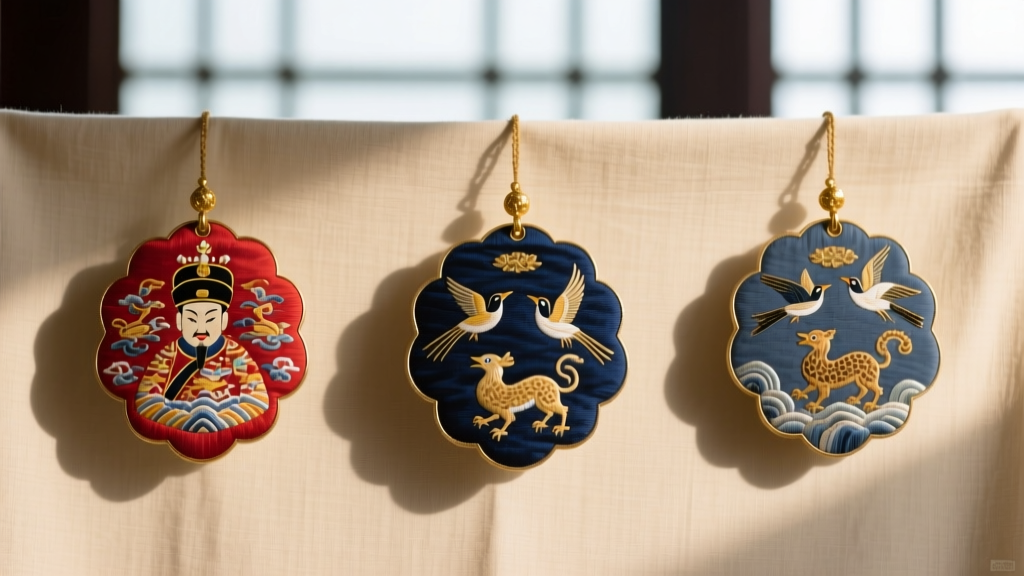
Perhaps the most rigid application of clothing symbolism occurred in the civil and military bureaucracies of the Ming and Qing dynasties through the use of Buzi (补子), or Mandarin squares. These intricately embroidered badges were affixed to the chest and back of official robes, acting as an immediate visual resume of the wearer's exact rank.
Civil officials wore squares depicting birds, symbolizing literary elegance and administrative grace. A first-rank civil official wore a white crane, while a ninth-rank official wore a paradise flycatcher. Military officials, conversely, wore squares depicting beasts to denote martial prowess and courage. A first-rank military commander wore a Qilin (a mythical chimera), while lower ranks wore tigers, leopards, or bears. Archives from The Palace Museum in Beijing reveal that the meticulous counting of feathers, claws, and the inclusion of specific background elements like the sun or clouds were heavily regulated by the Ministry of Rites.
Sourcing and Styling: Wearing Symbolic Garments Today
As the global interest in the Hanfu movement and traditional Asian textiles grows, consumers must navigate a market flooded with both culturally respectful reproductions and inaccurate fast-fashion approximations. When purchasing traditional Chinese clothing, understanding fabric composition and construction techniques is vital for authenticity.
Price Guide and Material Authenticity
- Mass-Market Costumes ($30 – $80 USD): Typically made from synthetic polyester or chiffon. These often feature machine-printed motifs rather than woven or embroidered ones, and frequently ignore the Jiaoling Youren left-over-right rule. Suitable for casual cosplay, but lacking in cultural depth.
- Mid-Tier Hanfu Brands ($150 – $350 USD): Brands specializing in Ming and Song dynasty revivals often use authentic jacquard silk, brocade, and proper structural tailoring. These garments feature woven metallic threads and correct panel counts, making them ideal for cultural festivals, tea ceremonies, and respectful daily wear.
- Heritage Artisan Pieces ($800 – $2,500+ USD): True investment pieces utilize heritage textiles like Xiangyunsha (Gambiered Guangdong Gauze)—a silk dyed with river mud and yam juice that requires intense manual labor—or Kesi (cut silk tapestry). These pieces feature hand-embroidered Buzi or intricate peony motifs using traditional Suzhou embroidery techniques.
Cultural Protocols for Modern Wearers
When styling these garments today, cultural respect is paramount. Always ensure the collar wraps left over right. Avoid wearing all-white ensembles unless specifically styled as modern fashion, as it remains heavily associated with mourning in traditional contexts. Furthermore, refrain from wearing five-clawed dragon motifs if you are not part of a theatrical performance, as it is still viewed by many traditionalists as an overstep of historical boundaries. By understanding the profound symbolism woven into every thread, wearers can honor the living legacy of Chinese sartorial philosophy.