Tang Suits: A Deep Dive into Silk Craftsmanship & Fabric

The Historical Misnomer: From Magua to APEC
When exploring the vast encyclopedia of Asian traditional garments, few items carry as much modern cultural weight—and historical irony—as the tang suits (known natively as Tangzhuang or 唐装). Despite the name, which implies a lineage tracing back to the glorious Tang Dynasty (618–907 CE), the modern tang suit is actually a contemporary hybrid. Its true silhouette is rooted in the Qing Dynasty (1644–1912) magua (riding jacket) and duanzhao (short coat), heavily modified with Western tailoring techniques.
The global popularization of the tang suit occurred during the 2001 APEC summit in Shanghai, where world leaders were photographed wearing vibrant, silk-brocade jackets. This event catalyzed a massive revival in domestic and international interest. Today, the tang suit stands as a symbol of global Chinese diaspora identity, worn prominently during Lunar New Year, weddings, and diplomatic functions. However, to truly appreciate this garment, one must look past the political symbolism and examine the extraordinary textile craftsmanship and structural engineering that define a high-quality piece.
Decoding the Textiles: Brocades and Silks of the Tang Suit
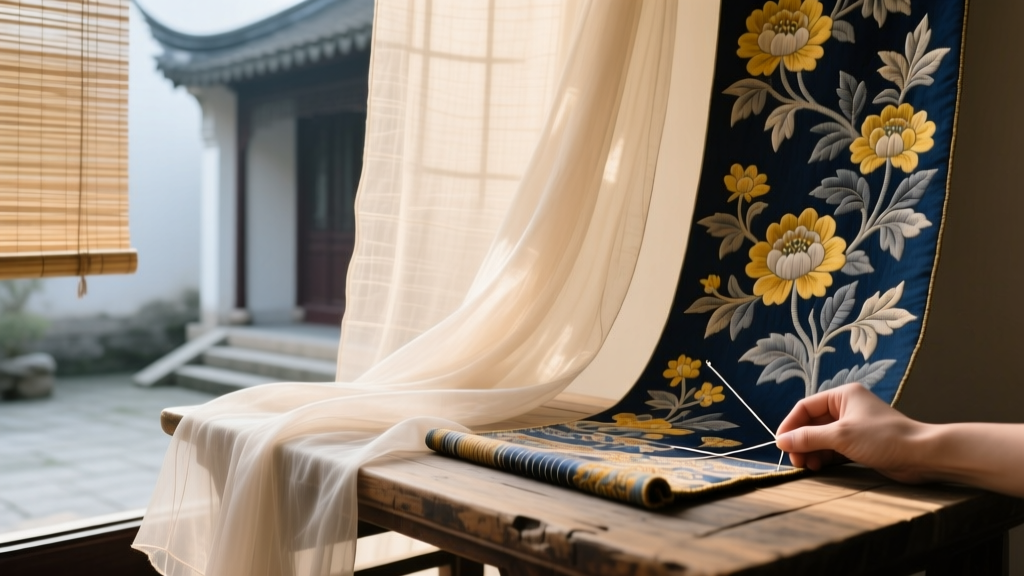
The soul of a premium tang suit lies in its fabric. While mass-market versions rely on synthetic polyester jacquards, authentic garments utilize heritage Chinese weaving techniques. According to the China National Silk Museum, traditional brocades (zhijin) are characterized by their complex supplementary weft patterns, which create a raised, embroidered effect directly on the loom.
The Three Great Brocades of China
Master tailors typically source from three historic weaving traditions when crafting luxury tang suits:
- Yun Brocade (Yunjin): Originating in Nanjing, Yun brocade is the pinnacle of Chinese silk weaving. Historically reserved for imperial dragon robes, it incorporates genuine gold and silver threads, as well as peacock feather filaments. The weave is so complex that traditional wooden draw-looms require two artisans operating simultaneously, producing only a few centimeters of fabric per day.
- Shu Brocade: Hailing from Sichuan province, Shu brocade is renowned for its vibrant, saturated color palettes and warp-faced polychrome weaving. It is highly durable and drapes beautifully, making it a favorite for festive tang suits featuring bold floral or geometric motifs.
- Song Brocade: Developed in Suzhou during the Song Dynasty, this fabric is softer, lighter, and features more subdued, elegant geometric and floral patterns. It is the preferred choice for scholarly or understated tang suits meant for formal daytime events.
Xiangyunsha: The Rare Mud Silk
For summer or subtropical climates, master artisans turn to Xiangyunsha (香云纱), a rare silk from Guangdong province. The silk is dyed using the tannin-rich juice of the薯莨 (shuliang) yam, then coated with iron-rich river mud and baked in the sun. The resulting fabric is dark, crisp, water-resistant, and possesses a distinct rustling sound. As documented by The Metropolitan Museum of Art in their Asian textile archives, the interaction between the yam tannins and river mud creates a unique, crackled glaze on the silk surface that softens beautifully with wear.
Fabric Comparison Chart: Weight, Drape, and Occasion
| Fabric Type | Origin Region | Weave / Dye Technique | Best Suited For | Price Range (USD) |
|---|---|---|---|---|
| Yun Brocade (Yunjin) | Nanjing, Jiangsu | Supplementary weft with metallic threads | Winter weddings, high diplomacy | $800 - $2,500+ |
| Shu Brocade | Chengdu, Sichuan | Warp-faced polychrome weave | Lunar New Year, festive banquets | $250 - $600 |
| Song Brocade | Suzhou, Jiangsu | Warp and weft joint weave | Tea ceremonies, formal daytime | $300 - $750 |
| Xiangyunsha (Mud Silk) | Foshan, Guangdong | Yam juice dye and river mud coating | Summer events, subtropical wear | $400 - $1,200 |
| Polyester Jacquard | Mass Market | Machine-woven synthetic blend | Costume, casual wear | $35 - $90 |
The Art of Pankou: Crafting the Frog Button
No tang suit is complete without pankou (盘扣), the intricate knotted frog buttons that serve as both functional fasteners and profound cultural motifs. Unlike standard buttons, a pankou is crafted entirely from fabric. The artisan cuts silk on the bias, wraps it tightly around a core material, and hand-stitches it into complex shapes.
The core of the button dictates its structure. For soft, traditional loops, a thick cotton cord is used. However, for elaborate floral or zodiac shapes (such as the plum blossom or the butterfly), artisans insert a thin, malleable copper wire into the silk bias tube. This allows the knot to hold rigid, sculptural shapes without collapsing. The 'knot head' (the male end) must be precisely sized to slip through the 'loop' (the female end) with a satisfying friction fit—too loose, and the jacket gapes; too tight, and the silk frays.
Cultural protocol dictates that the motifs chosen for the pankou must align with the occasion. Longevity knots (shou character) are reserved for elders' birthdays, while double-happiness knots are strictly for weddings. Furthermore, traditional clothing rules require the left side of the garment to cross over the right (youren), a protocol rooted in ancient Han philosophy that distinguishes the living from the deceased.
Structural Tailoring: Where East Meets West
The construction of the modern tang suit represents a fascinating collision of Eastern and Western sartorial philosophies. Traditional Chinese garments, such as the ancient hanfu or the Qing magua, were cut using a flat-pattern method. The front, back, and sleeves were often cut from a single continuous plane of fabric, resulting in a T-shape with no shoulder seams. This conserved precious silk but resulted in excess fabric bunching under the arms.
The contemporary tang suit abandons this flat cutting in favor of Western bespoke tailoring. Key structural upgrades include:
- Set-In Sleeves: Sleeves are cut separately and attached at a curved armhole, allowing for a cleaner shoulder line and greater mobility.
- Shoulder Pads and Darts: Subtle shoulder pads and waist-suppression darts are introduced to give the jacket a structured, three-dimensional silhouette that flatters the modern physique.
- Fused Interlinings: The iconic Mandarin collar (liziling) requires a stiff, fused interlining to stand upright without choking the wearer. High-end tailors use horsehair canvas or premium cotton interlinings rather than cheap synthetic fusibles, ensuring the collar molds to the wearer's neck over time.
- Full Silk Linings: Authentic tang suits are fully lined in habotai or charmeuse silk. This not only protects the delicate outer brocade from body oils but also allows the jacket to slide effortlessly over underlying garments.
Buying Guide: Evaluating Authentic Craftsmanship
When investing in a tang suit, distinguishing between authentic heritage craftsmanship and mass-produced costume wear is essential. Use this framework to evaluate potential purchases:
- The Luster and Slub Test: Genuine mulberry silk possesses a pearlescent, multi-directional luster, unlike the flat, plastic shine of polyester. Raw silk variants will feature 'slubs'—tiny, natural irregularities in the yarn that prove its organic origin.
- Examine the Brocade Reverse: Turn the fabric inside out. In true woven brocade, the pattern is created by the interlacing of warp and weft threads. If you see a uniform white backing with loose, floating threads that easily snag, it is likely an embroidered appliqué or a cheap printed synthetic.
- Inspect the Pankou Cores: Gently squeeze the knot buttons. You should feel a firm, structured core. If the buttons feel entirely soft and collapse when handled, they are likely machine-made and glued, lacking the copper-wire or cotton-cord reinforcement of artisan pieces.
- Check the Seam Allowances: High-quality silk tailoring requires generous, finished seam allowances (often bound in silk tape or French-seamed) to prevent the delicate brocade from fraying under tension.
For those seeking museum-quality pieces, the Victoria and Albert Museum frequently highlights the importance of provenance and artisan cooperatives in preserving these textile techniques. Purchasing directly from recognized heritage workshops in Suzhou or Nanjing ensures your garment supports living traditions rather than fast-fashion appropriation.
Care and Preservation of Woven Brocades
The metallic threads in Yun brocade and the delicate protein structure of mulberry silk require meticulous care. Never machine wash or hand wash a structured tang suit; water will cause the fused interlinings to warp and the metallic threads to tarnish or oxidize. Always seek a dry cleaner who specializes in heritage textiles and inform them of the metallic content.
When storing the garment for the off-season, avoid wire hangers, which will distort the shoulder pads and stretch the silk. Instead, use a wide, padded wooden hanger. Cover the jacket with a breathable, unbleached cotton garment bag—never plastic, which traps moisture and encourages mildew. Finally, place acid-free tissue paper inside the sleeves and between the folds of the garment to prevent permanent creasing in the stiff brocade weave, ensuring your tang suit remains a pristine artifact of Asian sartorial excellence for generations to come.