Chinese Dress Symbolism for Women

When we examine traditional Chinese dresses for women, we are looking at far more than mere fashion. Garments like the flowing Hanfu and the tailored Qipao serve as wearable canvases that encode centuries of philosophy, cosmology, and social values. In Chinese sartorial culture, every seam, color, and embroidered motif carries deliberate weight, reflecting the wearer's relationship with the universe, nature, and society. Whether you are a collector, a cultural enthusiast, or someone looking to wear these garments with authentic respect, understanding this visual language is essential.
The Architecture of Harmony: Hanfu Construction and Cosmology
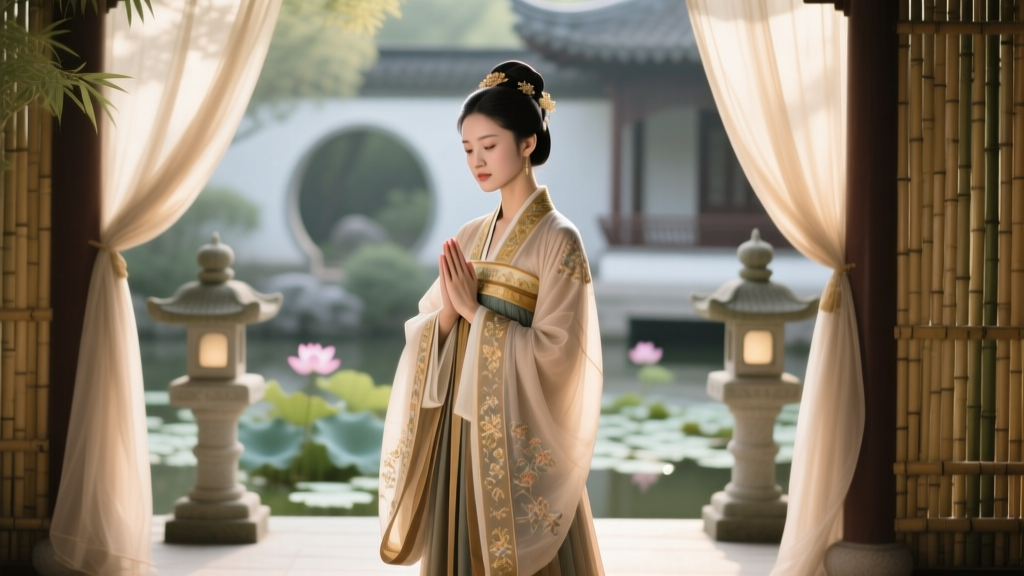
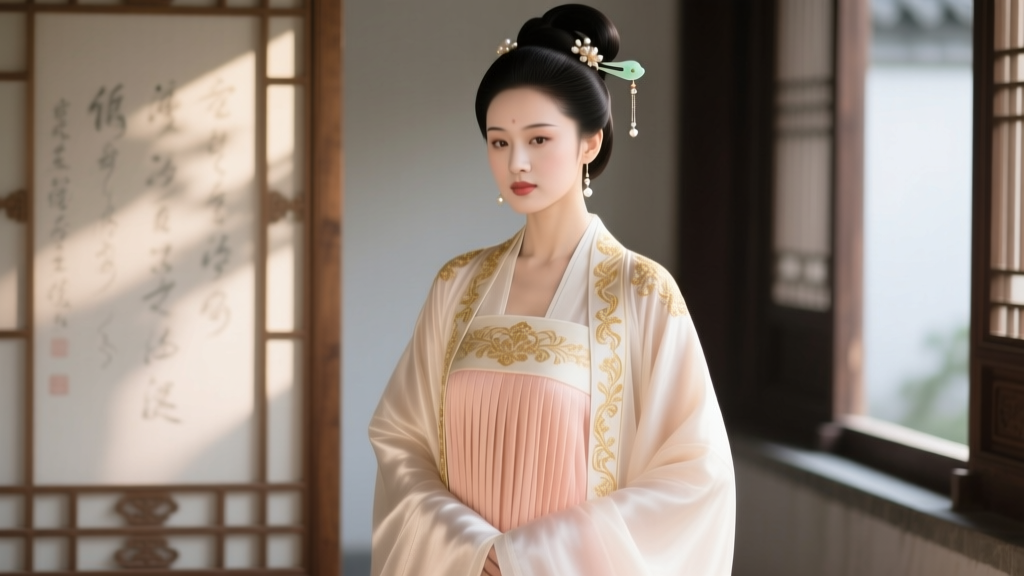
The Hanfu (汉服), the historical dress of the Han Chinese, is fundamentally rooted in the ancient cosmological concept of Tian Yuan Di Fang (Heaven is round, Earth is square). Unlike Western tailoring, which uses darts and seams to sculpt fabric to the body's contours, traditional Hanfu relies on flat-cutting. This preserves the integrity of the woven cloth, symbolizing harmony with nature and a respect for the materials provided by the earth.
Jiaoling Youren: The Crossed Collar
The most defining structural element of the Hanfu is the Jiaoling Youren (crossed collar, right lapel). The left side of the garment always crosses over the right and is tied at the right side of the body. In traditional Yin-Yang philosophy, the left represents Yang (life, light, and the living), while the right represents Yin (death, darkness, and the spiritual realm). Crossing left over right signifies the triumph of life and order. Historically, reversing this (right over left) was strictly reserved for burial garments or considered a mark of 'barbarian' tribes.
The Mamianqun: Pleats of Prosperity
Among the most iconic skirts in Chinese history is the Mamianqun (马面裙), or 'horse-face skirt,' which gained massive popularity during the Ming Dynasty (1368–1644). The skirt consists of two overlapping flat front and back panels (the 'horse faces') flanked by heavily pleated sides. The flat panels represent stability and uprightness, while the hidden pleats symbolize the unfolding of wealth and hidden virtues. Today, a high-quality Mamianqun woven with authentic Song brocade or metallic yarns can range from $150 to $600, while mass-produced polyester versions sell for $40 to $80.
Color Theory and the Five Elements (Wu Xing)
In traditional Chinese culture, color is not merely decorative; it is deeply tied to the Wu Xing (Five Elements) philosophy. According to institutions like the Metropolitan Museum of Art's Department of Asian Art, the use of color in historical textiles was strictly regulated by sumptuary laws and deeply embedded in spiritual beliefs.
| Color | Element (Wu Xing) | Direction | Symbolic Meaning and Cultural Usage |
|---|---|---|---|
| Red (Hong) | Fire | South | Joy, vitality, and good fortune. The quintessential color for weddings and Lunar New Year. |
| Yellow (Huang) | Earth | Center | Imperial power, neutrality, and the earth. Historically restricted to the Emperor and royal family. |
| Blue/Green (Qing) | Wood | East | Spring, youth, growth, and harmony. Often worn by scholars and young, unmarried women. |
| White (Bai) | Metal | West | Purity, but traditionally associated with autumn, mortality, and mourning rituals. |
| Black (Hei) | Water | North | Wisdom, the heavens (the night sky), and solemnity. Used in ancient ceremonial rites. |
Motifs and Embroidery: Reading the Visual Language
The embroidery on traditional Chinese dresses for women is a form of visual poetry. Master artisans, particularly those practicing Su Xiu (Suzhou embroidery)—a technique recognized for its incredible detail and split-silk threading—use motifs to bestow blessings upon the wearer. The Victoria and Albert Museum's Asian Collections highlights how these motifs often rely on visual puns and homophones in the Chinese language.
- The Peony (Mudan): Known as the 'King of Flowers,' the peony symbolizes wealth, honor, and feminine beauty. It is frequently embroidered on the hems of Qipaos and the flat panels of a Mamianqun.
- The Bat (Fu): Because the Chinese word for bat (fu) is a homophone for 'good fortune' or 'blessings,' bats are highly auspicious. A motif featuring five bats represents the 'Five Blessings': longevity, wealth, health, virtue, and a peaceful death.
- Magpie and Plum Blossom: The plum blossom blooms in the harsh winter, symbolizing resilience and perseverance. When paired with a magpie, the motif is read as Xi Shang Mei Shao (joy arriving at the tip of the eyebrow), signaling imminent good news.
- The Phoenix (Fenghuang): Representing the Empress and the ultimate Yin feminine principle, the phoenix embodies grace, virtue, and the harmonious union of yin and yang when paired with the dragon.
The Qipao: Modernity Meets Tradition
While the Hanfu represents ancient cosmology, the Qipao (旗袍) or Cheongsam represents the dynamic synthesis of tradition and modernity. Originating from the loose, A-line changpao worn by Manchu women during the Qing Dynasty (1644–1911), the Qipao was radically transformed in 1920s and 1930s Shanghai.
Structural Symbolism of the Shanghai Qipao
Tailors in Shanghai introduced Western darting, set-in sleeves, and high side slits (kaicha) to the garment. However, the symbolic essence remained intact. The high Mandarin collar signifies dignity and an upright moral character, framing the face and forcing the wearer to hold their head high. The continuous, unbroken line of the fabric from shoulder to hem represents a seamless, harmonious life path.
Pankou: Knots of Connection
The Pankou (frog closures) are the functional and decorative knots used to fasten the Qipao. Far from simple buttons, these hand-woven silk knots are symbolic of connection, unity, and the intertwining of fates. Intricate Pankou can be shaped into floral motifs, butterflies, or the longevity knot (shoujie), taking an artisan several hours to craft a single set. Bespoke Shanghai Qipaos featuring hand-rolled edges and artisanal Pankou typically start at $1,200 and can exceed $4,000 depending on the silk and embroidery complexity.
A Buyer’s Guide to Symbolically Authentic Garments
For those seeking to purchase traditional Chinese dresses for women, understanding fabric composition and regional origins is crucial for both cultural respect and investment value.
- Verify the Silk Origin: Authentic garments should utilize regional silks. Look for Xiangyunsha (Gambiered Canton Gauze) from Guangdong, a luxurious, mud-dyed silk that is breathable, water-resistant, and carries a distinct earthy scent, or Song Brocade from Suzhou, prized for its complex, multi-layered geometric and floral weaves.
- Check the Motif Accuracy: Ensure that the embroidery matches the intended occasion. Avoid wearing garments heavily embroidered with white chrysanthemums or stark white color palettes to joyous events like weddings, as these remain culturally tethered to mourning and solemnity in traditional contexts.
- Support Intangible Heritage Artisans: The UNESCO Intangible Cultural Heritage lists several Chinese textile techniques, including sericulture and silk weaving. Purchasing from verified artisan cooperatives in Suzhou, Hangzhou, or Nanjing ensures you are supporting living traditions rather than mass-produced, culturally disconnected fast fashion.
'To wear Hanfu is not merely to put on old clothes; it is to wrap oneself in the etiquette and philosophy of our ancestors. The fabric is the earth, the collar is the sky, and the wearer is the bridge between them.' — Contemporary Hanfu Movement Proverb.
Conclusion
Traditional Chinese dresses for women are profound cultural artifacts. From the Yin-Yang alignment of the Hanfu's crossed collar to the auspicious homophones stitched into a Qipao's silk bodice, these garments demand to be read as much as they are worn. By understanding the deep symbolism woven into every thread, wearers and collectors can honor the rich, living heritage of Chinese sartorial arts with the respect and knowledge it deserves.