Royal Hanfu Symbolism: Motifs & Meanings

When examining the royal Chinese traditional dress Hanfu, one must look beyond the sumptuous silk and intricate embroidery. Imperial court attire during the zenith of Han Chinese rule—most notably the Zhou, Tang, and Ming dynasties—was not merely fashion; it was a wearable cosmological map. Every thread, color, and motif was strictly codified to reflect the emperor's mandate from heaven (Tianming) and the structural harmony of the universe. This guide decodes the profound symbolism embedded in historical Hanfu court dress, offering cultural context for historians, textile enthusiasts, and modern Hanfu revivalists.
The Cosmological Blueprint of Imperial Hanfu
The foundational philosophy of royal Hanfu is rooted in the concept of Tianren Heyi (the unity of heaven and humanity). The silhouette itself was designed to mirror the cosmos. The upper garment (yi) represented the heavens and the unchanging spiritual realm, while the lower skirt (chang) represented the earth and the physical world.
Mianfu: The Emperor’s Ceremonial Silhouette
The highest order of royal Chinese traditional dress Hanfu was the Mianfu, worn exclusively by the emperor for the most sacred state rituals, such as the winter solstice sacrifice at the Temple of Heaven. The most striking feature of the Mianfu was the Mianliu, a flat-topped crown with bead curtains. The emperor’s crown featured exactly 12 strings of jade beads, representing the 12 months and 12 earthly branches. The rhythmic swaying of the beads forced the emperor to maintain a slow, dignified gait, physically embodying the weight and stability of the empire.
Color Theory and the Five Elements (Wuxing)
Imperial Hanfu color palettes were never arbitrary; they were dictated by the Wuxing (Five Elements) theory and dynastic elemental patronage. While popular media often associates Chinese royalty exclusively with bright yellow, historical Hanfu court dress utilized a much more complex chromatic hierarchy. During the Ming Dynasty (1368–1644), which claimed the element of Fire, red became a paramount imperial color, though yellow was eventually restricted exclusively to the emperor's daily court wear.
| Color | Element (Wuxing) | Direction | Imperial Application in Hanfu |
|---|---|---|---|
| Yellow (Huang) | Earth | Center | Reserved for the Emperor's Gunlongpao (dragon robe) in later dynasties; symbolizes the center of the universe. |
| Red (Chi) | Fire | South | Prominent in Ming court robes; symbolizes prosperity, joy, and the Ming dynasty's elemental mandate. |
| Black (Xuan) | Water | North | Used in the upper garment of the ancient Mianfu to represent the vast, mysterious heavens. |
| Blue/Green (Qing) | Wood | East | Worn by the emperor during spring agricultural rituals to encourage crop growth. |
| White (Bai) | Metal | West | Rarely used for joyous court events; reserved for mourning or specific autumnal military rituals. |
Bestiary of Power: Decoding Court Motifs
The embroidery on royal Hanfu served as a visual language of authority and moral virtue. The pinnacle of this iconography is the Shier Zhang (Twelve Symbols of Sovereignty), an ancient motif system dating back to the legendary Emperor Shun and codified in the Zhou dynasty.
The Twelve Symbols of Sovereignty
Only the emperor's ceremonial Hanfu could bear all twelve symbols, distributed strategically across the robe:
- Sun, Moon, and Stars: Embroidered on the shoulders, representing the emperor's enlightenment and his role as the celestial light guiding the empire.
- Mountains: Placed on the back, symbolizing stability, weight, and the emperor's role as the stabilizer of the earth.
- Dragons (Long): Placed on the sleeves or chest, representing adaptability, divine power, and the emperor's yang energy.
- Pheasant (Hua Chong): Symbolizing literary refinement and the beauty of courtly culture.
- Axe (Fu): Representing courage, executive power, and the authority to punish the wicked.
- Fu Symbol (interlocking squares): Denoting moral integrity, loyalty, and the duality of the universe.
The Dragon (Long) vs. The Mang (Python)
A common misconception in studying royal Chinese traditional dress Hanfu is confusing the imperial five-clawed dragon (Long) with the four-clawed python (Mang). During the Ming dynasty, the Mangpao (python robe) was a highly coveted garment gifted by the emperor to top-ranking officials, military generals, and favored eunuchs. The Mang is a dragon-like beast but strictly lacks the fifth claw and the horns of the true imperial Long. Wearing a five-clawed dragon without authorization was an act of treason punishable by death.
The Empress’s Diyi: Phoenixes and Virtue
The female equivalent to the emperor's Mianfu was the Diyi, worn by the empress for state ceremonies. The Diyi was traditionally a deep blue or black robe adorned with a repeating pattern of pheasants (Zhihui), which symbolized the five cardinal virtues: benevolence, righteousness, propriety, wisdom, and fidelity.
Accompanying the Diyi was the breathtaking Fengguan (Phoenix Crown). Historically, these crowns were masterpieces of Diancui (kingfisher feather inlay) and gold filigree. The iridescent blue feathers of the kingfisher were set into intricate gold frameworks shaped like soaring phoenixes, dragons, and immortal peaches. Because the traditional Diancui craft required the killing of kingfisher birds, modern Hanfu artisans and museums, such as those documented by the Victoria and Albert Museum's Asian collections, heavily study historical pieces to recreate the aesthetic using ethically sourced dyed goose feathers or silk ribbons.
Crucial Distinction: Hanfu Court Dress vs. Qing Qizhuang
When researching royal Chinese garments, it is vital to distinguish between Hanfu and Qizhuang. The ubiquitous "dragon robe" seen in modern cinema—characterized by a mandarin collar, horse-hoof cuffs, and a front-opening flap—is not Hanfu. It is the Chaofu or Jifu of the Qing Dynasty (1644–1912), which was established by the Manchu people.
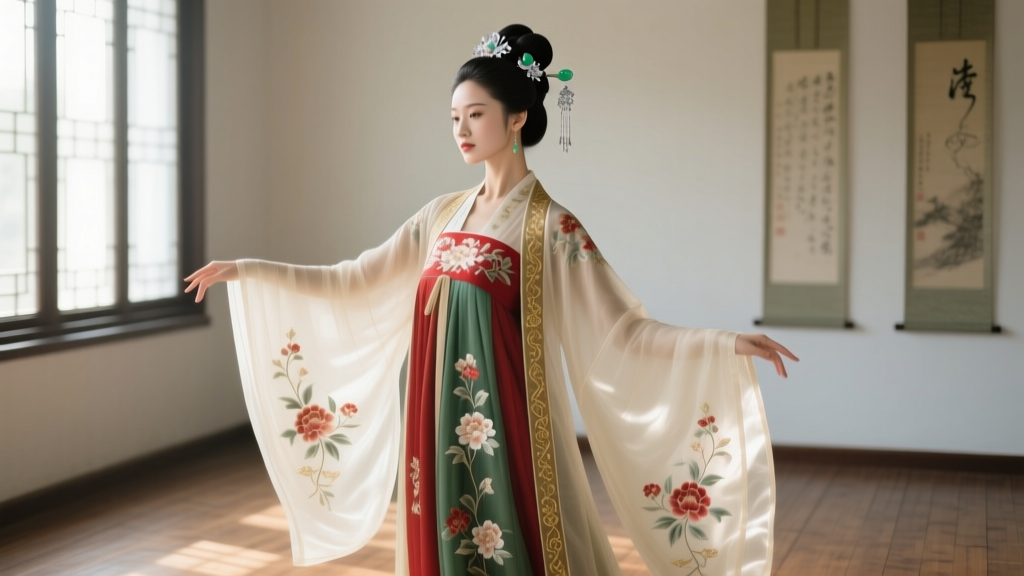
True royal Hanfu, such as the Ming dynasty Chaofu, features a cross-collar (jiaoling youren), wide flowing sleeves, and a distinct lack of Manchu tailoring elements. Understanding this distinction is critical for cultural accuracy and for buyers seeking authentic historical reproductions. For deeper historical context on the transition of Chinese court textiles, the Metropolitan Museum of Art's Heilbrunn Timeline of Art History provides excellent primary source analyses of Ming dynasty weaving techniques.
Sourcing Authentic Replicas and Museum Collections
For collectors, historical reenactors, and Hanfu enthusiasts looking to acquire royal-style garments, the market is divided into three distinct tiers. Understanding these tiers ensures you pay fair prices for authentic craftsmanship.
1. Mass-Produced Theatrical and Festival Wear ($50 - $150 USD)
These garments are typically made from polyester brocade or synthetic satin. While they capture the general silhouette of a Mangpao or Diyi, the motifs are machine-embroidered or printed, and the structural tailoring often ignores historical seam placements. These are suitable for stage performances or casual festival wear but lack cultural and historical depth.
2. Artisan-Crafted Revivalist Hanfu ($400 - $1,200 USD)
Produced by specialized Hanfu brands in Hangzhou, Suzhou, and Guangzhou, these robes use genuine silk blends, real metal-wrapped threads, and historically accurate cross-collar tailoring. Motifs are often hand-embroidered or woven using modern jacquard looms programmed with historical patterns sourced from The Palace Museum archives in Beijing. Expect to pay around $800 for a high-quality silk Feiyufu (flying fish robe) or a noblewoman's Mamianqun (horse-face skirt) with woven gold pheasant motifs.
3. Bespoke Intangible Cultural Heritage Pieces ($2,000 - $10,000+ USD)
At the apex of the market are garments woven using traditional Yunjin (Nanjing cloud brocade) or Zhuanghua techniques. Authentic Yunjin incorporates real peacock feather threads and 24k gold foil strips. Because traditional Yunjin looms require two artisans working in tandem and produce only a few centimeters of fabric per day, a fully tailored, historically accurate Ming-style Emperor's robe in genuine Yunjin can easily exceed $10,000 USD. These pieces are considered wearable art and are often commissioned by private collectors or cultural institutions.
Preserving the Legacy of Imperial Threads
The royal Chinese traditional dress Hanfu is a testament to the philosophical, artistic, and technological achievements of ancient Chinese civilization. By understanding the profound symbolism of the Shier Zhang, the elemental harmony of the Wuxing color palette, and the strict sartorial laws that governed the imperial court, we can appreciate these garments not just as beautiful textiles, but as profound historical documents woven in silk.