Qipao Mini: Modern Cheongsam Guide

The Hemline Ascent: From 1930s Shanghai to 1960s Hong Kong
To understand the qipao mini, one must first dismantle the misconception that the traditional Chinese qipao (旗袍) was ever inherently short. In its 1920s and 1930s Shanghai heyday, the qipao was a floor-sweeping or mid-calf garment, characterized by its modest hemline, high mandarin collar, and subtle side slits (kai cha). It was a symbol of the modern, educated 'New Woman' of the Republic of China, balancing traditional silk-weaving heritage with the streamlined silhouettes of Western Art Deco.
The journey of the hemline moving upward is intrinsically tied to the post-war economic boom and shifting gender dynamics in Hong Kong. By the 1950s and 1960s, Hong Kong had become a bustling cosmopolitan hub. Women were entering the workforce in greater numbers, and the sweeping hems of the Shanghai era became impractical for navigating crowded streets and office environments. According to the Victoria and Albert Museum's archives on the qipao, it was during this mid-century Hong Kong era that the garment's hemline first crept up to the knee, pairing with Western-style high heels and bobbed hair. However, the true 'mini' iteration—rising to the mid-thigh—did not become prevalent until the late 20th century, heavily influenced by global youthquake fashion, cinematic costuming, and eventually, the fast-fashion export market.
Tailoring the Mini: Flat-Pattern Heritage vs. Western Darting
The most critical distinction between a culturally authentic short qipao and a mass-produced 'qipao mini' costume lies in the garment's structural engineering. Traditional qipao tailoring relies on a flat-pattern cutting method. The fabric is folded and cut in a way that respects the natural drape of the silk, hiding the body's contours while allowing for elegant movement. The side slits are necessary for walking, not merely for visual allure.
When the garment was shortened to a mini length and exported to Western markets, tailors often applied Western darting (bust and waist darts) to force the fabric to cling tightly to the body. This fundamentally alters the DNA of the garment. A traditional short qipao will still feature a slight A-line or straight drop from the bust, relying on the tension of the pankou (frog buttons) and the side slits to accommodate movement. The Westernized mini qipao, conversely, acts like a bodycon dress with a mandarin collar grafted onto it.
The Anatomy of a Respectful Mini Qipao
For contemporary designers creating high-end mini qipaos, several traditional elements are preserved to maintain cultural integrity:
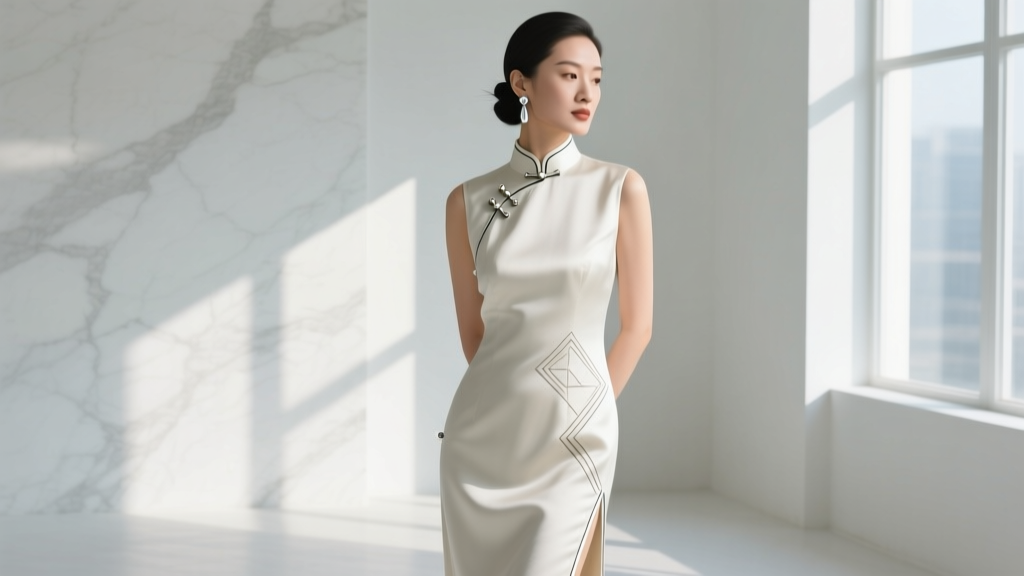
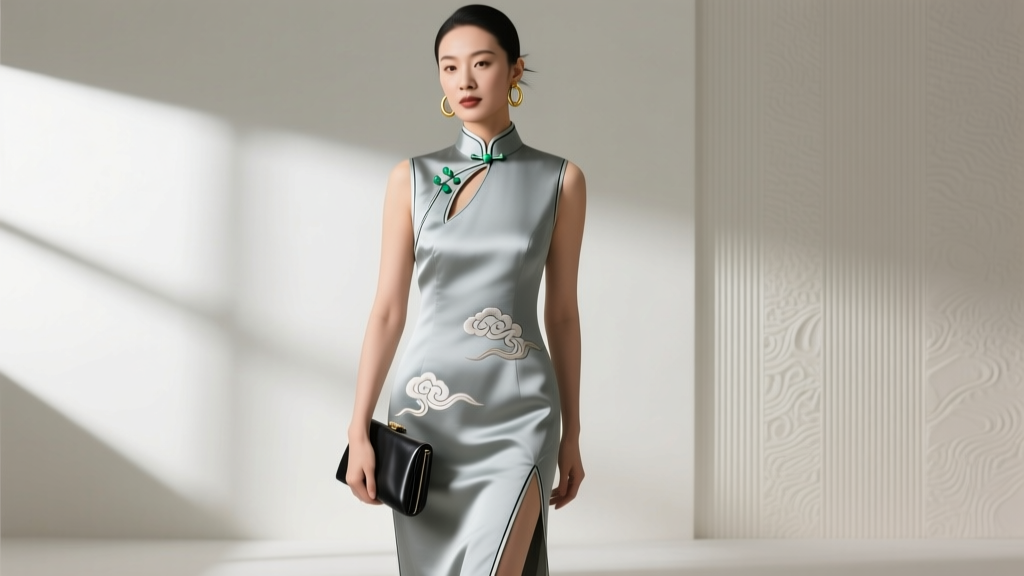
- Pankou (盘扣): Hand-knotted frog fasteners. In a quality garment, these are functional and meticulously knotted from the same silk as the dress, rather than cheap, stiff polyester loops glued to the collar.
- The Collar (元宝领 / 立领): The mandarin collar should be reinforced with traditional rice paste or modern interfacing to stand upright without choking the wearer, framing the jawline elegantly.
- Bound Edges (滚边): High-quality mini qipaos feature contrasting or tonal silk binding along the collar, sleeves, and slits, a technique that prevents the silk brocade from fraying and adds structural weight to the short hemline.
The 'Party Dress' Trope and Cultural Reclamation
In Western media and global fast fashion, the qipao mini has frequently been reduced to a hyper-sexualized costume, often conflated with exoticized tropes of Asian femininity. This tension famously erupted in 2018 when a white American teenager wore a mass-produced, mini-length cheongsam to her high school prom, sparking a massive global debate on cultural appropriation versus appreciation. The incident highlighted a crucial disconnect: while the qipao is a living, evolving garment for Chinese women, its miniaturized, mass-market versions in the West are often treated as disposable novelties.
However, within China and the global diaspora, the short qipao is currently experiencing a profound reclamation through the Xin Zhongshi (新中式) or 'New Chinese Style' movement. Young Gen Z and Millennial women are pairing mini qipaos with chunky sneakers, oversized leather jackets, and combat boots. In this context, the qipao mini is not a costume; it is an assertion of modern cultural identity, blending ancestral textile motifs with contemporary streetwear silhouettes. As noted in the M+ Museum's editorial on Hong Kong's mid-century fashion, the qipao has always been a sponge for global influences, and its current iteration as a streetwear-ready mini dress is simply the next logical step in its century-long evolution.
Market Matrix: Navigating the Qipao Mini Landscape
When shopping for a mini qipao, understanding the market tiers is essential for avoiding culturally insensitive costumes and investing in garments that honor the craft. Below is a buyer’s matrix to help navigate the current landscape.
| Market Tier | Price Range (USD) | Fabric Composition | Construction Method | Cultural Context & Best Use |
|---|---|---|---|---|
| Fast Fashion / Costume | $25 - $60 | Polyester blends, cheap synthetic brocade, spandex | Western darting, invisible back zipper, faux glued pankou | Halloween, themed parties. High risk of cultural appropriation and poor fit. |
| Contemporary Neo-Qipao | $120 - $350 | Cotton-linen blends, crepe, vegan silk, denim | Hybrid tailoring, functional pankou, moderate slits, hidden side zippers | Everyday streetwear, Gen Z 'Xin Zhongshi' fashion, casual dinners. |
| Bespoke / Artisan Short | $500 - $1,500+ | Mulberry silk, Xiangyunsha (mud-dyed silk), Song brocade | Traditional flat-pattern, hand-rolled hems, custom fit, hand-knotted pankou | High tea, modern weddings, cultural events, gallery openings. |
Note on Xiangyunsha (香云纱): For those seeking the pinnacle of artisan short qipaos, look for garments made from Xiangyunsha. This is a heritage silk from Guangdong province, dyed using river mud and the juice of the薯莨 (shulang) yam. It has a distinct, slightly crinkled texture, a dark, earthy color palette, and a subtle, leathery rustle when worn. It is highly prized by contemporary neo-qipao designers.
Styling the Neo-Qipao Mini: The Xin Zhongshi Movement
Styling a qipao mini with cultural respect and modern flair requires moving away from the 'traditional costume' mindset. The goal of the Xin Zhongshi movement is juxtaposition. Here are expert styling frameworks for wearing the short cheongsam today:
Footwear and Proportions
Avoid delicate, traditional silk slippers or overly delicate stilettos, which can push the outfit into costume territory. Instead, ground the mini hemline with substantial footwear. Chunky loafers, Mary Janes with a thick platform, or pristine minimalist sneakers anchor the garment in the 2020s streetwear aesthetic. This balances the visual weight of the short hem and provides a youthful, dynamic silhouette.
Layering for Modesty and Edge
Because the mini qipao features high side slits, layering is both a practical and stylistic necessity. In cooler months, layer a fine, semi-sheer silk turtleneck underneath the qipao. This not only provides warmth but creates a beautiful textural contrast between the structured brocade of the dress and the fluid silk of the underlayer. For an edgier look, wear the mini qipao unbuttoned at the bottom and top, treating it as a structured vest over a pair of wide-leg tailored trousers or raw-hem denim.
Hair and Accessories
The high mandarin collar draws immediate attention to the neck and jawline. Avoid heavy, traditional hair sticks or jade pendants that clutter the neckline. Opt for sleek, modern updos or a sharp, chin-length bob. When it comes to jewelry, contemporary geometric gold or silver pieces complement the architectural lines of the qipao far better than faux-vintage jade or dragon motifs, which can easily tip the look into caricature.
Institutional Archives & Further Reading
The study of the qipao is an ongoing academic and curatorial pursuit. For readers and collectors wishing to explore the historical lineage of the garment—from its Manchu origins to its Shanghai golden age and its modern mini iterations—the following institutional archives are invaluable:
- The Metropolitan Museum of Art: The exhibition catalog and digital archives for China: Through the Looking Glass provide extensive visual documentation of how the qipao has been interpreted by both Eastern and Western designers over the last century.
- The Victoria and Albert Museum (V&A): Their textile archives offer deep dives into the specific silk-weaving techniques and structural tailoring shifts of the 1930s and 40s.
- M+ Museum (Hong Kong): As a leading institution for contemporary visual culture, M+ frequently explores the intersection of mid-century Hong Kong cinema, local tailoring, and the global export of the cheongsam.
Ultimately, the qipao mini is not a bastardization of a historical artifact, but a reflection of a living culture. When approached with an understanding of its tailoring heritage, fabric integrity, and contemporary styling contexts, the short qipao remains one of the most dynamic and powerful garments in the Asian sartorial canon.