Qipao Meaning: Regional Substyles Decoded
When Western audiences envision traditional Chinese clothing, a single, form-fitting silhouette often dominates the imagination. However, to truly understand this iconic garment, one must look past the monolith and explore the deeper qipao meaning through the lens of regional variations and substyles. The qipao is not a static relic; it is a dynamic, living garment whose cut, fabric, and cultural significance shift dramatically depending on whether it is tailored in the historic hutongs of Beijing, the cosmopolitan streets of Shanghai, or the humid, bustling markets of Guangzhou.
The Etymology and Literal Qipao Meaning
To grasp the garment's evolution, we must first dissect the literal qipao meaning. In Mandarin, the word is written as 旗袍 (qípáo). The first character, qí (旗), translates to 'banner' or 'flag,' referring to the Eight Banner system of the Manchu-led Qing Dynasty (1644–1912). The second character, páo (袍), means 'long gown' or 'robe.' Therefore, the literal translation is 'banner gown.'
Originally, the term referred to the loose, straight-cut, and heavily embroidered robes worn by Manchu women, designed to conceal the figure and provide warmth in northern climates. According to the Metropolitan Museum of Art's Heilbrunn Timeline of Art History, Qing dynasty dress was strictly regulated by sumptuary laws, with Manchu clothing (qizhuang) remaining distinct from Han Chinese clothing (hanfu). It wasn't until the 1920s, during the Republican era, that Han Chinese women adopted and radically altered the Manchu gown, transforming it into the modern, body-conscious dress we recognize today. This historical synthesis is the bedrock of the modern qipao meaning: a symbol of early Chinese feminism, modernity, and cross-cultural integration.
The Great Divide: Jingpai (Beijing) vs. Haipai (Shanghai)
The most critical framework for understanding regional substyles is the dichotomy between Jingpai (Beijing Style) and Haipai (Shanghai Style). These two schools of thought represent entirely different philosophies regarding tailoring, modesty, and the garment's relationship to the female body.
Jingpai: The Imperial Legacy
Jingpai (京派) qipaos are deeply rooted in northern conservatism and imperial tradition. Originating in Beijing, this substyle favors a looser, more forgiving silhouette that skims the body rather than clinging to it. The construction relies on traditional flat-pattern cutting, which preserves the integrity of the fabric's woven motifs—often heavy brocades, velvets, or intricately woven damasks.
Jingpai garments typically feature lower slits, higher and stiffer Mandarin collars, and elaborate, hand-knotted pankou (frog fasteners) that serve as focal points of artistry. The aesthetic is regal, understated, and heavily reliant on the quality of the textile rather than the complexity of the tailoring.
Haipai: The Cosmopolitan Silhouette
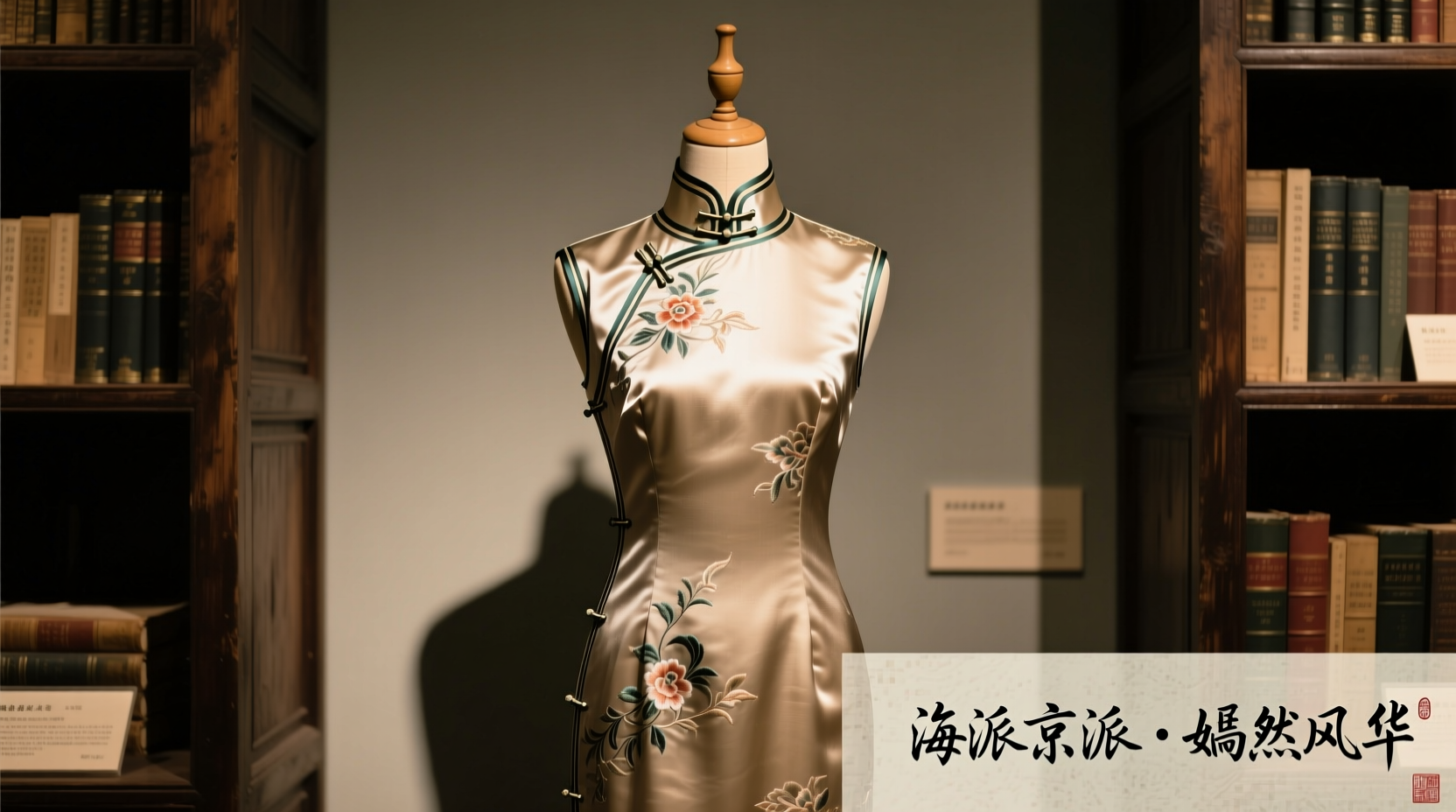
In stark contrast, Haipai (海派) represents the Shanghai style, born in the 1920s and 30s when Shanghai was known as the 'Paris of the East.' Haipai tailors were the first to integrate Western garment construction techniques into Chinese dress. They introduced bust darts, waist shaping, and set-in sleeves, transforming the qipao from a flat, two-dimensional robe into a three-dimensional, body-hugging silhouette.
Haipai qipaos utilize lighter, more fluid fabrics like silk crepe, charmeuse, and lace. The slits are cut higher to allow for movement and to showcase the leg, reflecting the liberated, modern spirit of the Shanghai mingyuan (socialites) and female intellectuals who popularized the style. The China National Silk Museum notes that the integration of Western textile imports and tailoring methods in Shanghai fundamentally redefined the structural possibilities of Chinese silk garments during this era.
Regional Construction and Silhouette Comparison
Understanding the nuances between these regional substyles requires a close look at their structural elements. The table below outlines the primary differences across China's major qipao-producing regions.
| Feature | Jingpai (Beijing) | Haipai (Shanghai) | Lingnan (Guangzhou/HK) |
|---|---|---|---|
| Silhouette | Relaxed, A-line, flat-cut | Form-fitting, darted, 3D tailored | Practical, varied, often shorter |
| Primary Fabrics | Heavy brocade, velvet, wool | Silk crepe, charmeuse, lace | Xiangyunsha (mud silk), cotton, linen |
| Collar Height | High, stiffened, structured | Medium to low, soft-edged | Low, open, or collarless for heat |
| Slit Height | Modest, below the knee | High, mid-thigh | Functional, adapted for mobility |
| Fasteners (Pankou) | Ornate, floral, highly decorative | Minimalist, geometric, hidden zippers | Simple knots, practical snap buttons |
Lingnan and Hong Kong: The Southern Substyles
As the qipao migrated south to the Lingnan region (encompassing Guangdong and Hong Kong), it encountered a subtropical climate that demanded radical adaptations. The heavy brocades of Beijing and the layered silks of Shanghai were entirely unsuited for the sweltering humidity of the Pearl River Delta.
Southern tailors pioneered the use of Xiangyunsha (香云纱), a highly prized, heritage silk dyed with the juice of the薯莨 (shuliang) yam and coated in iron-rich river mud. This results in a breathable, water-resistant, and uniquely rustling fabric that is deeply tied to Cantonese identity. Furthermore, the Hong Kong tailoring boom of the 1950s and 60s—centered around the legendary tailors of King's Road—introduced the 'short qipao' and sleeveless variations, prioritizing everyday wearability for working women while maintaining the garment's elegant neckline and side-fastening closures.
Sourcing Authentic Regional Qipaos: A Buyer’s Guide
For collectors, brides, and cultural enthusiasts seeking an authentic piece, understanding the regional substyles is crucial for making an informed purchase. The market is saturated with mass-produced, polyester costumes that strip the garment of its cultural dignity. Here is a practical framework for sourcing genuine regional qipaos:
- Mass-Market / Fast Fashion ($40 - $120 USD): Often found on global e-commerce platforms. These are typically factory-made, lacking proper bian (piping) and featuring glued-on, machine-made frog buttons. They do not represent any true regional substyle and are best avoided for serious cultural wear.
- Mid-Tier Boutique & RTW ($250 - $800 USD): Brands based in Shanghai or Hangzhou often offer high-quality ready-to-wear Haipai styles. Look for genuine silk, hand-rolled hems, and functional, hand-tied pankou. These are excellent for formal events and weddings.
- Bespoke Jingpai / Heritage Artisans ($1,500 - $5,000+ USD): For a true Jingpai or heritage piece, commissioning from a master tailor in Beijing or Suzhou is required. This price reflects the hundreds of hours required for hand-embroidery (such as Su embroidery), custom knotting, and the sourcing of imperial-grade brocades or authentic Xiangyunsha silk.
What to Inspect Before Buying
When evaluating a qipao, turn the garment inside out. A high-quality Haipai or Jingpai qipao will feature immaculate interior finishing. The bian (the silk piping that edges the collar and slits) should be hand-stitched and perfectly uniform. The Victoria and Albert Museum's Asian textile archives frequently highlight that the interior construction of historical Chinese garments is just as meticulous as the exterior, a standard that modern master tailors continue to uphold.
Preserving the Craft: Artisans and Institutions
The true qipao meaning is inextricably linked to the artisans who keep its regional variations alive. In Shanghai, the Haipai qipao tailoring technique is recognized as a form of intangible cultural heritage, with master tailors passing down the secrets of 3D draping and bias-cutting to new generations. Similarly, in the south, the complex, sun-dependent process of creating Xiangyunsha silk is protected by heritage cooperatives in Foshan.
Supporting these regional variations means seeking out certified artisan cooperatives and heritage boutiques rather than fast-fashion imitators. By understanding the profound differences between the conservative elegance of Jingpai, the cosmopolitan allure of Haipai, and the pragmatic beauty of Lingnan, wearers can honor the rich, multifaceted history woven into every seam of the qipao.