How to Pronounce Qipao: Meaning & Origins
The Phonetic Guide: How to Pronounce Qipao and Cheongsam
When exploring traditional Asian garments, linguistic accuracy is the first step toward cultural respect. If you are wondering how to pronounce qipao, you must first understand that the garment holds two primary names, rooted in distinct Chinese dialects, each carrying profound historical symbolism.
Mandarin: Qípáo (旗袍)
In Standard Mandarin, the term is written as 旗袍 and romanized as qípáo. To pronounce it correctly, break it down by Pinyin phonetics:
- Qí (chee): The Mandarin 'q' is an alveolo-palatal affricate. It sounds similar to the English 'ch' in 'cheese', but the tip of your tongue should rest behind your lower front teeth, with the middle of your tongue raised to the hard palate. The 'í' indicates a rising second tone, similar to asking a question in English ('chee?').
- Páo (paow): The 'p' is heavily aspirated (a strong puff of air). The 'ao' rhymes with the English word 'cow'. It also carries a rising second tone.
Cantonese: Chèuhngsàam (長衫)
In Cantonese, the garment is known as 長衫, romanized in Jyutping as coeng4 saam1 or colloquially spelled chèuhngsàam.
- Chèuhng (cheung): Sounds similar to the English name 'Cheung' with a low-falling tone. It translates to 'long'.
- Sàam (saam): Rhymes with 'calm' and is spoken with a high, flat tone. It translates to 'shirt' or 'garment'.
Qípáo: The 'Banner Gown' and Imperial Symbolism
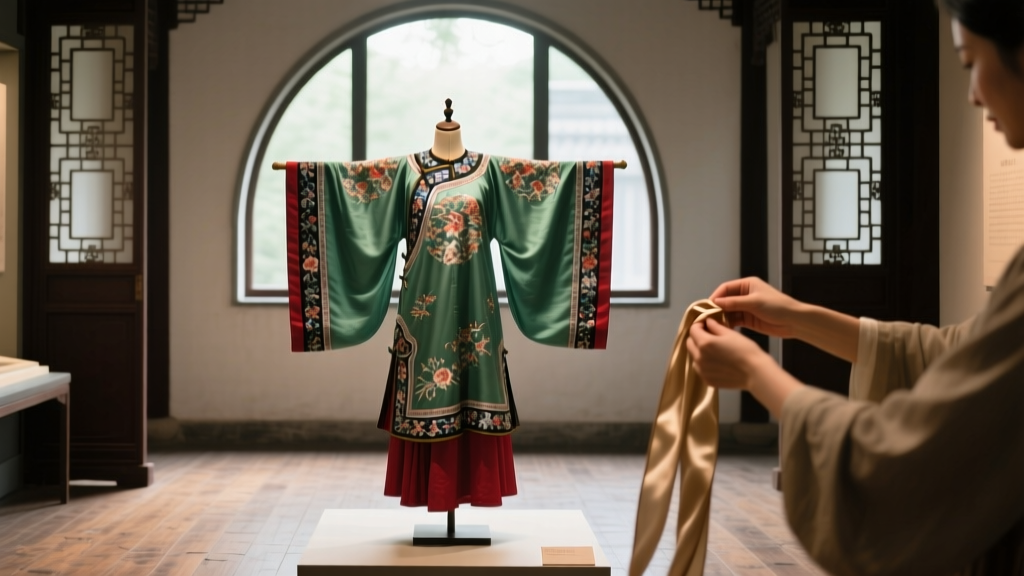
To understand the meaning behind the word qipáo, we must look to the Qing Dynasty (1644–1912). The literal translation of 旗袍 is 'Banner Gown'. This refers to the Eight Banners (baqi), the military and social divisions of the Manchu people who conquered China and established the Qing empire.
According to historical records preserved by institutions like The Metropolitan Museum of Art, the early qipao was a unisex, loose-fitting, floor-length robe. It was designed to conceal the human form and feature side slits that allowed for ease of movement during horseback riding and archery. The symbolic weight of the 'Banner Gown' was heavily tied to the Tifaling (hair and dress edict) of 1645, which forced Han Chinese men to adopt Manchu hairstyles and clothing as a symbol of submission and political unity.
Therefore, the original linguistic root of qipáo symbolizes imperial authority, Manchu ethnic identity, and strict social hierarchy. The high, stiff collar (lingzi) represented moral uprightness and discipline, while the modest, concealing cut reflected conservative Confucian values of the era.
Chèuhngsàam: The 'Long Shirt' and Feminist Emancipation
The transition from the imperial qipáo to the modern, form-fitting silhouette is deeply intertwined with the Cantonese term chèuhngsàam (Long Shirt). In the 1920s, following the fall of the Qing Dynasty, China entered the Republican Era. Female students and intellectuals in Shanghai and Guangzhou began adopting the male 'long shirt' as a radical act of gender subversion.
As documented by the Victoria and Albert Museum, women wearing the chèuhngsàam were making a profound symbolic statement: they were claiming the same educational, social, and political rights as men. By shedding the restrictive, multi-piece Hanfu skirts and adopting the single-piece 'long shirt', women symbolically stepped into the modern public sphere.
By the 1930s, the garment evolved in Shanghai into the figure-hugging, cosmopolitan dress recognized globally today. The side slits, once practical for riding horses, became symbols of female mobility, liberation, and a subtle, modern sensuality. The term chèuhngsàam thus carries the symbolic weight of feminist emancipation and East-meets-West modernity.
Comparative Linguistics and Regional Symbolism
| Term | Dialect / Language | Literal Translation | Historical Era | Core Symbolism |
|---|---|---|---|---|
| Qípáo (旗袍) | Mandarin | Banner Gown | Qing Dynasty (1644–1912) | Manchu heritage, imperial authority, ethnic identity |
| Chèuhngsàam (長衫) | Cantonese | Long Shirt | 1920s Republican Era | Gender equality, female emancipation, modernity |
| Zansae | Shanghainese (Wu) | Long Shirt | 1930s Shanghai | Cosmopolitan elegance, commercial modernity |
Decoding the Motifs: Visual and Phonetic Symbolism
The meaning of the qipao extends beyond its name into the very fabric and construction of the garment. Traditional Chinese embroidery relies heavily on visual and phonetic puns, where the spoken name of a motif dictates its symbolic blessing.
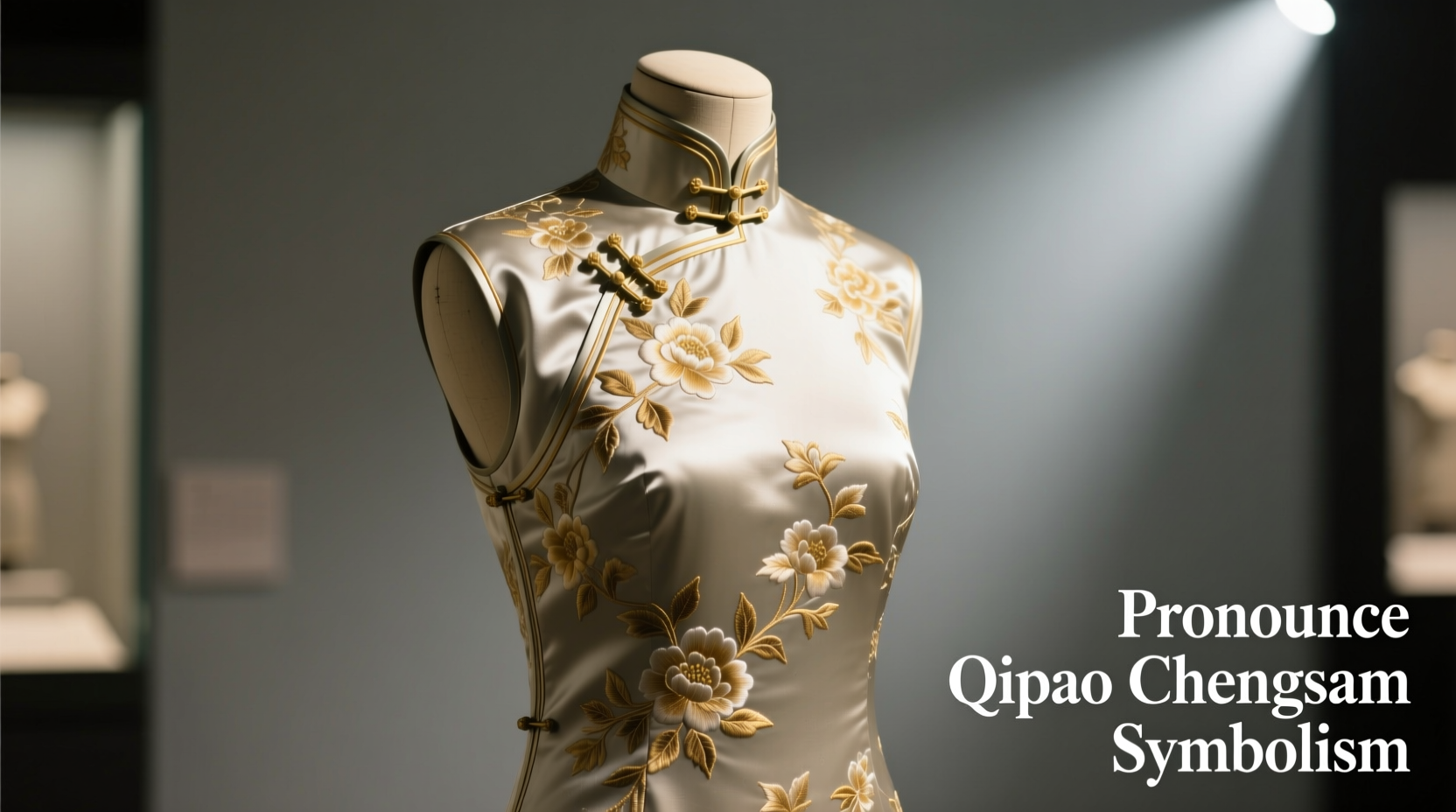
- The Peony (Mǔdān): Known as the 'King of Flowers', the peony symbolizes wealth, honor, and prosperity. It is the most common motif on wedding qipaos.
- The Bat (Fú): In Mandarin, the word for bat (fú) is a homophone for 'good fortune' or 'blessing'. A qipao embroidered with five bats represents the 'Five Blessings': longevity, wealth, health, virtue, and a natural death.
- The Pankou (Frog Buttons): These intricate knotted closures are not merely functional. According to the China National Silk Museum, the interlocking knots symbolize the harmonious union of yin and yang, and the tying together of heaven and earth. Complex shapes, like the butterfly pankou, represent joy and marital bliss.
Wearing the Name: Sourcing, Pricing, and Cultural Etiquette
Understanding how to pronounce qipao and cheongsam also guides you in knowing where and how to source an authentic garment. The market varies wildly based on construction and heritage techniques.
Market Price Guide (2026 Estimates)
- Mass-Produced / Fast Fashion ($30 – $80 USD): Typically made from polyester blends with printed (rather than embroidered) motifs. Often lacks the structural interfacing in the collar and uses standard plastic zippers instead of traditional side closures.
- Custom-Tailored Artisan ($300 – $800 USD): Found in Hong Kong, Shanghai, and specialized diaspora boutiques. These feature genuine silk brocade, hand-stitched hems, and custom-molded lingzi (collars) that fit the wearer's neck perfectly without choking.
- Haute Couture & Heritage Silk ($1,500 – $5,000+ USD): Garments featuring genuine Suzhou silk embroidery (Su Xiu), hand-woven Xiangyunsha (mud-silk), and solid gold or jade pankou buttons. These are investment pieces and museum-quality textiles.
Cultural Etiquette and Respectful Usage
When discussing or purchasing the garment, context dictates which term to use. In mainland China and academic historical contexts, qipáo is the standard and most respectful term. In Hong Kong, Macau, and many Western diaspora communities, cheongsam (the English corruption of the Cantonese pronunciation) remains the dominant colloquialism.
'Language is the thread that stitches history to the present. To pronounce the name of a cultural garment correctly is to honor the hands that wove its silk and the women who fought for the right to wear it.'
Ultimately, whether you are practicing the rising tones of qípáo or the flat cadence of chèuhngsàam, you are speaking the linguistic legacy of a garment that survived imperial edicts, feminist revolutions, and global modernization to remain a vital symbol of Chinese cultural identity today.