How to Style Pibo Hanfu for Traditional Events & Ceremonies

The Ethereal Elegance of the Pibo in Modern Hanfu Styling
When envisioning the golden age of Chinese fashion, the mind inevitably drifts to the Tang Dynasty (618–907 CE), an era defined by cosmopolitan exchange, artistic zenith, and sartorial opulence. At the heart of this visual legacy is the pibo (披帛), a flowing silk scarf or shawl that transforms the structural rigidity of traditional garments into a canvas of kinetic elegance. Today, as the Hanfu movement experiences a global renaissance, the pibo has transitioned from museum archives to modern cultural events, tea ceremonies, and traditional weddings.
However, styling a pibo hanfu ensemble requires more than simply draping fabric over the shoulders. It demands an understanding of historical precedents, textile behavior, and event-specific etiquette. This comprehensive occasion guide will equip you with the knowledge to source, drape, and wear the pibo with cultural reverence and sartorial precision.
Decoding the Pibo: Dimensions, Textiles, and Tang Dynasty Heritage
Unlike the structured collars of the Ming Dynasty or the layered robes of the Song, the Tang Dynasty pibo was an exercise in fluidity. Historically, a pibo measured between 200 to 300 centimeters in length and 50 to 80 centimeters in width. It was not a native Han Chinese invention; rather, art historians trace its origins to Hellenistic and Central Asian influences that traveled via the Silk Road, eventually being adopted by the Sui and popularized by Tang aristocrats.
The definitive visual record of the pibo is immortalized in Zhou Fang’s masterpiece, Court Ladies Adorning Their Hair with Flowers (簪花仕女图). In these depictions, the pibo is rendered in ultra-sheer textiles, allowing the vibrant colors of the underlying ruqun (襦裙) to show through. According to textile archives at the China National Silk Museum, Tang artisans favored Luo (罗 - complex gauze weaves) and Juan (绢 - tabby silk) for these accessories, prized for their gossamer weight and structural drape.
The Occasion Guide: Draping Protocols for Specific Events
The versatility of the pibo lies in its draping techniques. Different events call for distinct silhouettes, balancing historical accuracy with practical mobility. Below is a framework for matching your draping technique to your scheduled occasion.
| Draping Technique | Best Suited Event | Recommended Fabric | Historical Precedent & Protocol |
|---|---|---|---|
| The Classic V-Drape (Crossed at the chest, ends hanging evenly over both forearms) | Formal Weddings, Ancestral Veneration, Academic Ceremonies | Heavy Silk Damask or Brocade | Conveys dignity and formality. Frequently seen in formal court portraits and ceramic figurines housed at The Metropolitan Museum of Art. |
| The Single-Shoulder Cascade (Draped over one shoulder, wrapped once around the opposite arm) | Tea Ceremonies, Guqin Recitals, Artistic Photoshoots | Silk Chiffon or Organza | Asymmetrical and poetic. Mimics the celestial Feitian (apsaras) depicted in the Dunhuang Academy mural paintings. |
| The Wrist-Wrap (Looped around the back of the neck, with ends tightly wound around the wrists) | Lantern Festivals, Outdoor Parades, Active Dance Performances | Lightweight Raw Silk or Cotton-Silk Blend | Prioritizes mobility. Prevents the fabric from dragging in mud or catching on lantern frames during bustling outdoor events. |
| The Banbi Tuck (Tucked into the waistband or belt of a half-sleeve jacket, trailing behind) | Casual Hanfu Meetups, Market Strolls, Museum Visits | Printed Crepe or Georgette | A practical, working-class adaptation from the late Tang and Five Dynasties periods, allowing for ease of movement. |
Sartorial Architecture: Pairing Pibo with Ruqun and Banbi
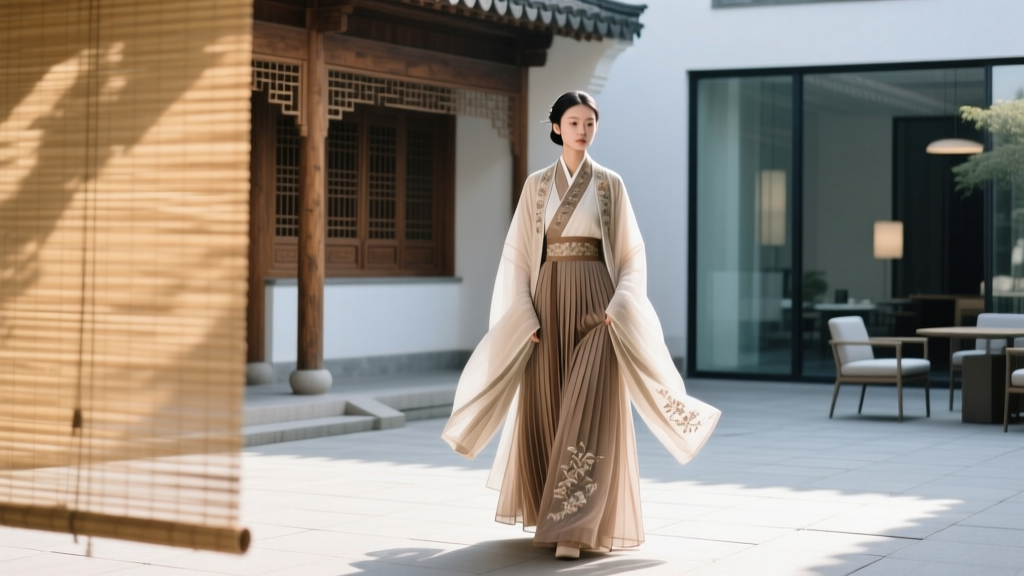
The pibo does not exist in a vacuum; it is the finishing architectural layer of a specific Hanfu silhouette. For modern events, the most culturally resonant pairing is the Qixiong Ruqun (齐胸襦裙), a chest-high pleated skirt paired with a short-sleeved or long-sleeved top. The high waistband provides a necessary anchor point; when executing the Classic V-Drape, the crossover of the pibo should sit precisely at or just below the skirt's top hem to create a flattering, elongated torso.
Alternatively, for autumn or winter events, the pibo is layered over a Banbi (半臂), a short-sleeved half-jacket worn over the primary inner robe. The contrast between the structured, embroidered edges of the Banbi and the sheer, floating nature of a silk gauze pibo creates a masterclass in textural juxtaposition, highly favored in contemporary Hanfu styling competitions.
Investment Guide: Sourcing Silk, Synthetics, and Artisan Weaves
When procuring a pibo for your wardrobe, the textile composition will dictate how the garment behaves in photographs and in motion. Synthetic fabrics often lack the 'memory' and weight required to hold a drape, resulting in a stiff, unnatural silhouette. Below is a buyer’s matrix for navigating the modern Hanfu market.
- Tier 1: Mass-Market Synthetics (Polyester Chiffon)
Price Range: $12 – $25 USD (¥80 – ¥180 CNY)
Profile: Highly accessible and available in vibrant, machine-embroidered gradients. However, polyester generates static and slips off the shoulders easily, requiring hidden pins. Best for beginners attending casual, single-day festivals. - Tier 2: Mid-Tier Mulberry Silk (Organza and Crepe)
Price Range: $40 – $90 USD (¥280 – ¥650 CNY)
Profile: The gold standard for event-goers. Mulberry silk organza possesses a natural 'bite' that grips underlying garments, keeping the drape secure without excessive pinning. It catches the light beautifully in evening settings and breathes well during summer tea ceremonies. - Tier 3: Heritage Artisan Weaves (Hand-loomed Luo with Metallic Threads)
Price Range: $150 – $400+ USD (¥1,000 – ¥3,000+ CNY)
Profile: Commissioned from specialized weaving cooperatives in Hangzhou and Suzhou. These pibo feature complex leno weaves (Luo) interspersed with gold or silver foil threads. They are heirloom pieces reserved for brides, cultural ambassadors, and high-formal galas.
Event Day Logistics: Securing the Pibo
The greatest challenge of wearing a pibo hanfu to a live event is gravity. Tang Dynasty court ladies had the luxury of remaining relatively stationary or relying on attendants. Modern attendees navigating crowded banquet halls or uneven outdoor terrain must employ discreet securing methods.
The Hidden Brooch Technique: Avoid piercing delicate silk gauze with standard safety pins, which will snag and tear the leno weave. Instead, use magnetic clasps or specialized Hanfu anti-slip brooches hidden beneath the crossover point at the chest. The Hairpin Anchor: For the Single-Shoulder Cascade, traditional Zan (簪) hairpins can be adapted to pin the pibo securely to the shoulder seam of the underlying robe, distributing the weight of the silk without damaging the fibers.
'The pibo is not merely an accessory; it is the physical manifestation of the Tang Dynasty's open borders and flowing aesthetics. To wear it is to participate in a living dialogue between ancient Silk Road exchanges and modern cultural reclamation.'
Navigating Cultural Etiquette and Respect
As the Hanfu community grows, so does the responsibility to wear these garments with informed respect. When attending solemn events such as ancestral rites or traditional coming-of-age ceremonies (Jili / 笄礼), opt for subdued, historically accurate color palettes—such as indigo, celadon, or ochre—and avoid overly theatrical, anime-inspired draping styles. Conversely, for the Mid-Autumn Festival or Lantern Festival, vibrant gradients and dynamic wrist-wraps celebrate the joyous, communal spirit of the holiday. By aligning your textile choices and draping protocols with the specific gravity of the occasion, you honor the profound legacy of the pibo and the artisans who keep its weave alive today.