Parts of a Hanfu: Fabric & Craftsmanship Guide
The Architectural Philosophy of Hanfu Construction
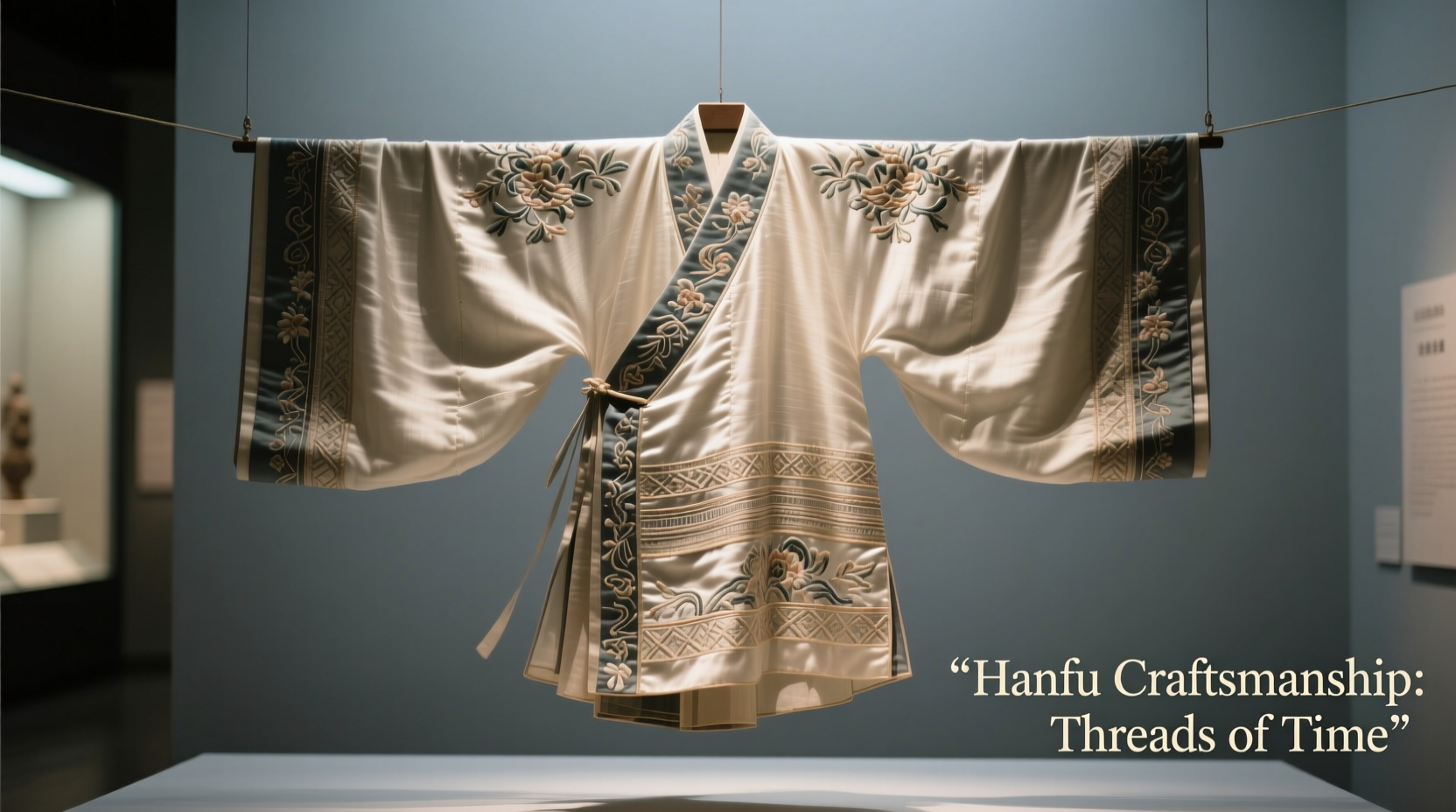
To truly understand the parts of a hanfu, one must first look beyond the silhouette and examine the structural philosophy that governs its creation. Unlike Western tailoring, which relies on darts, princess seams, and complex 3D draping to contour the human body, traditional Hanfu is rooted in Pingmian Caijian (flat cutting). This two-dimensional approach treats the fabric as a canvas, prioritizing the natural drape, fluid movement, and the preservation of the textile's structural integrity over rigid body-hugging fits.
Historically, traditional Chinese looms produced narrow bolts of fabric, typically measuring between 50 to 60 centimeters in width. This technological constraint birthed a defining feature of Hanfu construction: the Zhongfeng (center-back seam). Rather than viewing the seam as a mere necessity, Hanfu makers elevated it to a symbol of moral uprightness and balance. When the garment is laid flat, the left and right sides are perfectly symmetrical, reflecting the Confucian ideals of harmony and impartiality.
Deconstructing the Garment: Essential Parts of a Hanfu
A complete Hanfu ensemble is a modular system composed of several distinct structural elements. Each part serves both a functional purpose and a symbolic role within traditional Chinese cosmology. Below is a detailed breakdown of the primary anatomical components:
| Garment Part (Pinyin) | English Translation | Craftsmanship Details & Cultural Significance |
|---|---|---|
| Ling (领) | Collar | The Jiaoling (crossed collar) is the most iconic. It must always follow the Youren rule: the left side of the garment crosses over the right, securing on the wearer's right side. This represents the triumph of life (Yang) over death (Yin). |
| Jin (襟) | Lapel / Front | The overlapping front panel. In the Ming Dynasty, the Yuanling (round collar) often featured a concealed button and a structured lapel, requiring precise edge-piping techniques to prevent fraying. |
| Xiu (袖) | Sleeves | Sleeves are cut in one continuous piece with the bodice. Variations include the Pipa Xiu (lute-shaped, narrowing at the wrist) and Guangxiu (broad, flowing sleeves). The curved underarm gusset allows for immense arm mobility. |
| Ju (裾) | Hem / Skirt Edge | The hem of the robe or skirt. In the Shenyi (deep robe), the hem is composed of 12 separate panels of fabric, symbolizing the 12 months of the year and the 12 earthly branches. |
| Ren (衽) | Lapel Edge / Overlap | The specific diagonal or curved edge of the fabric that crosses the body. The angle of the Ren dictates the formality and historical era the garment represents. |
Textile Heritage: Fabrics that Define the Silhouette
The fluid, ethereal drape of Hanfu is entirely dependent on the textiles chosen. Because flat cutting lacks structural darts, the fabric's weight, warp, and weft dictate how the garment behaves in motion. According to The Metropolitan Museum of Art's Heilbrunn Timeline of Art History, Chinese silk weaving has been a closely guarded state secret for millennia, resulting in highly specialized regional weaves that remain highly sought after by modern Hanfu artisans.
Xiangyunsha: The Soft Gold of the South
For high-end, museum-grade Hanfu, few fabrics command as much respect as Xiangyunsha (Gambiered Canton Gauze). Originating from Guangdong province, this silk is dyed using the tannin-rich juice of the Shuliang (Dioscorea cirrhosa) yam and then coated with iron-rich river mud. The chemical reaction between the tannins and the iron creates a lustrous, dark brown or black fabric that is naturally water-resistant, cooling to the touch, and uniquely crinkled. Authentic Xiangyunsha is entirely hand-processed and sun-dried, making it incredibly rare. A single yard of genuine Xiangyunsha can cost between $150 and $400 USD, and a fully tailored robe can easily exceed $1,500 USD.
Song Jin and Yun Jin: The Brocade Masters
For formal and ceremonial Hanfu, such as the Ming Dynasty Mamianqun (horse-face skirt) or the Dashan (ceremonial jacket), heavy brocades are essential. Song Jin (Song Brocade) is prized for its subtle, matte elegance and complex geometric weaves, while Nanjing Yun Jin (Cloud Brocade) incorporates real gold and silver threads, as well as peacock feather filaments. Recognizing its unparalleled complexity, the UNESCO Intangible Cultural Heritage registry lists Nanjing Yunjin as a protected human treasure. A single Yunjin loom requires two weavers working in tandem, producing merely five centimeters of fabric per day.
Artisan Techniques: Edge Finishing and Embroidery
The true mark of a master Hanfu artisan lies not just in the cut, but in the finishing. Because Han fabrics are often delicate silks or loosely woven ramies, raw edges must be meticulously enclosed.
- Xiangbian (Piped Edging): A technique where a contrasting strip of fabric is folded and stitched along the collar, lapel, and cuffs. In the Ming Dynasty, the width and color of the Xiangbian were strictly regulated by sumptuary laws to denote the wearer's social rank.
- Yuanbian (Rolled Hemming): Used for lightweight summer garments like the Banbi (half-sleeve jacket), the edge is rolled inward multiple times and stitched with nearly invisible silk thread to maintain a clean, unbroken line.
- Embellishment Protocols: Traditional embroidery, such as Suzhou Su Xiu, is applied before the garment is cut and sewn. Artisans map out the flat pattern on the loom-woven silk, embroider the motifs (ensuring patterns align perfectly across the Zhongfeng center seam), and only then proceed to tailoring. This guarantees that a dragon's scale or a peony petal is never severed by a structural seam.
Sourcing Authentic Hanfu: Price Ranges and Quality Markers
As the Hanfu revival movement continues to grow globally, the market has fractured into distinct tiers of craftsmanship. Understanding these tiers is crucial for collectors, cultural practitioners, and enthusiasts looking to invest in authentic pieces. The Victoria and Albert Museum's Chinese Textiles collection highlights the historical accuracy of these weaves, providing a benchmark for modern buyers.
Market Tiers and Price Guide
- Commercial / Fast-Fashion Hanfu ($30 - $80 USD): Typically made from polyester chiffon, jacquard blends, or synthetic organza. While accessible, these fabrics lack the breathability and natural drape of historical textiles. The cutting often shortcuts the traditional wide-sleeve gussets, resulting in restricted arm movement.
- Mid-Tier Artisan Studios ($120 - $350 USD): These makers utilize natural fibers like linen, cotton, and cultivated mulberry silk. Patterns are drafted using historical flat-cutting manuals. You will find proper Zhongfeng seams, genuine silk thread embroidery, and accurate collar angles. This is the recommended tier for daily wear and cultural festivals.
- Heritage & Museum-Grade ($500 - $3,000+ USD): Commissioned pieces utilizing heritage fabrics like Xiangyunsha, Zhangzhou velvet, or real-gold Yunjin brocade. These garments are hand-woven, naturally dyed, and finished with traditional piped edges. They are considered investment pieces and wearable art.
'The beauty of Hanfu does not lie in how it restricts the body, but in how it liberates the fabric. When you wear a properly cut Shenyi, you are not just wearing clothes; you are wearing the geometry of the cosmos and the history of the loom.'
— Master Weaver of the Suzhou Silk Museum
Preserving the Loom: The Future of Hanfu Craftsmanship
Understanding the parts of a hanfu is an exercise in cultural preservation. As modern consumers increasingly demand authenticity, a new generation of designers is returning to the narrow looms and natural dye vats of their ancestors. By recognizing the profound intentionality behind every crossed collar, center seam, and hand-woven brocade, we ensure that the craftsmanship of Hanfu remains a living, breathing tradition rather than a static museum relic.