Symbolism in Ming Dynasty Hanfu: Motifs, Colors, and Meaning
The Cosmological Blueprint of Ming Tailoring
The Ming Dynasty (1368–1644) marked a profound cultural renaissance in China. Following the collapse of the Mongol-led Yuan Dynasty, the Hongwu Emperor sought to restore traditional Han Chinese customs, instituting strict sumptuary laws that dictated everything from fabric width to sleeve length. However, Ming Dynasty hanfu was never merely about aesthetic preference or social policing; it was a wearable manifestation of the cosmos. Every stitch, seam, and silhouette was imbued with philosophical meaning rooted in Confucianism, Daoism, and ancient Chinese cosmology.
The foundational concept governing Ming tailoring was Tian Yuan Di Fang (天圆地方), or "Heaven is round, Earth is square." This cosmological worldview was physically translated into the garments. The round collars (yuanling) of official robes represented the heavens, while the square hems and structured, flat panels of skirts represented the earth. Furthermore, the ubiquitous cross-collar, right-lapel style (jiaoling youren) was deeply symbolic. In Chinese philosophy, the left side represents Yang (life, light, and the living), while the right represents Yin (death, darkness, and the spiritual realm). Wrapping the left lapel over the right signified the triumph of life and order over death and chaos. To reverse this was strictly reserved for the deceased.
Chromatic Sumptuary Laws: The Hierarchy of Color
In the Ming court, color was a highly regulated language of power. The imperial household and government officials were bound by rigid chromatic hierarchies, while commoners were largely restricted to undyed or muted tones. Understanding these colors is essential for anyone studying or recreating authentic Ming Dynasty hanfu today.
| Color | Chinese Term | Symbolic Meaning & Wearer |
|---|---|---|
| Imperial Yellow | Huang (黄) | Reserved exclusively for the Emperor, Empress, and Empress Dowager. Symbolized the center of the universe and the earth element. |
| Vermillion / Red | Zhu (朱) | Worn by high-ranking officials (1st to 4th rank) and royalty. Symbolized fire, vitality, and auspiciousness. Also the standard color for bridal wear. |
| Deep Blue / Cyan | Qing (青) | Worn by mid-to-lower ranking officials (5th to 9th rank) and scholars. Associated with the east, spring, and the wood element. |
| White / Undyed | Bai (白) | Worn by commoners (early Ming) and used universally for mourning rites. Symbolized purity, but also the metal element and autumn. |
The Language of Buzi: Reading the Mandarin Square
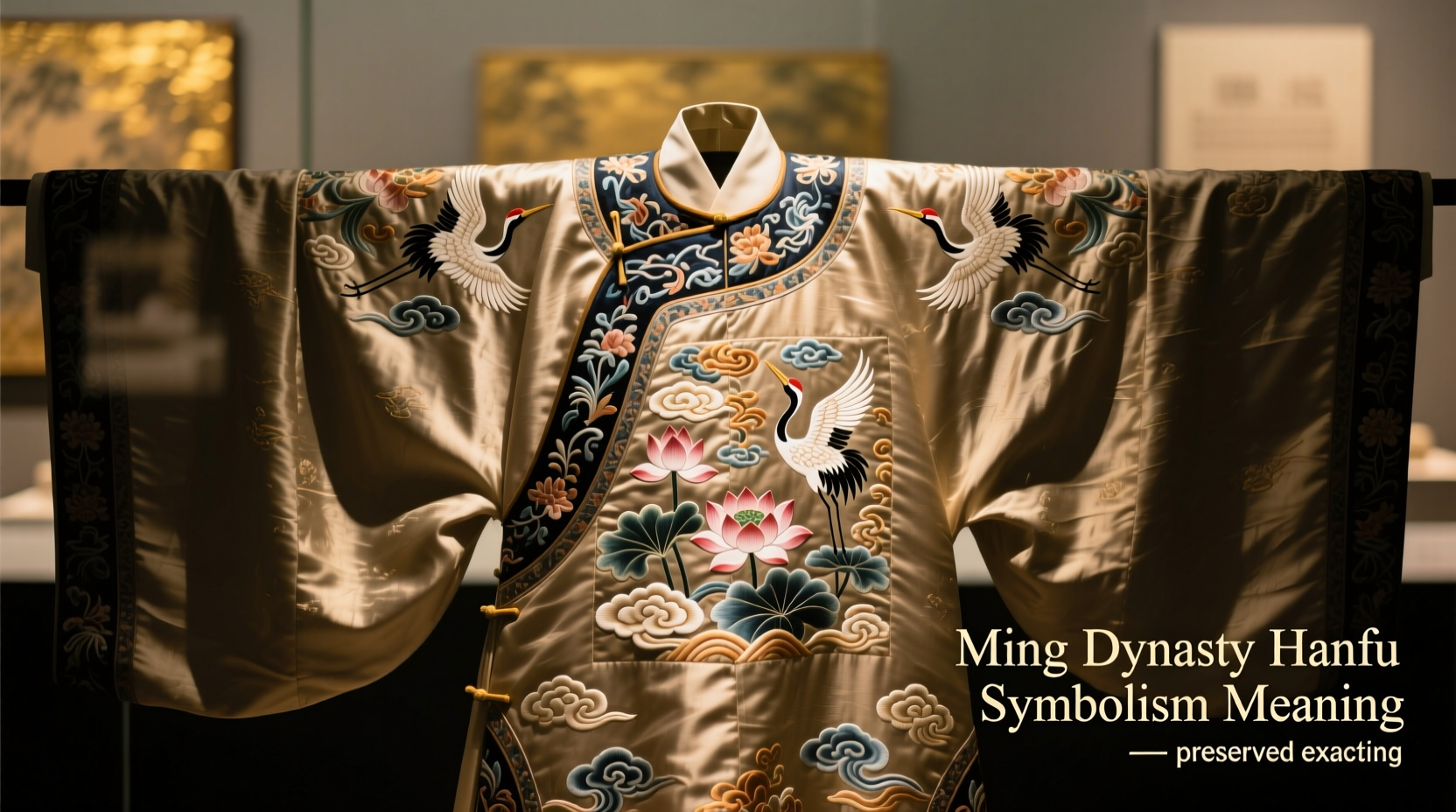
Perhaps the most visually striking symbolic element of Ming Dynasty hanfu is the buzi (补子), or "Mandarin square." These intricately embroidered badges were affixed to the front and back of the yuanlingpao (round-collar robe) worn by civil and military officials. Introduced formally during the Ming era (and later adopted by the Qing), the buzi served as an immediate visual identifier of an official's exact rank and department.
Civil officials wore birds, representing elegance, literary refinement, and the heavens. Military officials wore beasts, representing courage, strength, and the earth. According to the Metropolitan Museum of Art's Heilbrunn Timeline of Art History, these textiles were not just badges of office but masterpieces of silk embroidery that required hundreds of hours of artisan labor.
Civil and Military Buzi Comparison
- 1st Rank Civil: Xianhe (Crane) - Symbolizes longevity and high scholarly achievement.
- 2nd Rank Civil: Jinji (Golden Pheasant) - Represents duty and moral obligation.
- 3rd Rank Civil: Kongque (Peacock) - Denotes beauty, dignity, and cultural refinement.
- 1st Rank Military: Qilin (Mythical Chimera) - Later replaced by the Lion; symbolizes ultimate martial prowess and benevolence.
- 2nd Rank Military: Shizi (Lion) - Represents fearless bravery and protection of the realm.
- 3rd Rank Military: Bao (Leopard) - Denotes agility, ferocity, and strategic warfare.
Structural Symbolism: The Mamianqun and Daopao
Beyond the court, the daily wear of the Ming elite and scholarly classes carried profound structural symbolism. Two garments stand out in their philosophical design: the Mamianqun and the Daopao.
The Mamianqun (Horse-Face Skirt)
The Mamianqun is a wrap-around skirt characterized by flat front and back panels (the "horse faces") flanked by heavily pleated sides. The symbolism here is deeply Confucian. The flat, unpleated panels represent zheng (uprightness and integrity), while the intricate, hidden pleats on the sides represent he (harmony and flexibility). When the wearer walked, the pleats would fan out dynamically, only to settle back into perfect, structured order when standing still—a physical metaphor for the ideal Confucian gentleman or noblewoman who adapts to the world without losing their moral center. For a deeper dive into the preservation of these weaving techniques, the China National Silk Museum in Hangzhou offers extensive archives on Ming-era pleating and loom technologies.
The Daopao (Scholar's Robe)
The Daopao was the quintessential garment of the Ming literati. It featured a cross-collar, wide sleeves, and distinctive side slits that revealed hidden side panels (anbai). These hidden panels were symbolic of modesty and the concealment of one's inner virtues from the vulgar world. The wide sleeves, often large enough to carry scrolls or small items, represented the expansive mind and broad-mindedness expected of a Confucian scholar.
Material Culture: Yunjin Brocade and the Weight of Silk
The symbolism of Ming Dynasty hanfu extended to the very threads used in its creation. The pinnacle of Ming textile art was Yunjin (cloud brocade) from Nanjing. Woven on massive drawlooms requiring two artisans to operate simultaneously, Yunjin incorporated real gold threads, peacock feather filaments, and heavy silk. The use of gold was not merely ostentatious; it was meant to capture the literal light of the sun, elevating the wearer to a celestial status. The Victoria and Albert Museum's Asian Collections frequently highlights the technical mastery of Ming Yunjin, noting how the density of the weave was believed to trap auspicious energy (qi) close to the body.
The Modern Hanfu Revival: Acquiring Ming-Style Garments
Today, the Hanfu Yundong (Hanfu Movement) has sparked a massive global interest in traditional Chinese clothing. When acquiring Ming Dynasty hanfu, understanding the difference between historical reproduction, theatrical costuming, and modern fast-fashion is vital for cultural respect and authenticity.
Buying Guide and Price Tiers
If you are looking to invest in Ming-style garments, here is a practical framework for navigating the market:
- Historical Reproductions ($400 - $2,000+): Brands like Shiyang Jiji or Ming Hua Tang use historically accurate patterns based on extant tomb artifacts (such as those from the Kong Family Mansion or the Dingling Mausoleum). They utilize pure silk, authentic Zhuanghua (brocade) weaves, and natural plant dyes. These are investment pieces meant for serious collectors and formal cultural events.
- High-Quality Artisanal ($150 - $350): Mid-tier brands offer excellent structural accuracy (correct collar angles, proper sleeve curves, authentic Mamianqun pleating) but use modern blended fabrics, rayon, or polyester brocades to keep costs manageable. Ideal for festivals, daily wear, and photography.
- Mass-Market / Fast Fashion ($30 - $80): Often found on global e-commerce platforms. While accessible, these frequently suffer from structural inaccuracies (e.g., left-over-right lapels, incorrect skirt pleating, synthetic fabrics that do not drape correctly). Buyers should research thoroughly to avoid culturally inaccurate "ancient Chinese" costumes.
Cultural Protocol Note: When wearing Ming Dynasty hanfu today, always ensure the collar crosses left-over-right (jiaoling youren). Wearing it right-over-left is universally recognized in Han culture as dressing the deceased and is considered highly inauspicious and disrespectful in living contexts.
Conclusion
Ming Dynasty hanfu is far more than a historical fashion statement; it is a complex, woven text of Chinese philosophy, social structure, and cosmological belief. From the auspicious cranes on a civil official's chest to the hidden pleats of a scholar's skirt, every element was designed to align the wearer with the moral and physical order of the universe. By understanding these deep symbolic roots, modern wearers and historians can appreciate these garments not just as beautiful textiles, but as profound artifacts of human thought.