Traditional Chinese Clothing Men: Hanfu, Changshan & Styles

When curating a wardrobe of traditional Chinese clothing, men have several historically distinct options that reflect thousands of years of evolving aesthetics, philosophy, and social structure. Far from being a single monolithic garment, Chinese menswear encompasses the flowing, structured elegance of the Han dynasty, the tailored pragmatism of the Qing era, and the modernized silhouettes of the 20th century. Whether you are attending a cultural festival, participating in a tea ceremony, or seeking a profound connection to your heritage, understanding the nuances of these garments is essential.
The Classical Silhouette: Hanfu and the Scholar Aesthetic
Hanfu (汉服) translates literally to 'Han clothing' and represents the historical dress of the Han Chinese people prior to the Qing dynasty (1644–1912). For men, the Hanfu silhouette is characterized by its generous use of fabric, flat-pattern cutting, and profound symbolic geometry. According to the China National Silk Museum, the construction of Hanfu relies on a deep respect for natural fibers and the unbroken flow of cloth, avoiding the darts and tailored waistlines common in Western menswear.
Key Menswear Hanfu Styles
- Daopao (道袍): Despite the name translating to 'Taoist robe,' this was the standard everyday garment for Ming dynasty scholars and officials. It features a crossed collar, wide sleeves, and distinctive side slits that reveal an inner layer of fabric, creating a dignified, layered look when walking.
- Shenyi (深衣): A 'deep robe' that connects the upper and lower garments into one piece. It is heavily steeped in Confucian philosophy, with the square collar representing earth and the round sleeves representing heaven.
- Yisan (曳撒): A pleated, martial robe with a crossover collar and a waist seam, originating from Mongol influences during the Yuan and Ming dynasties. It is highly practical and favored today by martial arts practitioners.
Changshan and Magua: The Qing Dynasty Legacy
The establishment of the Qing dynasty brought Manchu rulers to power, resulting in a mandatory shift in Chinese menswear. The flowing sleeves of the Hanfu were replaced by the Changshan (长衫, long shirt) and Magua (马褂, riding jacket). These garments were designed for an equestrian lifestyle, featuring narrower sleeves, horse-hoof cuffs (which could be folded back), and side slits for riding.
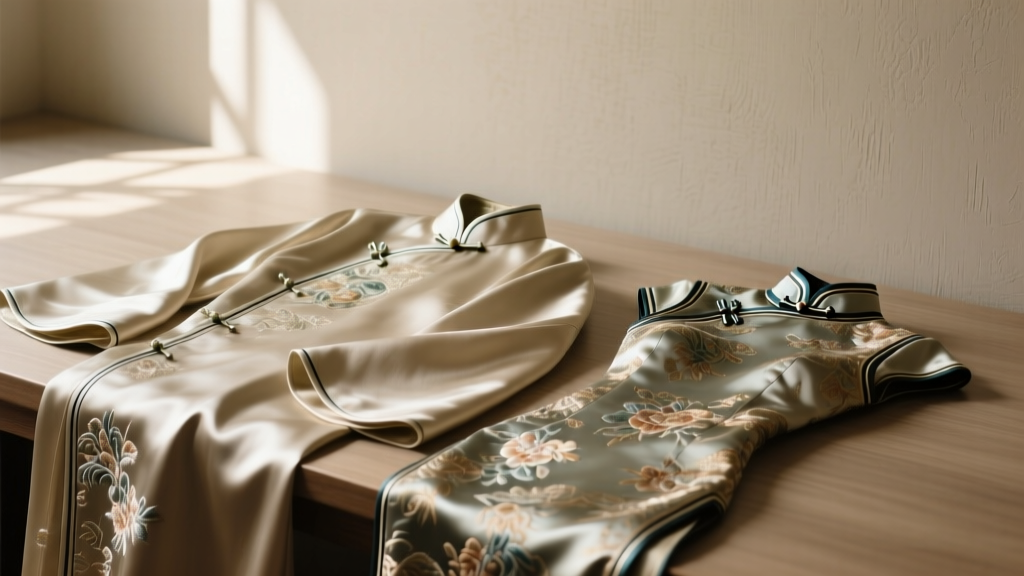
The Changshan is a long, ankle-grazing robe with a Mandarin collar (standing collar) and fastened by Pankou (盘扣) — intricate, hand-knotted frog buttons. During the Republic of China era (1912–1949), the Changshan became the intellectual's uniform, worn by scholars, writers, and revolutionaries alike. The Palace Museum in Beijing houses extensive collections of Qing-era Changshan, showcasing the evolution from heavy, brocaded court robes to the lighter, more understated silk and linen robes worn by 20th-century academics.
The 'Tang Suit' Misnomer
Often sold in Western boutiques as a 'Tang Suit' (唐装), this garment actually has no connection to the Tang dynasty (618–907 AD). It is a modern adaptation of the Qing-era Magua, popularized globally during the 2001 APEC summit when world leaders wore them in Shanghai. Characterized by a Mandarin collar, frog buttons, and stiff brocade fabrics, the modern Tang Suit is a staple for Lunar New Year celebrations and weddings, though it lacks the deep historical roots of true Hanfu.
Comparative Guide: Choosing the Right Garment
To help you navigate the varieties of traditional Chinese clothing for men, the following table breaks down the core differences in construction, era, and modern application.
| Garment | Historical Era | Collar Style | Fastening | Modern Occasion |
|---|---|---|---|---|
| Hanfu (Daopao) | Pre-1644 (Ming) | Crossed (Jiaoling) | Tie strings (Yin-dai) | Festivals, Ceremonies, Hanfu Movement |
| Changshan | Qing to Republic | Mandarin (Standing) | Frog knots (Pankou) | Formal events, Tea ceremonies, Weddings |
| Magua / Tang Suit | Qing / Modern | Mandarin (Standing) | Frog knots (Pankou) | Lunar New Year, Family gatherings |
| Zhongshan Suit | 20th Century | Turn-down / Stand | Buttons (5 front) | State functions, Formal political events |
Fabric Composition and Construction Details
Authentic traditional Chinese clothing relies heavily on the natural properties of its textiles. Because historical Chinese tailoring utilized flat-pattern cutting—where the fabric is folded and cut in straight lines without complex Western-style darts—the drape of the garment is entirely dependent on the weight and weave of the cloth.
- Summer Wear: Ramie and linen are historically accurate for hot weather. Ramie, in particular, has been used in Southern China for millennia due to its breathability and slight stiffness, which holds the structural lines of a Hanfu collar beautifully.
- Everyday Elegance: Mulberry silk (specifically Chou or plain weave silk) offers a subtle sheen and fluid drape, ideal for inner layers and scholarly robes.
- Winter and Formal Wear: Zhijin (brocade) and heavy damask silks are woven with metallic threads or complex geometric patterns. These are reserved for outer layers, wedding garments, and winter robes, providing both insulation and visual weight.
Cultural Protocols: The Rule of the Lapel
When wearing Hanfu or any crossed-collar traditional Chinese garment, one must strictly adhere to the rule of Jiaoling Youren (交领右衽). This dictates that the left side of the collar must cross over the right side, securing on the wearer's right side.
'The right lapel (Youren) is the defining boundary between the living and the dead, between civilization and the wilderness in classical Chinese sartorial philosophy.' — Curatorial notes on Han Dynasty textiles, The Metropolitan Museum of Art.
Crossing the right lapel over the left (Zuoren) is strictly reserved for dressing the deceased for burial, or historically associated with non-Han nomadic tribes. Wearing a garment with the wrong lapel crossover at a cultural event is considered a severe faux pas and a bad omen. Note that this rule applies primarily to Hanfu; Qing-era Changshan and Tang suits, which use center-fastening frog buttons, do not have this specific crossover restriction.
Buying Guide and Price Ranges in 2026
As we navigate the 2026 market for heritage garments, the accessibility of traditional Chinese clothing for men has expanded, but quality varies wildly. Here is what you should expect to invest based on your needs:
1. Mass-Produced / Costume Grade ($30 - $80 USD)
Typically made from polyester blends or synthetic brocades. These garments are widely available on global e-commerce platforms. While they capture the general silhouette, they lack breathability and historical accuracy in their patterns. Suitable for one-off costume parties or casual Lunar New Year photos, but not recommended for serious cultural practitioners.
2. Artisan / Hanfu Brand Grade ($120 - $350 USD)
The modern 'Hanfu Movement' has birthed dozens of specialized brands that collaborate with historians to recreate Ming and Song dynasty patterns. At this price point, expect genuine mulberry silk, accurate flat-cutting techniques, and hand-finished seams. Brands in this tier often provide detailed historical citations with their garments.
3. Bespoke and Master Tailored ($500 - $2,000+ USD)
For a custom-fitted Changshan or a hand-woven brocade Daopao, you will need to commission a master tailor. In cities like Suzhou or Hangzhou, or through specialized diaspora boutiques in North America and Europe, bespoke garments feature hand-rolled hems, custom-knotted Pankou buttons made from the same silk as the robe, and premium natural dyes. This is the tier required for grooms, cultural ambassadors, and serious collectors.
Styling Tips for the Modern Man
Integrating traditional garments into a modern context requires a balance of respect and practicality. If wearing a full Hanfu Daopao, pair it with traditional cloth boots (Xuezi) rather than modern leather dress shoes, which clash with the historical aesthetic. For a more contemporary, fusion look, a well-tailored Qing-style Magua can be worn over a crisp white dress shirt and dark trousers, bridging the gap between Eastern heritage and Western formalwear. Always ensure the garment's shoulder seam sits naturally; because traditional cuts lack shoulder padding, the drape must be supported by your natural posture.