Traditional Chinese Dress for Men: Hanfu to Tang Suits

Navigating the Evolution of Menswear in Chinese History
When exploring traditional Chinese dress for men, it is crucial to understand that 'Chinese clothing' is not a monolith. It is a dynamic tapestry woven from thousands of years of dynastic shifts, philosophical movements, and cross-cultural exchanges. For modern enthusiasts, cultural practitioners, and grooms seeking authentic attire, the landscape is broadly divided into three distinct categories: the ancient Hanfu (pre-1644), the Qing and Republic-era Changshan and Magua, and the contemporary Tangzhuang (Tang Suit).
This comprehensive guide compares these garments across historical context, structural construction, fabric composition, and modern styling protocols, providing you with the exact knowledge needed to select, wear, and respect these cultural artifacts.
Hanfu (汉服): The Pre-Qing Indigenous Silhouette
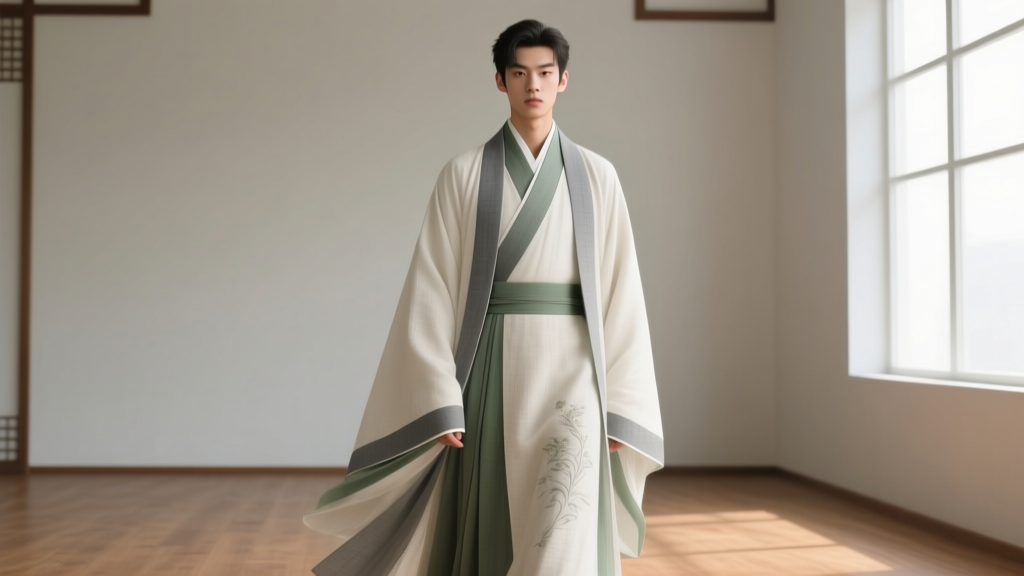
Hanfu translates literally to 'Han clothing' and refers to the traditional dress of the Han Chinese people before the Manchu-led Qing Dynasty imposed new sartorial laws in 1644. For men, Hanfu is characterized by fluid lines, generous fabric usage, and a deep connection to Confucian and Daoist philosophies regarding cosmic order.
Key Male Hanfu Varieties
- Shenyi (深衣 - Deep Robe): Originating in the Han Dynasty (202 BC – 220 AD), this one-piece robe connects the upper garment and lower skirt. It features the iconic jiaoling youren (交领右衽)—a cross-collar that always wraps the left side over the right side, a rule strictly tied to living human etiquette.
- Daopao (道袍 - Daoist Robe): Despite its name, this was the standard daily wear for Ming Dynasty (1368–1644) scholars and officials. It features wide sleeves and distinctive side slits with hidden internal panels (anbai) that maintain modesty and structural drape while walking.
- Yisan (曳撒): A Ming dynasty garment influenced by Mongol military attire. It features a cross-collar, a fitted bodice, and a heavily pleated lower skirt, originally designed for horseback riding and martial arts.
Construction and Sourcing
Authentic Hanfu avoids the use of buttons, relying instead on woven silk ties (jiedai). According to the China National Silk Museum, historical Hanfu utilized specific weaving techniques like Luo (gauze) for summer and heavy brocades for winter. Today, a high-quality, bespoke Ming-style Daopao crafted from authentic mulberry silk will cost between $350 and $800 USD, while mass-market polyester or cotton-linen blends on platforms like Taobao or Etsy range from $45 to $120 USD.
Changshan (长衫) & Magua (马褂): The Qing and Republic Era
The establishment of the Qing Dynasty (1644–1912) brought the Tifa Yifu edict, which forced Han Chinese men to adopt Manchu hairstyles and clothing. This era birthed the silhouettes that Western audiences most commonly associate with historical Chinese menswear.
Anatomy of the Qing Silhouette
The Changshan (long shirt) is a straight-cut, ankle-length robe featuring a Mandarin collar (liling) and side slits for ease of movement. Over this, men wore a Magua (riding jacket), a waist-length jacket with a center-front closure. The defining structural element of this era is the Pankou (盘扣)—intricate, hand-knotted frog buttons made from silk or cotton cords. As noted by the Metropolitan Museum of Art, Qing dynasty textiles were heavily regulated by sumptuary laws, where specific colors, dragon motifs, and rank badges (buzi) denoted strict social hierarchies.
The Republic Era (1912–1949) Adaptation
Following the fall of the Qing Dynasty, the Changshan evolved into the uniform of the intellectual class. Scholars like Lu Xun and Hu Shi famously wore unadorned, dark-colored cotton or wool Changshan paired with Western fedoras and leather oxfords, creating a unique Sino-Western intellectual aesthetic. Today, a tailored wool Changshan for formal events or weddings typically costs between $150 and $400 USD from bespoke tailors in cities like Shanghai or Taipei.
Tangzhuang (唐装): The Modern 'Tang Suit' Misnomer
Despite its name, the Tangzhuang has no historical connection to the Tang Dynasty (618–907 AD). It is a modern hybrid garment created in the late 20th century, based heavily on the Qing Dynasty Magua.
The garment exploded in global popularity during the 2001 APEC Summit in Shanghai, where world leaders were photographed wearing matching red and gold Tangzhuang. Structurally, it features a Mandarin collar, raglan sleeves, and Pankou frog closures, but it incorporates Western tailoring techniques, such as darts and shoulder pads, to create a boxier, more structured fit than its historical predecessors. It is primarily worn today by older generations during the Lunar New Year or by grooms in modern, fusion-style Chinese weddings. Mass-market versions are highly accessible, usually priced between $30 and $90 USD.
Comparative Matrix: Men's Traditional Garments
| Garment Name | Historical Era | Collar Style | Closure System | Best Modern Use Case | Avg. Price (USD) |
|---|---|---|---|---|---|
| Hanfu (Daopao/Shenyi) | Pre-1644 (Han to Ming) | Cross-Collar (Jiaoling) | Fabric Ties | Cultural festivals, Hanfu movement, tea ceremonies | $80 - $600+ |
| Changshan | Qing to Republic (1644-1949) | Mandarin Collar | Pankou (Frog Knots) | Formal weddings, academic events, traditional arts | $150 - $450 |
| Magua | Qing Dynasty | Mandarin Collar | Pankou (Frog Knots) | Layering over Changshan, martial arts uniforms | $70 - $200 |
| Tangzhuang | Modern (Late 20th C.) | Mandarin Collar | Pankou / Hidden Zip | Lunar New Year, family gatherings, casual formal | $30 - $120 |
Fabric Composition and the Luxury Market
The authenticity of traditional Chinese dress for men is heavily dictated by textile choice. While modern interpretations often use polyester brocades for affordability, traditionalists seek out heritage fabrics.
- Xiangyunsha (Gambiered Canton Gauze): A UNESCO-recognized intangible cultural heritage from Guangdong. Silk is dyed with the juice of the薯莨 (Dioscorea cirrhosa) yam and coated with iron-rich river mud, creating a dark, crackled, water-resistant fabric that sounds like rustling paper when worn. Garments made from authentic Xiangyunsha start at $500 and can exceed $2,000 USD.
- Song Brocade (Songjin): Originating from the Song Dynasty, this intricate, warp-faced silk features geometric and floral patterns. It is stiff and heavy, making it ideal for structured outer robes and Magua jackets.
- Ramie and Linen: Historically worn by commoners and scholars seeking a Daoist, unpretentious aesthetic. High-quality, hand-loomed ramie remains a premium summer choice for Hanfu due to its exceptional breathability.
For those sourcing authentic textiles, the Victoria and Albert Museum's Asian collections provide an excellent digital archive of historical Chinese weaving techniques, serving as a benchmark for evaluating the quality of modern reproductions.
Cultural Protocols and Styling Etiquette
Wearing traditional garments requires adherence to specific cultural protocols to avoid severe faux pas.
The Left-over-Right Rule (Youren)
In Hanfu and traditional cross-collar garments, the left lapel must always cross over the right lapel (youren). In traditional Chinese cosmology, the left represents the living and the yang energy, while the right represents the deceased and the yin energy. Wrapping the right side over the left (zuoren) is strictly reserved for dressing the dead for burial or is used in certain ethnic minority clothing. Wearing it incorrectly is considered highly inauspicious.
Footwear and Accessories
The silhouette of traditional menswear extends to the ground, making footwear critical. For Hanfu, traditional black cloth boots with white soles (yunlu) or woven straw sandals are historically accurate. For the Changshan and Tangzhuang, black leather loafers or traditional cloth shoes (lao Beijing buxie) are the standard. Avoid pairing traditional robes with modern athletic sneakers, as the visual dissonance breaks the structural drape of the garment.
Hair and Headwear
Historically, adult Han Chinese men did not cut their hair, instead binding it in topknots secured by jade or wooden hairpins (zan) and covered by scholarly caps (guan or jin). Today, while modern hairstyles are accepted, practitioners of the Hanfu revival often use traditional wooden topknot crowns or minimalist jade pins to complete the silhouette respectfully.
Final Thoughts on Sourcing and Respect
Whether you are investing in a bespoke Ming Dynasty Daopao for a cultural exhibition or purchasing a silk Tangzhuang for a Lunar New Year banquet, understanding the lineage of these garments elevates the wearing experience. Traditional Chinese dress for men is not merely a costume; it is a living archive of philosophy, craftsmanship, and history. By prioritizing natural fibers, respecting structural rules like the jiaoling youren cross-collar, and understanding the historical context of your chosen garment, you participate in the respectful continuation of one of the world's oldest sartorial traditions.