Hanfu Man: A Historical Guide to Men's Traditional Dress

The resurgence of traditional Chinese clothing has sparked a global movement, yet the discourse often disproportionately centers on women's silhouettes. For the modern hanfu man, navigating the rich, three-millennia-old sartorial history of China requires a nuanced understanding of garment construction, dynastic shifts, and cultural philosophy. Hanfu (汉服), literally meaning 'Han clothing,' is not a monolith; it is a dynamic, evolving system of dress that reflects the cosmology, social hierarchy, and aesthetic ideals of Chinese civilization.
This comprehensive guide decodes the historical and cultural foundations of men's Hanfu, offering actionable insights into garment typology, fabric selection, and respectful styling for contemporary practitioners and historians alike.
The Cosmology of the Cut: Foundational Principles
Before examining specific garments, one must understand the structural DNA of Hanfu. Unlike Western tailoring, which relies on darts and complex pattern cutting to contour the body, traditional Chinese dress is rooted in geometric minimalism and fabric conservation. The cloth is cut along straight lines, honoring the integrity of the woven textile.
The most critical defining feature of the hanfu man's wardrobe is jiaoling youren (交领右衽)—the intersecting collar with the right lapel. The left side of the garment crosses over the right, forming a 'y' shape at the neckline. This is deeply tied to Chinese cosmology, where the left (Yang, life, the east) honors the right (Yin, death, the west). Reversing this to zuoren (left lapel over right) is strictly reserved for the deceased or, historically, associated with non-Han 'barbarian' tribes. Getting the collar direction right is the most fundamental rule of cultural respect in Hanfu.
Core Components of the Hanfu Man's Wardrobe
Men's Hanfu is broadly categorized into three structural systems: the separate top-and-trouser system, the one-piece deep robe, and the layered formal outerwear.
Yi (Upper Garments) and Ku (Trousers)
The Yiku (衣裤) system is the oldest form of Chinese dress, dating back to the Shang and Zhou dynasties. The Yi is a cross-collared upper garment, while Ku refers to trousers. Historically, this was the practical, everyday wear for laborers, soldiers, and martial artists. Today, the modern hanfu man often adopts a refined version of the Yiku for casual summer wear or martial arts practice, favoring breathable linen and cotton blends.
Shenyi (The Deep Robe)
Emerging prominently during the Spring and Autumn period and standardizing in the Han Dynasty, the Shenyi (深衣) is a one-piece robe that conceptually unites the upper Yi and lower Chang (skirt). According to the Liji (Book of Rites), the Shenyi's construction is laden with moral symbolism: the round sleeves represent heaven, the square collar represents earth, and the straight back seam represents human integrity. The Curved-Hem Shenyi (Quju) and Straight-Hem Shenyi (Zhiju) remain staple formal garments for scholars and cultural ceremonies today.
Zhiduo and Daopao (Ming Dynasty Outerwear)
For the contemporary hanfu man seeking a dignified, structured silhouette, the Ming Dynasty (1368–1644) offers the Zhiduo (直裰) and Daopao (道袍). Despite its name translating to 'Daoist robe,' the Daopao was the ubiquitous daily formalwear for Ming scholars and officials. It features a crossed collar, wide sleeves, and distinctive hidden side pleats (暗摆) that allow for ease of movement while maintaining a modest, unbroken front drape. The Zhiduo is similar but features open side slits, making it slightly more casual.
Formality and Occasion: Decoding Men's Hanfu Tiers
Understanding when to wear specific garments is crucial for cultural accuracy. The following table outlines the primary tiers of men's Hanfu, their historical contexts, and modern applications.
| Garment Name | Peak Dynasty | Formality Level | Defining Characteristics & Modern Use |
|---|---|---|---|
| Yiku (衣裤) | Zhou / Han | Casual / Utility | Cross-collared top and trousers. Ideal for casual outings, travel, and martial arts. |
| Banjia (半臂) | Tang | Semi-Formal | Half-sleeved jacket worn over an inner garment. Excellent for transitional weather layering. |
| Shenyi (深衣) | Han | Formal / Ritual | One-piece deep robe. Worn for coming-of-age ceremonies (Guan Li), ancestral worship, and graduations. |
| Yuanlingpao (圆领袍) | Tang / Song | Formal / Official | Round-collared robe fastened with a toggle. Often paired with a leather belt and boots. Used for formal banquets. |
| Daopao (道袍) | Ming | High Formal | Cross-collared robe with hidden side pleats. The quintessential scholarly garment for weddings, tea ceremonies, and festivals. |
| Ji Bian Fu (祭服) | Zhou / Ming | Supreme Ritual | Elaborate sacrificial garments featuring the Twelve Symbols of Sovereignty. Reserved for historical reenactments and state-level rituals. |
Fabric, Color, and Motif: The Language of Status
Historically, sumptuary laws strictly dictated what fabrics and colors a man could wear based on his social rank. While these laws no longer apply, understanding them elevates the appreciation of the garments.
Textile Composition
Before the widespread cultivation of cotton in the late Song and Yuan dynasties, the common man's Hanfu was woven from ma (hemp) or ramie, which provided breathable but coarse textiles. The elite wore silk. Today, the China National Silk Museum notes that authentic traditional weaving techniques, such as Yunjin (cloud brocade) and Luodi (gauze), are experiencing a revival. For modern buyers, a high-quality hanfu man's wardrobe should include 100% linen for summer Yiku, mid-weight cotton-linen blends for daily Daopao, and 19-22 momme mulberry silk or jacquard brocade for formal outerwear.
Color Symbolism
In the Han dynasty, black and red were revered, reflecting the elemental theories of water and fire. By the Ming dynasty, the Hongwu Emperor established strict color codes: bright yellow was exclusively for the Emperor, vermilion and deep purples for high-ranking officials, while commoners were restricted to muted earth tones, pale blues, and undyed whites. Contemporary practitioners often lean toward the understated elegance of Song and Ming scholar aesthetics—think celadon, ink blue, charcoal, and bamboo green—reserving vibrant crimsons and golds for wedding attire.
The Modern Hanfu Man: Sourcing and Styling Authentic Pieces
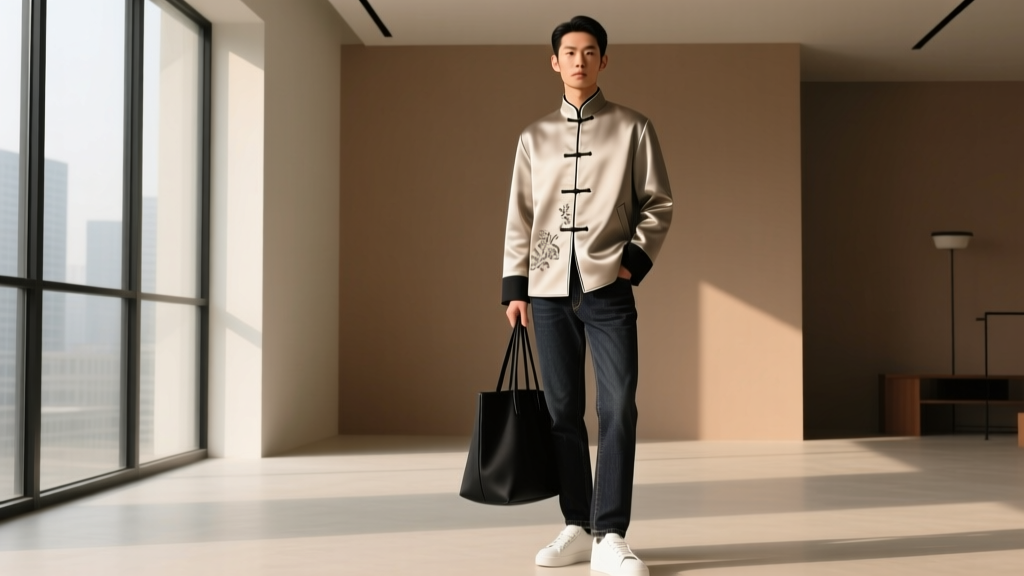
The market is currently saturated with 'ancient costume' (古装) cosplay wear, which often features synthetic fabrics, inaccurate collars, and fantasy embellishments. A discerning hanfu man must differentiate between costume grade and traditional grade.
Price Ranges and Quality Tiers
- Entry-Level / Mass Market ($40 - $90 USD): Typically polyester-cotton blends. While affordable, they lack the drape and breathability of natural fibers. Acceptable for beginners or casual streetwear.
- Mid-Tier / Artisan Brands ($120 - $280 USD): Features natural fibers (linen, ramie, cotton) and accurate historical patterning. Brands in this tier often collaborate with historical consultants to ensure correct jiaoling youren angles and proper sleeve proportions (the sleeve length should ideally extend past the fingertips and fold back).
- High-End / Bespoke ($400 - $1,500+ USD): Custom-tailored garments utilizing genuine silk brocades, hand-woven Xiangyunsha (perfumed cloud gauze), and traditional plant dyeing techniques. These are investment pieces meant for significant life events.
For those researching historical silhouettes, the Metropolitan Museum of Art's Asian Art collection and the Palace Museum digital archives provide invaluable visual references for Ming dynasty court robes and scholar garments, offering a benchmark for authentic proportions and motif placement.
Cultural Protocols and Respectful Wear
Wearing Hanfu is an act of cultural continuity. To wear it respectfully, the modern hanfu man must observe a few key protocols:
- The Collar Rule: Always ensure the left lapel crosses over the right. Double-check this in mirrors and photographs, as camera flipping can inadvertently create a zuoren (funerary) appearance.
- Headwear (Guan and Jin): Historically, a man's hair was never left completely unbound in public. The Guan (formal cap) or Jin (scarf/wrap) is essential for a complete formal look. The Ming dynasty Wangjin (hair net) paired with a Zanju (hairpin) is highly recommended for men with long hair.
- Footwear: Avoid modern sneakers with formal robes. Opt for traditional cloth boots (yunxie), woven straw sandals for rustic aesthetics, or minimalist, unadorned leather loafers in neutral tones for a contemporary fusion that respects the garment's hemline.
- The Sash: Hanfu relies on fabric ties, not buttons. The waist sash should be tied securely but not restrictively, allowing the garment to hang from the shoulders rather than the waist, creating the characteristic flowing, dignified silhouette.
'Clothing is not merely a covering; it is the outward manifestation of inner virtue and societal harmony. When a man dons the Shenyi, he aligns himself with the geometry of the cosmos.' — Adapted from the Liji (Book of Rites)
The journey of the hanfu man is one of historical reclamation and personal expression. By prioritizing accurate construction, natural textiles, and a deep respect for the philosophical underpinnings of the dress, men can honor the legacy of Han civilization while forging a dignified, modern sartorial identity.