Mandarin Collar Other Names: A Tailoring and Craft Guide
The Anatomy of the Stand Collar: Beyond Western Terminology
When Western tailors and fashion historians refer to the upright, unbanded collar commonly seen on Asian traditional garments, they most frequently use the term 'Mandarin collar.' However, this exonym—rooted in 19th-century colonial observations of Qing Dynasty officials—fails to capture the rich sartorial diversity and precise tailoring traditions of the garment's true origins. For cultural garment enthusiasts, bespoke tailors, and historians, understanding mandarin collar other names is essential to appreciating the distinct construction techniques, regional fabrics, and cultural protocols associated with this iconic neckline.
At its core, the stand collar is a band of fabric that encircles the neck without a fold-over leaf. Yet, the architectural execution of this simple band varies wildly from the silk-brocade changshan of Shanghai to the raw-silk bandhgala of Jodhpur. This deep dive explores the regional nomenclature, the structural craftsmanship, and the fabric science that elevates the stand collar from a simple design element to a masterpiece of Asian tailoring.
Mandarin Collar Other Names Across Asian Cultures
To source authentic garments or commission bespoke pieces, one must use the correct regional terminology. The table below maps the Western exonyms to their authentic cultural counterparts, highlighting the specific garments and closure systems that define them.
| Western / Common Name | Authentic Native Term | Cultural Origin | Primary Garment | Distinctive Craft Feature |
|---|---|---|---|---|
| Mandarin Collar | Liling (立领) / Yuanling (圆领) | China | Changshan, Qipao | Continuous bias-cut band with pankou (frog) closures |
| Nehru Collar | Bandhgala (बंदगला) | India | Jodhpuri Suit, Achkan | Stiffly interfaced band with hook-and-eye (dori) closures |
| Mao Collar | Zhongshan Zhuang (中山装) | China | Mao Suit | Notched stand collar designed to fold over or stand rigid |
| Band Collar | N/A (Tailoring Term) | Global / Western | Modern Minimalist Shirts | Straight-grain band, usually lacking traditional Asian closures |
| Grandad Collar | N/A (Colloquial) | UK / Ireland | Casual Linen Shirts | Soft, unstructured band with standard button placket |
Cultural Note: The term 'Mandarin' refers to the bureaucratic class of Imperial China, not the garment itself. According to the The Metropolitan Museum of Art, Qing dynasty court dress (qizhuang) featured highly structured collars that signified rank, making the modern Western umbrella term a vast oversimplification of a complex sartorial hierarchy.
Regional Craftsmanship: A Deep Dive into Construction
The true difference between a mass-produced 'band collar' shirt and an authentic Asian stand-collar garment lies in the inner architecture and the fabric manipulation. Let us examine the craftsmanship of the two most prominent variations.
The Chinese Liling: Bias, Silk, and Pankou
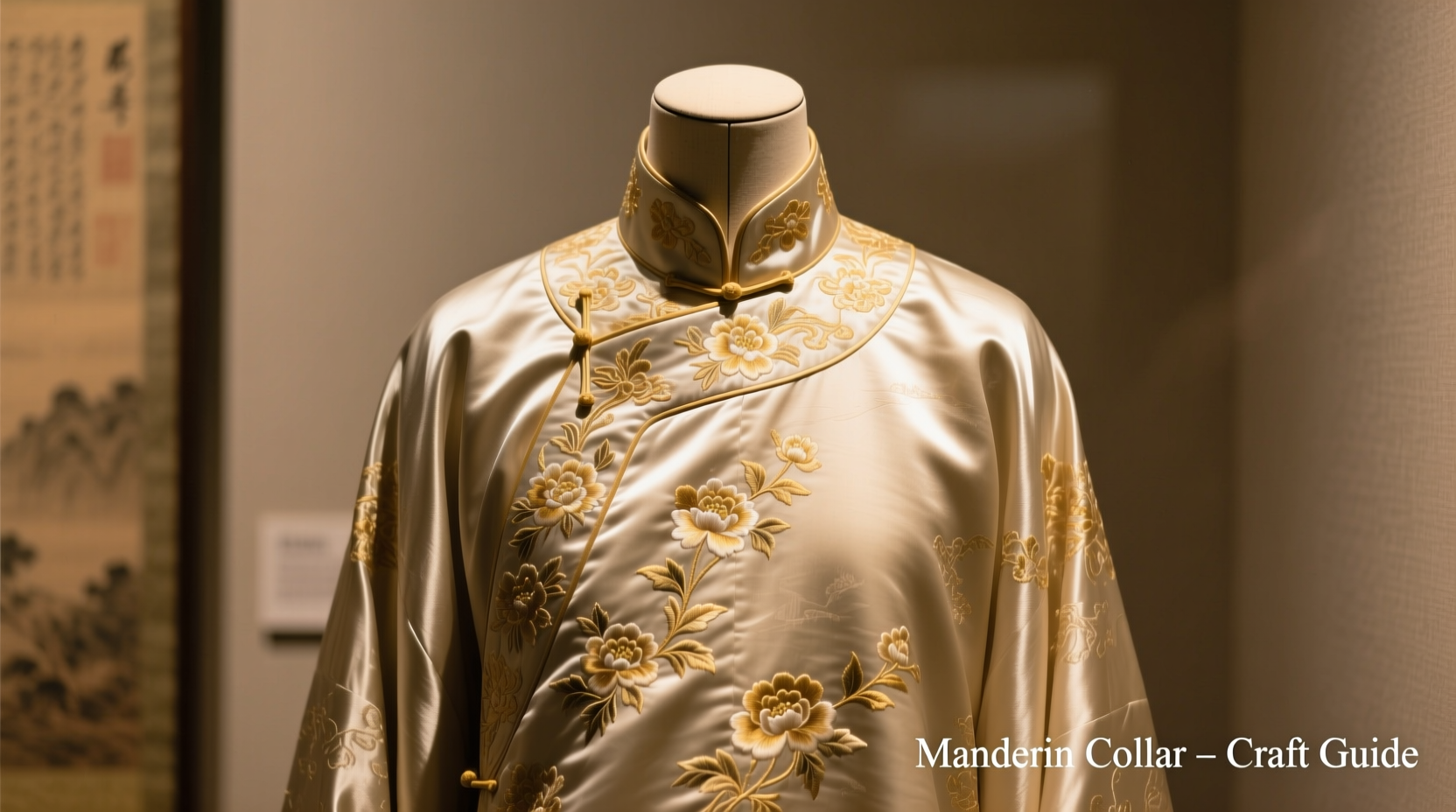
In traditional Chinese tailoring, particularly for the qipao (cheongsam) and the men's changshan, the collar (liling) is a masterclass in tension and drape. Unlike Western shirts that cut the collar band on the straight grain, master tailors in Shanghai and Hong Kong often cut the collar band on the bias (a 45-degree angle to the selvedge). This allows the silk or brocade to stretch and curve organically around the cervical spine, preventing the collar from buckling or gaping away from the neck.
Fabric Selection: Traditional liling collars utilize heavily structured silks. Xiangyunsha (gambiered Guangdong gauze) and Song brocade are favored for their natural body. The inner architecture relies on multiple layers of silk organza or traditional rice-paste stiffening rather than modern synthetic fusibles, ensuring the collar remains breathable in humid climates while maintaining a rigid, elegant posture. The collar is almost always fastened with pankou—hand-knotted silk frog buttons that require the collar edge to be finished with meticulous bias piping.
The Indian Bandhgala: Canvas, Velvet, and Structure
Transitioning to the Indian subcontinent, the 'Nehru collar' finds its authentic expression in the bandhgala (literally 'closed neck'). Originating in Jodhpur, Rajasthan, as a fusion of indigenous achkan tailoring and British suit construction, the bandhgala collar demands an entirely different structural approach.
Interfacing and Padding: A bespoke bandhgala collar is heavily structured. Tailors use layers of horsehair canvas, felt, and sometimes cotton wadding to create a collar that stands perfectly perpendicular to the clavicle. The edge is often finished with a subtle piping or a velvet contrast. According to archives documented by the Victoria and Albert Museum regarding South Asian dress, the rigidity of the Indian stand collar was historically designed to project martial and royal authority, requiring the wearer to maintain an upright, dignified posture.
Closure Mechanics: Instead of buttonholes, the bandhgala utilizes concealed hook-and-eye closures or dori (braided thread) loops, keeping the front facade of the collar and chest entirely unbroken by visible hardware.
The Tailor's Workbench: Step-by-Step Collar Architecture
For those studying garment construction or commissioning bespoke Asian traditional wear, understanding the step-by-step architecture of a premium stand collar is vital. Here is the framework used by master tailors for a traditional changshan:
- Step 1: The Under-Band (Inner Collar): Cut from a soft, moisture-wicking cotton or silk habotai. This sits against the skin and absorbs perspiration, protecting the delicate outer brocade.
- Step 2: The Interlining: A mid-weight silk organza or traditional horsehair canvas is basted to the outer fabric. Modern tailors may use a high-quality woven fusible, but hand-basted canvas provides a superior 'roll' and memory.
- Step 3: The Outer Band: Cut from the primary garment fabric (e.g., Jacquard silk). The grainline is meticulously matched to the center front of the garment to ensure the pattern flows seamlessly from the chest up to the neck.
- Step 4: Edge Finishing: The top edge is finished with a micro-piping (often less than 2mm wide) to prevent fraying and add a crisp, defined silhouette.
- Step 5: Pankou Integration: The knotted buttons are anchored not just to the outer fabric, but sewn through the interlining to distribute tension and prevent tearing.
Sourcing Authentic Garments: Price Ranges and Artisans
When seeking out garments featuring these traditional collars, buyers must differentiate between fast-fashion interpretations and authentic craftsmanship. The price reflects the labor-intensive nature of the inner architecture and hand-finishing.
Chinese Changshan and Qipao
An off-the-rack, machine-made polyester tang suit with a basic fused collar can be found for $40 to $80. However, a bespoke qipao or changshan featuring a hand-basted bias collar, authentic Song brocade, and hand-tied pankou crafted by a master tailor in Shanghai or Hong Kong will typically range from $600 to $2,500 USD. The Kyoto Costume Institute Digital Archives frequently highlights the immense value of these preserved silk garments, noting that the collar construction alone can take a master artisan up to eight hours of hand-stitching.
Indian Bandhgala Suits
A factory-produced 'Nehru jacket' made from poly-blend fabrics with a flimsy interlining usually retails between $100 and $250. Conversely, a bespoke bandhgala from a heritage tailor in Jodhpur or Mumbai, utilizing pure raw silk or Italian wool with a hand-padded horsehair canvas collar, ranges from $800 to $3,000 USD. The investment here is in the structural integrity; a properly canvassed bandhgala collar will retain its rigid, regal posture for decades without collapsing.
Conclusion: Respecting the Nomenclature and the Craft
While 'mandarin collar other names' like band, grandad, or Nehru provide useful shorthand in Western retail, they strip the garment of its profound cultural and technical context. Whether you are examining the bias-cut silk liling of a Shanghai qipao, the heavily canvassed bandhgala of an Indian groom, or the utilitarian notch of a Zhongshan zhuang, the stand collar remains one of the most technically demanding and culturally significant elements in global tailoring. By using the correct native terminology and understanding the intricate fabric science beneath the collar band, we honor the living traditions and master artisans who continue to shape Asia's sartorial heritage.