Kimono vs Hanfu: A Historical & Cultural Comparison Guide

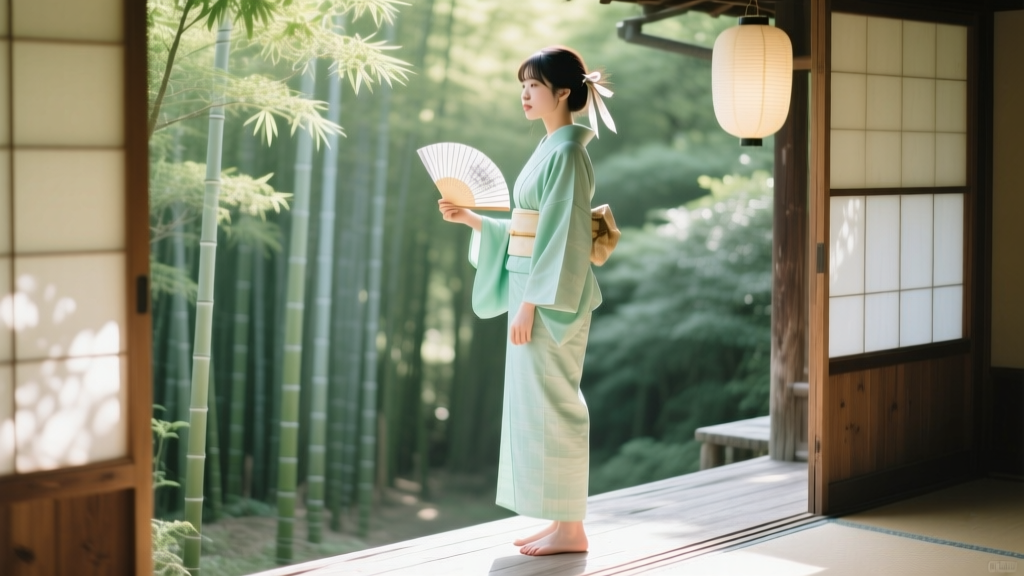
When discussing East Asian sartorial heritage, enthusiasts and historians frequently engage in the kimono vs hanfu comparison. While both garments represent centuries of refined textile artistry and profound cultural philosophy, they are fundamentally distinct in their construction, historical evolution, and modern revival. Understanding the nuances between China’s Hanfu and Japan’s Kimono requires looking beyond their shared Silk Road origins to examine the unique geometric, social, and aesthetic frameworks that define each tradition.
The Roots of Silk: Tracing the Lineage from Tang China to Edo Japan
To accurately compare these garments, one must first acknowledge their historical intersection. The earliest iterations of Japanese clothing were heavily influenced by Chinese garments introduced during the Han and Tang dynasties (206 BCE – 907 CE). Diplomatic missions to Tang China brought back not only silk-weaving techniques but also the foundational concepts of collar wrapping and wide sleeves.
However, the divergence occurred as both cultures isolated and evolved. In China, Hanfu (literally 'Han clothing') continued to mutate through the Song, Yuan, and Ming dynasties, adapting to shifting court protocols, nomadic influences, and changing loom technologies. In Japan, following the cessation of official missions to China in the late 9th century, the Heian period (794–1185) birthed a uniquely Japanese aesthetic. The clothing flattened, straightened, and evolved into the Kosode, the direct ancestor of the modern Kimono, which was later codified during the Edo period (1603–1867) under the Tokugawa shogunate.
Structural Anatomy: Geometry and the Art of Draping
The most critical distinction in the kimono vs hanfu debate lies in pattern cutting and structural geometry. Both traditions historically utilize flat, straight-line cutting to preserve the integrity of the woven textile, but their approach to the human form is radically different.
Hanfu: The Architecture of Flowing Proportions
Hanfu is characterized by its emphasis on drape, movement, and the concealment of the body's natural contours through layered volume. A defining feature is the Jiaoling Youren—the crossing collar where the left side of the garment wraps over the right side. (Wrapping right-over-left is strictly reserved for dressing the deceased in traditional Han mortuary rites).
Hanfu is broadly categorized into several silhouettes:
- Shenyi (Deep Robe): A one-piece robe that connects the top and bottom, symbolizing the unity of heaven and earth.
- Ruqun: A two-piece ensemble consisting of a short top (ru) and a long, flowing wrap-around skirt (qun), often tied high on the chest or waist.
- Aoqun: Popular in the Ming Dynasty, featuring a longer, lined or padded top worn over a skirt, notably the pleated Mamianqun (horse-face skirt).
Fastening is achieved entirely through fabric ties and sashes; buttons are historically rare and largely absent in orthodox Hanfu construction.
Kimono: The T-Shaped Canvas and the Ohashori
The Kimono (literally 'thing to wear') is constructed from a Tanmono—a standard bolt of fabric approximately 36 centimeters wide and 11.5 meters long. The garment is cut into straight panels and sewn with minimal curves, creating a T-shaped silhouette that acts as a canvas for surface design rather than structural tailoring.
Unlike Hanfu, which is tied at the waist or chest and allowed to fall to the floor, a Kimono's length is adjusted to the wearer's height via the Ohashori. This is a deliberate fold of excess fabric tucked under the Obi (sash) at the waist. The art of dressing, known as Kitsuke, requires a complex system of undergarments (Juban), padding, and stiff ties to create a smooth, cylindrical silhouette that suppresses the body's natural curves.
Comparative Breakdown: Hanfu vs Kimono at a Glance
| Feature | Hanfu (Chinese) | Kimono (Japanese) |
|---|---|---|
| Collar Protocol | Left lapel over right (Jiaoling Youren) | Left side wrapped over right side |
| Silhouette | A-line, flowing, emphasizes drape and volume | Cylindrical, straight, suppresses body curves |
| Length Adjustment | Hiked up via sash ties for mobility, no folded tuck | Ohashori (folded tuck at the waist) |
| Primary Fastening | Fabric ties, waist sashes | Complex Obi knots, stiff inner ties |
| Formal Footwear | Cloud-head shoes, wooden clogs (Mu) | Zori sandals with Tabi split-toe socks |
The Language of Textiles: Motifs, Seasons, and Philosophy
According to archives maintained by the Kyoto Costume Institute, the surface decoration of East Asian garments serves as a complex visual language. However, the application of this language differs vastly between the two cultures.
In traditional Hanfu, motifs are often deeply symbolic, rooted in Daoist philosophy, imperial hierarchy, and auspicious blessings. Dragons, phoenixes, peonies, and the 'Twelve Symbols of Sovereignty' denote rank and cosmic harmony. The fabric itself—whether it is Suzhou song brocade or Hangzhou silk gauze—often features woven patterns that catch the light dynamically as the wearer moves.
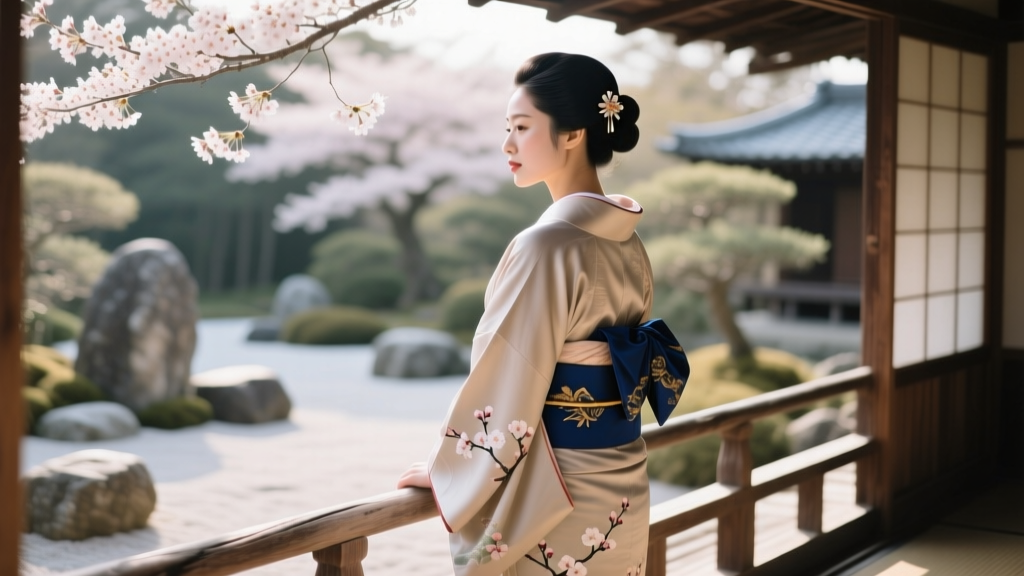
Conversely, the Kimono is governed by a strict adherence to seasonality, known as Kacho-fugetsu (flowers, birds, wind, and moon). As documented by the Metropolitan Museum of Art, a formal Kimono’s motifs must anticipate the season by roughly two to three weeks. Wearing a maple leaf motif in autumn is acceptable, but wearing cherry blossoms after they have bloomed in real life is considered a sartorial faux pas. Techniques like Yuzen resist-dyeing allow for highly pictorial, painterly landscapes to be stretched across the back seams of the garment.
'While Hanfu seeks to harmonize the wearer with the cosmic order through flowing volume and symbolic geometry, the Kimono transforms the wearer into a living, seasonal landscape through structured restraint and pictorial dyeing.'
Modern Revival and Sourcing: What Collectors Should Know
The contemporary landscapes for acquiring and wearing these garments are as distinct as their histories. The early 2000s sparked the Hanfu Yundong (Hanfu Movement), a grassroots cultural revival among Chinese youth seeking to reclaim pre-Qing dynasty sartorial identity. Today, Hanfu is widely worn on city streets, subways, and during traditional festivals.
Because the Hanfu industry is largely driven by a booming e-commerce and social media market, prices are highly accessible. Mass-produced, historically inspired sets from reputable Taobao brands (such as Shisan Yu or Ming Huatang) range from $50 to $150 USD. Bespoke, museum-replica sets utilizing authentic Ming-dynasty weaving techniques and real gold thread can cost between $800 and $3,000+ USD.
The Kimono market, meanwhile, operates on a dual track of high-end artisan craftsmanship and a massive vintage recycling economy. While everyday cotton Yukata cost around $40 to $100 USD, formal silk Kimono (Houmongi or Furisode) purchased new from a Gofuku-ya (kimono merchant) in districts like Kyoto’s Nishijin involve months of hand-weaving and dyeing, commanding prices from $3,000 to well over $10,000 USD. For enthusiasts and collectors, Japan’s network of 'Recycle Shops' offers a treasure trove of mid-century vintage silk Kimono and Obi for $30 to $200 USD, providing an affordable entry point into authentic, high-quality textiles.
Preserving the Integrity of the Garment
Whether one is drawn to the sweeping, wind-sculpted elegance of a Ming Dynasty Aoqun or the quiet, structured poetry of an Edo-period Komon, respecting the cultural protocols of these garments is paramount. The kimono vs hanfu comparison is not a competition of superiority, but a study in how two magnificent civilizations took the shared gift of silk and wove it into entirely distinct expressions of human identity. For museums, collectors, and modern wearers alike, preserving the accurate terminology, structural integrity, and historical context of these garments ensures their legacy will endure for centuries to come.