Kimono Hanfu Textile Arts: Fabric & Craftsmanship Deep Dive

The Loom of History: Tracing Kimono Hanfu Textile Lineages
When curators, collectors, and cultural enthusiasts research kimono hanfu textile histories, they are engaging with a comparative study of two of the world’s most sophisticated garment traditions. While both the Japanese kimono and Chinese hanfu share ancient roots in East Asian sericulture, their evolutionary paths diverged dramatically, resulting in distinct weaving philosophies, dyeing methodologies, and structural tailoring. The shared origin of silk cultivation—dating back to the Neolithic Yangshao culture and later transmitted to the Japanese archipelago via the Korean peninsula during the Yayoi period—laid the groundwork for a shared reverence for the silkworm. However, by the time of the Ming Dynasty in China and the Edo Period in Japan, the textile arts had developed highly localized, fiercely protected regional identities.
Understanding the craftsmanship behind these garments requires moving beyond surface-level aesthetics to examine the microscopic twist of silk threads, the chemical alchemy of natural dyes, and the zero-waste geometry of traditional cutting. This deep dive explores the material culture that defines these iconic garments.
Silk Weaves and Fabric Composition: Tang Silk vs. Nishijin-ori
The foundation of both traditions is silk, yet the manipulation of the silk filament creates vastly different textile behaviors. Chinese hanfu relies heavily on the interplay of light and shadow through complex structural weaves, while Japanese kimono silks often prioritize a matte, pebbled canvas that serves as a backdrop for surface-level embellishment.
Chinese Hanfu Textiles: Brocades and Gauzes
Traditional Hanfu utilizes a rich vocabulary of weaves. Luo (gauze) and Sha (leno weave) are prized for summer garments due to their breathable, open structures that maintain a crisp drape. The Ming Dynasty popularized Zhuanghua (brocade weaving), where supplementary weft threads are introduced to create raised, shimmering motifs. The renowned Shu brocade of Sichuan and Song brocade of Suzhou remain the pinnacle of Hanfu textiles, characterized by their heavy weight, structural integrity, and complex geometric or floral patterns woven directly into the fabric.
Japanese Kimono Silks: Chirimen and Rinzu
Japanese kimono craftsmanship is epitomized by Chirimen (silk crepe). The secret to Chirimen lies in the extreme twisting of the weft threads—up to 3,000 twists per meter—before weaving. When the fabric is washed and the tension released, it shrinks and creates a distinctive pebbled surface known as shibo. This texture not only prevents wrinkles but also absorbs dyes beautifully, making it the premier canvas for Yuzen dyeing. Another staple is Rinzu (silk damask), which uses a satin weave structure to create subtle, tone-on-tone patterns that catch the light without overpowering the painted motifs.
| Garment | Weave Name | Texture & Drape | Primary Use |
|---|---|---|---|
| Hanfu | Luo (Gauze) | Sheer, breathable, crisp | Summer Ruqun, lightweight outer layers |
| Hanfu | Zhuanghua (Brocade) | Heavy, structured, raised motifs | Ming-style Mamianqun, winter jackets |
| Kimono | Chirimen (Crepe) | Pebbled, matte, fluid drape | Formal Komon and Houmongi kimono |
| Kimono | Nishijin-ori (Brocade) | Stiff, metallic, highly ornate | Formal Obi sashes, Uchikake wedding robes |
The Art of Color: Yuzen Dyeing vs. Xiangyunsha and Su Embroidery
While the loom provides the structure, the application of color and pattern provides the soul. The dyeing and embellishment techniques of the kimono and hanfu represent some of the most labor-intensive artisan processes in the world.
Kyo-Yuzen and the Pictorial Canvas
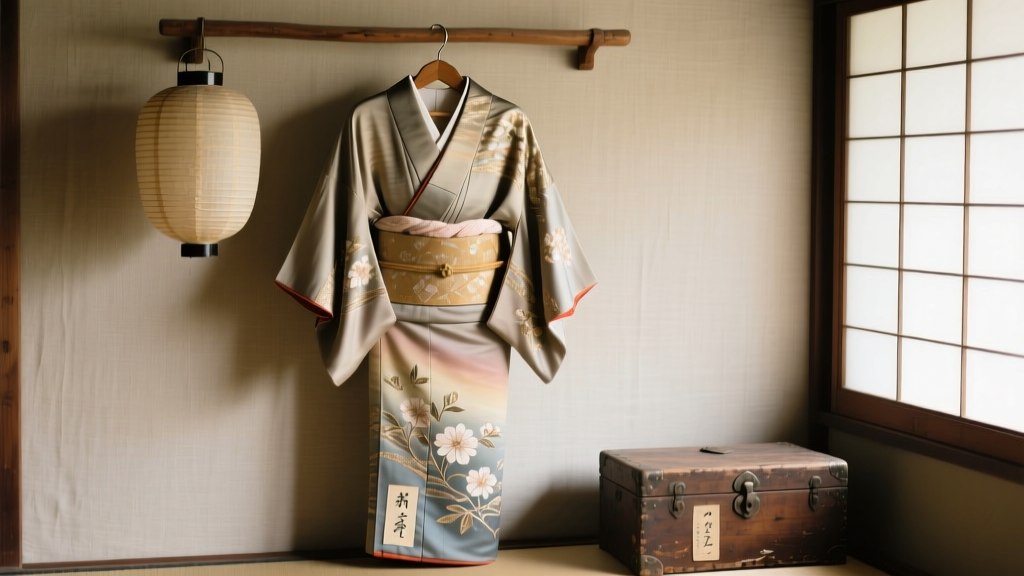
Developed in the late 17th century by Miyazaki Yuzensai, Kyo-Yuzen revolutionized Japanese textile arts. Artisans use a rice-paste resist (itome-nori) to draw intricate outlines on the silk, preventing colors from bleeding. This allows for highly detailed, pictorial designs featuring landscapes, flora, and fauna that mimic the brushstrokes of traditional Japanese painting. A single Yuzen kimono can require the collaboration of over a dozen specialized artisans, from the pattern designer to the gold-leaf applicator.
Xiangyunsha and Su Embroidery
In the realm of Hanfu, the Cantonese Xiangyunsha (fragrant cloud silk) represents a triumph of ecological dyeing. Woven silk is repeatedly dyed in the tannin-rich juice of the Dioscorea cirrhosa tuber and then coated with iron-rich river mud. A chemical reaction between the tannin and iron creates a luxurious, dual-toned fabric—deep brown on one side and glossy black on the other—with a distinctive crackle effect and water-resistant properties. Furthermore, Su embroidery from Suzhou is frequently applied to Hanfu collars and cuffs, utilizing silk threads split into 1/48th of their original thickness to achieve photorealistic shading and seamless color gradients.
Tailoring and Construction: Straight Lines and Structured Drapes
Both the kimono and hanfu adhere to a fundamental philosophy of zero-waste tailoring: the straight-line cut. Unlike Western tailoring, which cuts fabric to conform to the body’s curves, East Asian traditional garments are constructed from rectangular panels. The silhouette is created entirely through the art of dressing and wrapping.
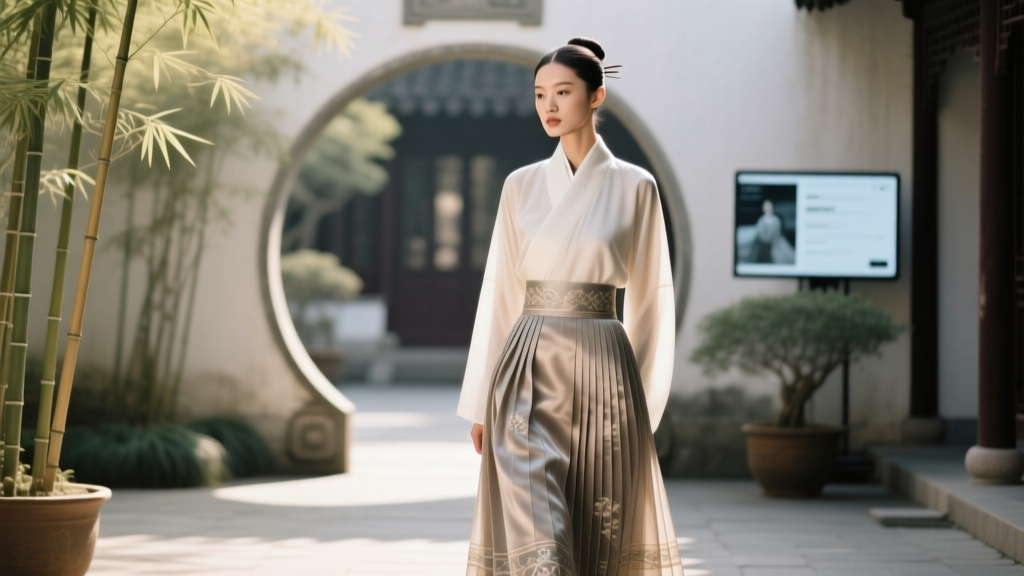
However, their structural executions differ. The Hanfu Jiaoling Youren (cross-collar, right lapel) relies on precise geometric ratios to ensure the collar sits perfectly against the neck without gaping. The Ming Dynasty Mamianqun (horse-face skirt) is a masterclass in pleating, featuring two overlapping flat panels flanked by knife pleats that remain perfectly flat when standing but expand dynamically during movement. Conversely, the kimono’s silhouette is heavily dependent on the Obi (sash) and the art of Kitsuke (dressing). The straight panels of the kimono are folded and tucked at the waist to adjust the hem length, creating the iconic Ohashori (waist tuck), a structural necessity that has become a defining aesthetic feature of the garment.
"The beauty of the straight-line cut lies not in its simplicity, but in its demand for perfection in the textile. Because there are no darts or curved seams to hide imperfections, the weave, the dye, and the drape of the silk must be absolutely flawless." — Curator of Asian Textiles, Victoria and Albert Museum.
Artisan Economics: Pricing and Sourcing Authentic Garments
For collectors and practitioners looking to acquire authentic pieces, understanding the economics of these living traditions is crucial. The price disparity between mass-market reproductions and artisan-crafted garments is vast.
- Authentic Hanfu: Mass-produced polyester or basic cotton Hanfu ranges from $40 to $120. However, bespoke, artisan-crafted Hanfu utilizing authentic Ming-style Zhuanghua brocade or genuine Xiangyunsha silk from heritage mills in Guangdong and Suzhou typically ranges from $600 to $2,500. Brands like Minghuatang command premium prices for their historical accuracy and use of museum-grade textiles.
- Authentic Kimono: Vintage silk kimono from the mid-20th century can be sourced for $150 to $500, though they often require professional cleaning (arai-hari). A newly commissioned, artisan-dyed Kyo-Yuzen kimono, complete with a hand-woven Nishijin-ori Obi and custom tailoring, represents a significant investment, easily ranging from $5,000 to over $20,000.
Preserving the Threads: Museums and Living Treasures
The survival of these complex textile techniques relies on institutional preservation and the dedication of designated Living National Treasures. Researchers and enthusiasts can study the material evolution of these garments through world-class archives. The China National Silk Museum in Hangzhou offers unparalleled access to the evolution of Hanfu weaves, housing fragments dating back to the Han Dynasty alongside modern loom reconstructions. In Japan, the Kyoto National Museum maintains an exquisite collection of Edo-period kosode, showcasing the transition from woven patterns to surface-level Yuzen dyeing. Furthermore, the Victoria and Albert Museum in London provides a global perspective, holding comparative collections that highlight the export and cross-cultural pollination of East Asian silk textiles during the 18th and 19th centuries.
Ultimately, the study of kimono and hanfu craftsmanship is not merely an exercise in fashion history; it is an exploration of how two distinct cultures engineered the very fibers of their environment to express identity, philosophy, and aesthetic perfection.