Is a Kimono Chinese or Japanese? A Cultural Garment Guide

When navigating the rich tapestry of East Asian heritage, a common question arises among collectors, travelers, and fashion enthusiasts: is a kimono Chinese or Japanese? The definitive answer is that the kimono is unequivocally Japanese. However, the complete truth is far more nuanced. The Japanese kimono did not emerge in a cultural vacuum; it is the result of a millennia-long sartorial dialogue, heavily influenced by ancient Chinese dynastic fashion before evolving into a distinctly Japanese masterpiece.
To truly understand the kimono—and to confidently distinguish it from Chinese garments like the Hanfu or the Qipao—one must examine the linguistic clues, historical divergence, and precise structural anatomy of these iconic garments. This guide provides a deep dive into the origins, construction, and cultural protocols of East Asian dress.
Linguistic Clues: Gofuku, Wafuku, and the Kimono
The very terminology used in Japan to describe traditional clothing hints at its cross-cultural origins. The word kimono (着物) literally translates to "thing to wear" (ki = wear, mono = thing). It is a generic term that only became synonymous with the T-shaped robe in the late 19th century to distinguish native dress from Western clothing (yōfuku).
Historically, traditional Japanese clothing was referred to as gofuku (呉服). The prefix Go refers to the ancient Wu dynasty of China, indicating that the earliest weaving and sewing techniques were imported from the Chinese mainland. Today, high-end kimono fabric shops in Japan are still called gofukuya. Conversely, wafuku (和服) translates to "Japanese clothing," a term solidified during the Meiji Restoration to foster a distinct national identity. Thus, while the roots of the weaving techniques honor Chinese antiquity, the garment known globally as the kimono is entirely Japanese.
Historical Divergence: From Tang Dynasty to Heian Period
To understand how the kimono became Japanese, we must look to the Nara period (710–794 CE). During this era, Japan actively sent envoys to Tang Dynasty China, importing everything from Buddhism and tea culture to courtly fashion. Early Japanese aristocrats wore garments that closely mirrored Chinese Hanfu, characterized by flowing, cross-collared robes and divided skirts.
The Heian Period and the Birth of the Kosode
The pivotal shift occurred in 794 CE, marking the beginning of the Heian period. Japan ceased its official diplomatic missions to China, turning inward to refine its own culture. Stripped of the need to emulate the Chinese court, Japanese nobility began to experiment with indigenous aesthetics. They developed the kosode (小袖), meaning "small sleeve." Originally worn as an undergarment beneath the lavish, multi-layered Chinese-style court robes (jūnihitoe), the kosode eventually emerged as the primary outer garment for all social classes by the Muromachi period (1336–1573). This straight-seamed, T-shaped kosode is the direct, undisputed ancestor of the modern Japanese kimono.
Structural Anatomy: Kimono vs. Hanfu vs. Qipao
Superficial similarities often lead to the confusion of East Asian garments. However, a master tailor or cultural historian can identify a garment's origin through its cut, fastening mechanisms, and silhouette. According to the Victoria and Albert Museum's extensive textile archives, the Japanese kimono is defined by its straight-line construction, whereas Chinese garments utilize distinct geometric and tailoring philosophies.
| Feature | Japanese Kimono | Chinese Hanfu | Chinese Qipao (Cheongsam) |
|---|---|---|---|
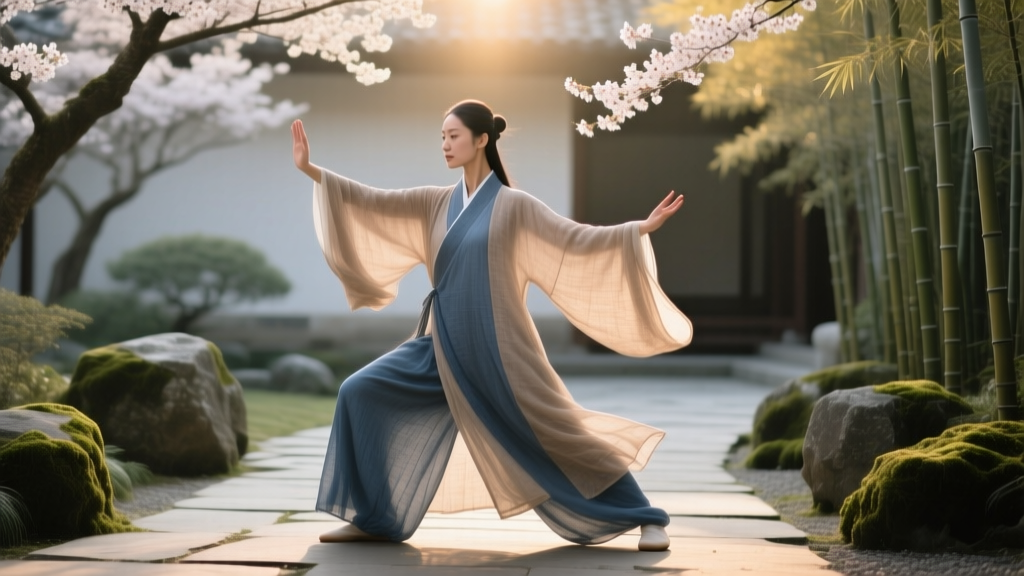
| Silhouette | Cylindrical, T-shaped, conceals the body's natural curves. | Flowing, A-line or voluminous, emphasizing movement and drape. | Form-fitting, tailored to accentuate the natural curves of the body. |
| Construction | Cut from straight, uncurved strips of fabric (tanmono); zero waste. | Often features curved armholes, gussets, and varied panel widths. | Western-influenced tailoring with darts, set-in sleeves, and side slits. |
| Collar | Thick, padded collar sitting away from the nape of the neck. | Thinner cross-collar (jiaoling youren) sitting flush against the neck. | Mandarin collar (Yuanling) standing upright around the neck. |
| Fastening | No buttons. Secured by a wide, structured brocade belt (obi). | No buttons. Secured by soft silk sashes or jade-weighted belts. | Secured by intricate knotted frog buttons (pankou) and hidden zippers. |
| Sleeves | Rectangular, attached to the body with an open underarm gap. | Can be exceptionally wide and long, often fully attached or curved. | Short, cap, or sleeveless; set-in with Western tailoring techniques. |
Fabric, Motif, and Cultural Protocols
Beyond the cut, the textiles and motifs serve as a geographic fingerprint. The Metropolitan Museum of Art's Heilbrunn Timeline of Art History details how Chinese silk weaving techniques like Kesi (cut silk tapestry) and the four major schools of regional embroidery (Su, Shu, Yue, and Xiang) heavily favor auspicious motifs: dragons, phoenixes, peonies, and bats (symbolizing good fortune).
Japanese Textile Traditions
Japanese kimono textiles, while historically indebted to Chinese silk, developed highly localized techniques. Yuzen dyeing, invented in the 17th century, allows for intricate, pictorial designs resembling painted scrolls, featuring native flora like cherry blossoms, maple leaves, and cranes. Furthermore, Nishijin-ori brocades from Kyoto are renowned for their dense, metallic thread work. The kimono is also governed by strict seasonal protocols; wearing a motif of autumn bellflowers in the spring is considered a significant cultural faux pas.
The Protocol of the Lapel
Both Japanese kimono and Chinese Hanfu share the rule of left over right (the left lapel crosses over the right). In Japan, this is known as sashimono. Crossing the garment right-over-left is strictly reserved for dressing the deceased for burial. While this rule originated in ancient China (where the "barbarian" tribes were noted for wearing right-over-left), it was codified into Japanese law during the Yoro Code of 718 CE and remains a vital cultural protocol today.
Buying and Wearing: Avoiding Cultural Conflation
For collectors and enthusiasts looking to acquire authentic garments, understanding the market and price ranges is essential to avoid purchasing mislabeled "pan-Asian" costume pieces.
Price Ranges and Authenticity Markers
- Authentic Japanese Kimono: Vintage silk kimono can be found in Tokyo's recycle shops (like Tansu-ya) for $50 to $300 USD. However, a brand new, custom-tailored formal Furisode (long-sleeved kimono for unmarried women) crafted with genuine Yuzen dyeing and Nishijin brocade obi will range from $3,000 to over $10,000 USD. Look for the tanmono bolt width (approx. 36cm) as a marker of authenticity.
- Authentic Chinese Hanfu: The modern Hanfu revival movement has spurred high-quality production. Reputable Taobao brands (e.g., ShisanYu, Zhongzheng) offer historically inspired Ming or Song dynasty sets ranging from $80 to $250 USD. Custom, hand-embroidered silk Hanfu from artisan cooperatives in Suzhou can exceed $1,500 USD.
- Authentic Qipao: A bespoke, tailored Qipao from a master tailor in Shanghai or Hong Kong, featuring genuine silk crepe and hand-rolled frog buttons, typically starts around $400 USD and can reach $2,000+ USD for intricate Su embroidery.
"When we ask if a garment is Chinese or Japanese, we are really asking about the lineage of human ingenuity. The kimono is a triumph of Japanese structural engineering—a garment that folds flat, wastes no fabric, and adapts to the wearer's body through the art of the obi, rather than forcing the body to adapt to the garment."
— Curatorial notes on East Asian Dress, National Museum of Asian Art
Conclusion: Respecting the Lineage
So, is a kimono Chinese or Japanese? It is a Japanese garment, born from the womb of ancient Chinese cultural exchange, but raised and refined by centuries of isolated Japanese aesthetic philosophy. By understanding the distinct T-shaped construction of the kimono, the flowing cross-collars of the Hanfu, and the tailored elegance of the Qipao, enthusiasts can engage with Asian traditional garments with the accuracy, respect, and cultural appreciation they deserve.