Traditional Chinese Garments: A Cultural History Guide

The study of chinese garments is an exploration of one of the world's oldest and most continuous textile traditions. Spanning over three millennia, the evolution of clothing in China is not merely a record of changing fashions, but a visual language of cosmology, social hierarchy, and philosophical shifts. From the flowing, unstructured silhouettes of ancient Hanfu to the precision-tailored elegance of the 20th-century Qipao, traditional Chinese dress reflects the profound relationship between the wearer, the natural world, and the cosmos.
This historical and cultural guide examines the foundational elements of Chinese sartorial heritage, the mastery of indigenous textiles, and the practical realities of sourcing and wearing these garments in the modern era.
The Foundations: Hanfu and the Cross-Collar Tradition

Hanfu, the traditional dress of the Han Chinese, dominated the sartorial landscape from the legendary Yellow Emperor (c. 27th century BCE) until the mid-17th century. Unlike Western tailoring, which historically sought to sculpt fabric to the three-dimensional contours of the body, traditional Hanfu construction is inherently two-dimensional. Garments are cut from straight widths of woven silk, minimizing waste and honoring the integrity of the textile.
Shenyi and Ruqun: Anatomy of the Silhouette
The most defining characteristic of Hanfu is the jiaoling youren—the cross-collar wrapping to the right. The left lapel crosses over the right, a rule deeply rooted in ancient Chinese cosmology where the left (associated with yang and life) respects and covers the right (associated with yin and death). Reversing this lapel was historically reserved for dressing the deceased.
Two primary silhouettes dominated early Hanfu:
- Shenyi (Deep Robe): A one-piece garment where the upper jacket and lower skirt are sewn together at the waist. Popular during the Han Dynasty (202 BCE – 220 CE), the Shenyi featured wide sleeves and a wrapping silhouette that concealed the body's form, reflecting Confucian ideals of modesty and restraint.
- Ruqun (Jacket and Skirt): A two-piece ensemble consisting of a short upper garment (ru) and a long, wrap-around skirt (qun). During the Tang Dynasty (618–907 CE), a cosmopolitan era heavily influenced by Silk Road trade, women adopted the Qixiong Ruqun, tying the skirt high above the chest and draping sheer silk shawls (pibo) over their shoulders.
According to the Metropolitan Museum of Art's Heilbrunn Timeline, the absence of buttons in early Hanfu necessitated the use of intricate sashes and fabric ties (dai), allowing the wearer to adjust the garment's fit and drape dynamically.
Textile Mastery: Silk, Brocade, and Symbolic Motifs
To understand chinese garments is to understand Chinese sericulture. Silk was not just a fabric; it was a currency, a diplomatic tool, and a canvas for philosophical expression. The Victoria and Albert Museum notes that Chinese weavers developed highly complex draw-loom techniques as early as the Han Dynasty, allowing for the creation of intricate brocades and damasks.
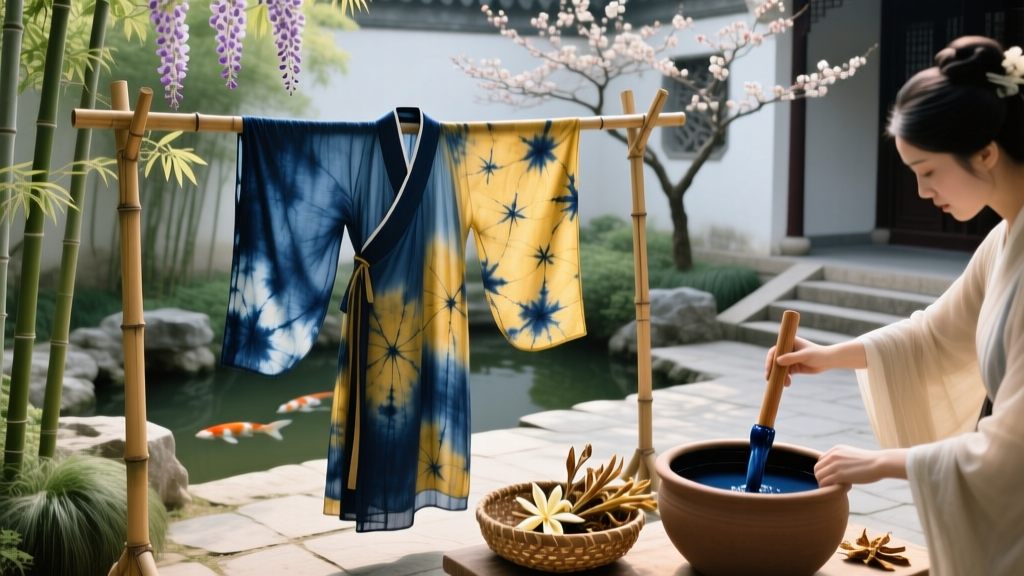
One of the most prized and historically significant textiles is Xiangyunsha (Gambiered Canton Gauze). Originating in Guangdong province, this silk is dyed using the juice of the薯莨 (Shulang yam) and then coated in iron-rich river mud. The chemical reaction between the tannins and the iron creates a distinctive, crackled black-brown fabric that is waterproof, cooling in summer, and rustles softly when worn. Due to its labor-intensive, weather-dependent production, authentic Xiangyunsha remains one of the most expensive silks in the world.
Decoding the Visual Language

Embroidery and woven motifs on traditional garments were strictly regulated by sumptuary laws and carried profound auspicious meanings. The Smithsonian National Museum of Asian Art highlights how homophones and visual puns were frequently used to encode blessings into the very fabric of the clothing.
| Motif | Native Term | Symbolic Meaning | Era of Prominence |
|---|---|---|---|
| Dragon | Long | Imperial authority, yang energy, cosmic power | Ming & Qing Dynasties |
| Peony | Mudan | Wealth, honor, and prosperity | Tang & Song Dynasties |
| Bat | Fu | Good fortune (homophone for blessing) | Qing Dynasty |
| Plum Blossom | Meihua | Resilience, perseverance through winter | Song & Ming Dynasties |
| Gourd | Hulu | Fertility, longevity, and warding off evil | Ming & Qing Dynasties |
The Qing Dynasty Shift and the Birth of the Qipao
The sartorial landscape of China underwent a seismic shift in 1644 with the establishment of the Qing Dynasty by the Manchu people. The Manchu rulers enforced the Tifa Yifu policy, mandating that Han Chinese men adopt the Manchu queue hairstyle and clothing, effectively ending the continuous, unbroken tradition of male Hanfu. Manchu garments, such as the Changpao (long robe) and Magua (riding jacket), introduced narrow, horse-hoof-shaped sleeves designed for archery and riding, alongside the widespread use of knotted fabric buttons (pankou).
The Shanghai Evolution: 1920s to 1940s
The modern Qipao (or Cheongsam) is not an ancient garment, but rather a product of 20th-century modernity. Emerging in 1920s Shanghai, the early Qipao was a loose, A-line dress worn by progressive female students as a symbol of gender equality, adopting the one-piece silhouette previously reserved for men.
By the 1930s, Shanghai tailors began integrating Western sartorial techniques into the Qipao. They introduced darts, set-in sleeves, and gussets to contour the fabric to the female form, transforming it into the sleek, high-collared, side-slit garment recognized globally today. The Qipao represents a fascinating synthesis: a garment constructed using Western three-dimensional tailoring, yet adorned with traditional Chinese silk, motifs, and pankou closures.
The Modern Hanfu Revival and the Mamianqun

In the 21st century, China has experienced a massive cultural movement known as the Hanfu Revival (Hanfu Yundong). Driven by younger generations seeking to reconnect with pre-Qing cultural identity, this movement has resurrected historical silhouettes for daily wear. The undisputed centerpiece of this revival is the Mamianqun, or 'horse-face skirt'.
Originating in the Song and Ming dynasties, the Mamianqun is a wrap-around skirt constructed from two overlapping pieces of fabric. It features flat, unpleated panels at the front and back (the 'horse faces'), with deep, structured pleats on the sides. Historically, the flat panels were heavily embroidered with auspicious motifs, while the pleats allowed for ease of movement, particularly when riding horses. Today, the Mamianqun is frequently paired with modern knitwear or traditional Ming-style Ao (lined jackets), bridging the gap between historical accuracy and contemporary streetwear.
Sourcing and Wearing Traditional Garments Today
For collectors, cultural enthusiasts, and those seeking authentic attire for ceremonies or daily wear, navigating the market for chinese garments requires an understanding of construction quality, textile authenticity, and pricing tiers.
Price Ranges and Market Tiers
- Entry-Level / Off-the-Rack ($40 – $120 USD): Typically made from polyester blends or rayon. While accessible and durable for casual wear or cosplay, these lack the breathability and drape of natural fibers. Mass-produced machine embroidery is common.
- Mid-Tier / Artisanal ($150 – $450 USD): Garments crafted from mulberry silk, linen, or high-grade cotton. Embroidery may be a mix of machine and hand-stitching. This tier is ideal for cultural festivals, tea ceremonies, and serious enthusiasts.
- Bespoke / Heritage ($800 – $3,000+ USD): Custom-tailored pieces utilizing heritage textiles like Xiangyunsha or Kesi (silk tapestry). High-end Qipao tailors in Shanghai or Hong Kong will hand-roll the hems and craft custom pankou knots from the dress's own silk bias.
A Buyer's Checklist for Authenticity
When investing in traditional garments, scrutinize the construction details to ensure cultural accuracy and quality craftsmanship:
- Verify the Lapel: Authentic Hanfu must feature jiaoling youren (left over right). Be highly suspicious of vendors selling 'Hanfu' with the right lapel over the left, as this indicates a fundamental misunderstanding of cultural protocols.
- Examine the Seams and Pleats: A high-quality Mamianqun will have crisp, heat-set side pleats that do not splay open awkwardly when walking. The waistband should be reinforced to support the heavy silk without warping.
- Assess the Pankou: On a Qipao, the knotted buttons should be hand-rolled from the same silk as the dress. Avoid garments that use stiff, mass-produced synthetic cord or plastic imitation knots.
- Check the Lining: Traditional garments, particularly winter Ao or high-end Qipao, should be fully lined with silk or cupro to protect the outer brocade from body oils and to maintain the garment's structural drape.
Preserving a Living Heritage
The story of chinese garments is not confined to museum archives; it is a living, breathing tradition. Whether it is the meticulous weaving of a Song-style Beizi jacket or the precise tailoring of a Shanghai Qipao, these garments demand a deep respect for the artisans who preserve these ancient techniques. By understanding the historical context, textile composition, and cultural protocols of these garments, wearers and collectors can participate in the ongoing preservation of one of humanity's most magnificent sartorial legacies.