Hanfu Styles for Every Occasion: The Complete Event Guide
The modern revival of traditional Han Chinese clothing, known as the Hanfu Yundong (Hanfu Movement), has transformed historical garments from museum relics into living, breathing wardrobes. However, Hanfu is not a single monolith; it encompasses over three millennia of evolving silhouettes, regional textiles, and strict sartorial protocols. Selecting the correct hanfu styles for a specific occasion requires an understanding of historical dynasty aesthetics, fabric weight, and cultural etiquette.
Unlike Western tailoring, which relies on darts and structured shoulder seams to follow the body's contours, traditional Hanfu is constructed using a flat-pattern cutting method. Garments are woven in continuous pieces with dropped shoulders and wide sleeves, secured entirely by sashes and ties rather than buttons. This guide decodes the most prominent hanfu styles, matching them to modern events, formality levels, and seasonal requirements.
Matching Hanfu Styles to Your Event Calendar
The key to wearing Hanfu with cultural accuracy and comfort lies in aligning the garment's historical dynasty with the formality and setting of your event. Below is a breakdown of the most popular styles categorized by occasion.
Casual Outings & Daily Wear (Song Dynasty Minimalism)
For modern street wear, tea house visits, or casual museum outings, the Song Dynasty (960–1279) aesthetic is unparalleled in its practicality. Song hanfu styles are characterized by narrow sleeves, slender silhouettes, and understated elegance. The quintessential casual ensemble features the Beizi (褙子), a straight, open-front jacket that falls to the mid-thigh or knee, worn over a narrow-sleeved inner shirt.
For the lower half, wearers often pair the Beizi with a Baidi (a simple, flat-pleated skirt) or Songku (tailored, wide-leg trousers). Because these garments do not restrict movement, they are ideal for navigating modern urban environments. Fabrics for daily wear typically include breathable linen, raw cotton, or lightweight rayon, with price points for authentic, mass-produced sets ranging from $45 to $90 USD.
Lantern Festivals & Spring Galas (Tang Dynasty Romanticism)
When attending vibrant outdoor festivals, Mid-Autumn gatherings, or evening galas, the Tang Dynasty (618–907) styles offer unmatched theatricality and grace. The Tang era was a period of cosmopolitan wealth, heavily influencing its fashion with flowing, voluminous silhouettes and bold, contrasting colors.
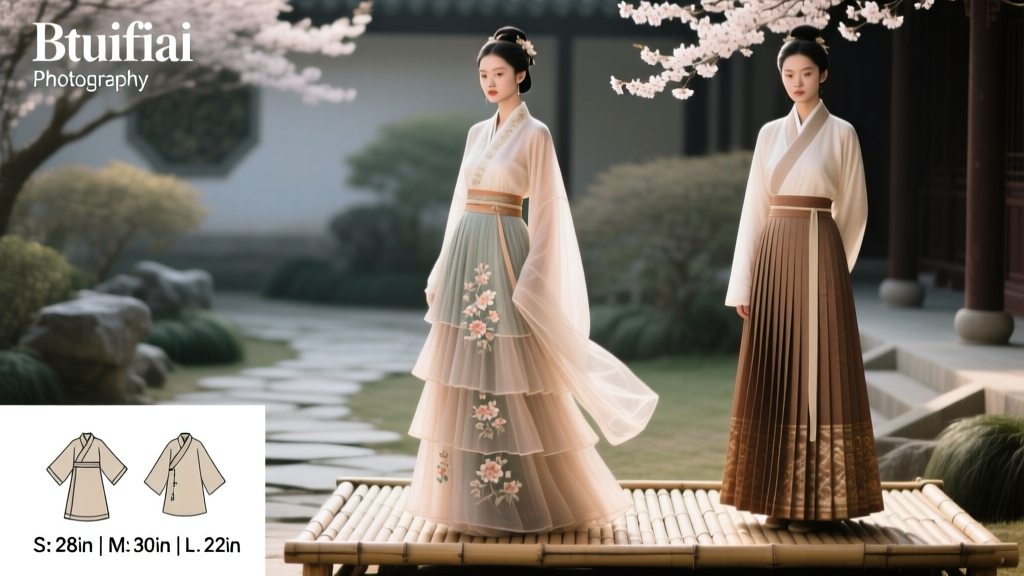
The most iconic festive style is the Qixiong Ruqun (齐胸襦裙), a chest-high skirt tied securely above the bust, paired with a short, tucked-in blouse. For cooler evenings or more grandiose events, a Daxiushan (大袖衫)—a sweeping, large-sleeved translucent outer robe—is draped over the shoulders. Tang styles favor silk chiffon, jacquard weaves, and organza, allowing for dramatic movement in the wind. Expect to invest between $80 and $200 USD for a high-quality, multi-layered Tang festival set.
Weddings & High-Formality Ceremonies (Ming Dynasty Grandeur)
For weddings, ancestral worship, and high-formality banquets, the Ming Dynasty (1368–1644) provides the most structured and opulent hanfu styles. Ming formalwear is defined by the Aoqun (袄裙) silhouette, featuring a lined, high-collared or round-collared jacket worn over a skirt.
The centerpiece of Ming formalwear is the Mamianqun (马面裙), or 'horse-face skirt.' This masterpiece of textile engineering consists of two overlapping flat panels at the front and back, flanked by deeply pleated side panels. Authentic formal Mamianqun are often woven using Zhuanghua (Nanjing cloud brocade), a UNESCO-recognized intangible cultural heritage technique that incorporates gold and peacock feather threads into the silk. For grooms or those preferring robes, the Yuanlingpao (圆领袍), a round-collared robe with structured wing-like shoulder extensions, commands deep respect. Bespoke Ming wedding ensembles utilizing genuine brocade can range from $500 to over $2,500 USD.
Rites of Passage & Academic Milestones (Pre-Qin Ritual Robes)
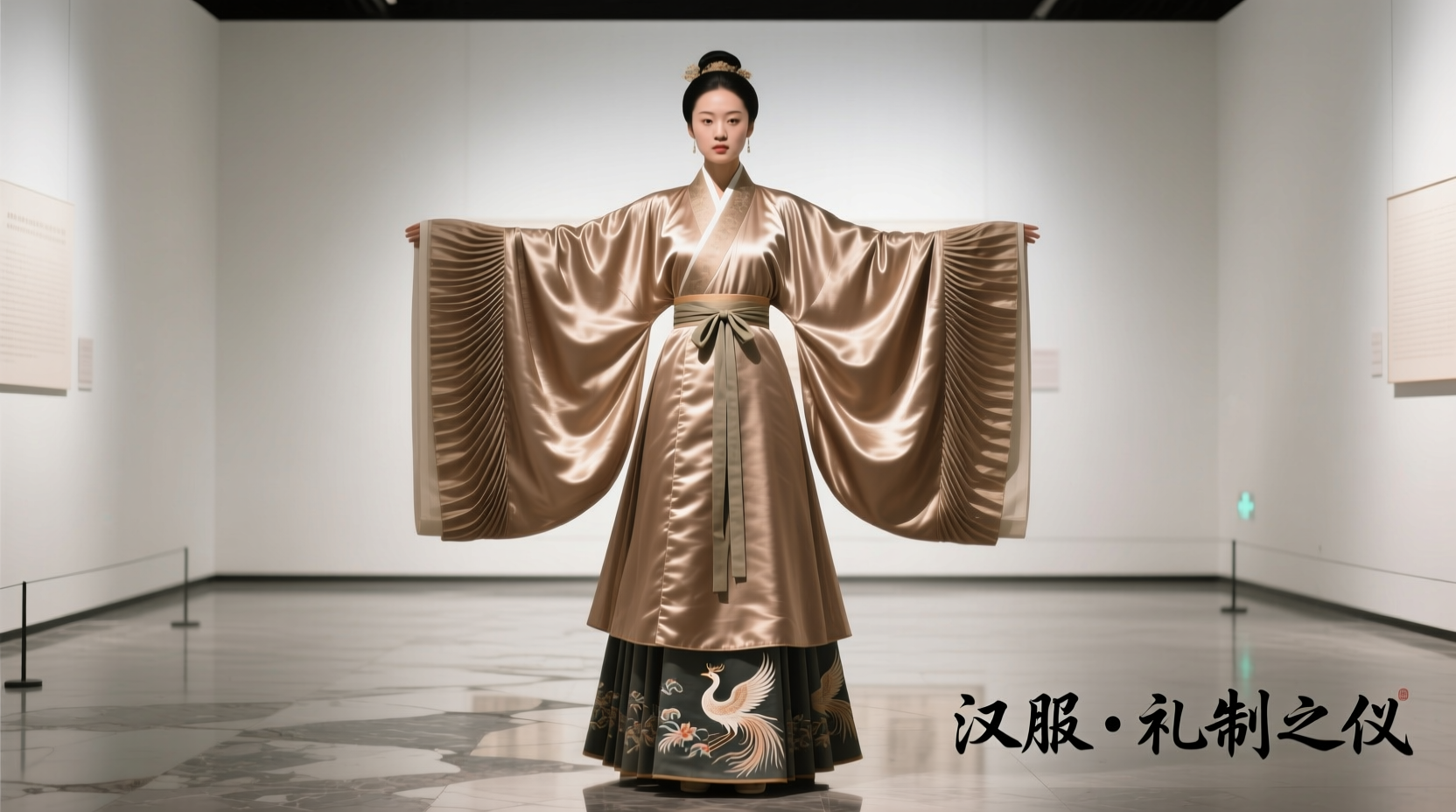
For coming-of-age ceremonies (Guanli for men, Ji Li for women), graduations, or solemn academic rites, the Pre-Qin and Han Dynasty styles are the standard. The Shenyi (深衣), or 'deep robe,' is a one-piece garment that conceptually links the separate top and bottom of ancient Chinese dress, symbolizing the harmony of heaven and earth. The traditional Shenyi is cut from 12 panels of fabric, representing the 12 months of the lunar year. Woven in modest, unpatterned hemp or heavy matte silk, the Shenyi projects scholarly virtue and historical reverence.
The Sacred Protocol: Jiaoling Youren and Dress Etiquette
Regardless of the dynasty or occasion, all Hanfu wearers must adhere to the foundational rule of Jiaoling Youren (交领右衽)—the intersecting collar where the left lapel crosses over the right lapel. In traditional Chinese cosmology, the left represents Yang (life, the sun, the living), while the right represents Yin (death, the moon, the underworld). Wrapping the right side over the left (Zuoren) is strictly reserved for dressing the deceased or certain historical nomadic tribes. Wearing Hanfu with the correct lapel orientation is a non-negotiable sign of respect for the culture and the ancestors.
Fabric Matrix: Seasonality, Weaves, and Investment Tiers
Choosing the correct textile is as important as selecting the silhouette. Below is a guide to traditional fabrics and their appropriate event applications.
| Fabric Type | Native Term | Best Season / Occasion | Est. Price Range (USD) |
|---|---|---|---|
| Raw Hemp / Linen | Bu (布) | Summer / Daily Wear, Scholar Retreats | $40 - $120 |
| Silk Chiffon / Organza | Luo (罗) / Sha (纱) | Spring Festivals / Tang Dynasty Layering | $90 - $250 |
| Cantonese Mud-Dyed Silk | Xiangyunsha (香云纱) | Late Summer / Autumn, High-End Casual | $300 - $800+ |
| Nanjing Cloud Brocade | Zhuanghua (妆花) | Winter Weddings / Formal Ceremonies | $600 - $3,000+ |
Of particular note is Xiangyunsha, a highly prized silk gauze from Guangdong province. It is dyed using the juice of the Shuliang yam and coated with iron-rich river mud, creating a unique, crackled, water-resistant fabric that rustles softly when walking. According to conservation experts at the China National Silk Museum, this complex dyeing process requires specific humidity and intense sunlight, making authentic Xiangyunsha a rare and expensive investment for serious collectors.
Sourcing Authentic Hanfu: From Taobao to Artisan Cooperatives
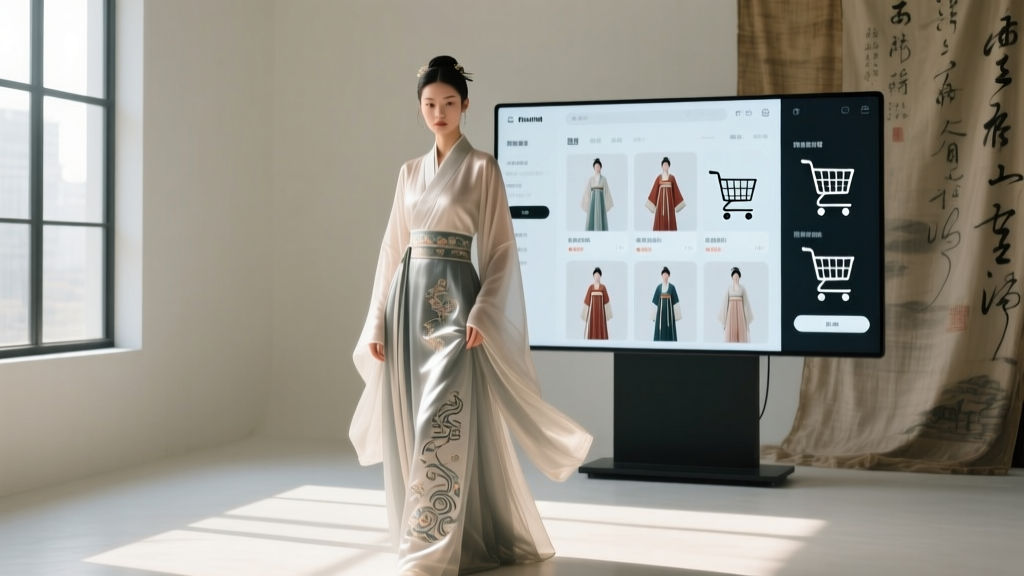
The market for Hanfu has exploded, but quality varies wildly. For beginners, reputable Taobao and AliExpress brands (such as Shisan Yu or Zhongzhi) offer historically informed, machine-washable sets ideal for casual festivals. However, as the Victoria and Albert Museum's Asian Collections demonstrates through its preserved Ming textiles, true historical accuracy requires attention to the flat-cut seam allowances, authentic tie placements, and natural fiber dyes.
For formal events and weddings, buyers should seek out artisan cooperatives specializing in intangible cultural heritage weaves. When purchasing a Mamianqun, examine the waistband: traditional skirts feature a sturdy, contrasting cotton or linen waistband meant to grip the sash securely, while the pleats should be heat-set or hand-stitched to maintain their structure over years of wear. Footwear should ideally consist of traditional cloth boots (Yunxie) or minimalist leather flats, avoiding modern synthetic sneakers which disrupt the garment's historical drape.
By understanding the deep historical context, structural engineering, and cultural protocols behind these garments, wearers do more than simply dress up; they participate in the ongoing, respectful stewardship of Asian textile heritage.