Hanfu Parts: Guide to Traditional Anatomy

When exploring the rich tapestry of Asian traditional garments, few sartorial systems are as complex, historically layered, and culturally profound as Hanfu (汉服). Translating literally to 'Han clothing,' Hanfu represents the traditional dress of the Han Chinese people, evolving continuously over three millennia before facing periods of suppression and eventual modern revival. For beginners, the sheer volume of terminology and structural variations can be overwhelming. Understanding the specific hanfu parts is not merely an exercise in fashion vocabulary; it is a gateway into ancient philosophies, social hierarchies, and textile engineering.
This comprehensive guide deconstructs the anatomy of Hanfu, moving from the foundational layers to the intricate details of collars and sleeves. Whether you are a cultural enthusiast, a historical reenactor, or a newcomer looking to purchase your first authentic set, mastering these components will deepen your appreciation and ensure culturally respectful wear.
The Foundation: Core Layers of the Hanfu System
Unlike many Western historical garments that rely on rigid corsetry or single-piece construction, traditional Hanfu is built on a sophisticated layering system. The way these layers interact dictates the garment's drape, formality, and seasonal appropriateness.
Neiyi (内衣) and Zhongyi (中衣): The Inner Layers
The foundation begins with the Neiyi, the innermost undergarments akin to modern lingerie or undershirts. Over this lies the Zhongyi, the middle layer. Typically made of breathable, lightweight cotton or linen, the Zhongyi serves a dual purpose: it protects the expensive outer silk layers from body oils and sweat, and it provides a crisp, visible collar line that frames the neck. In formal wear, the white collar of the Zhongyi peeking out from beneath the outer robe is a hallmark of elegance and proper dressing.
Waiyi (外衣): The Outer Presentation
The Waiyi encompasses the visible outer garments. This is where the primary aesthetic, regional variations, and dynastic markers are displayed. The Waiyi is rarely a single piece; it is usually a combination of upper and lower garments or a full-body robe, secured not with buttons, but with intricately tied sashes and ribbons.
Deconstructing the Silhouette: Upper and Lower Hanfu Parts
The fundamental philosophy of Hanfu construction is the separation of the upper and lower body, reflecting ancient Chinese cosmological concepts of Heaven (upper) and Earth (lower). While one-piece robes exist, the two-piece system remains the most iconic.
The Upper Body: Ru (襦), Ao (袄), and Shan (衫)
- Ru (襦): A short, unlined or lightly lined jacket that typically ends at the waist or hips. It is one of the oldest hanfu parts, frequently worn by women in the Tang and Song dynasties, often paired with high-waisted skirts.
- Shan (衫): An unlined, lightweight upper garment, usually made of sheer or fine woven fabrics like ramie or lightweight silk. It is essential for summer wear, providing sun protection while allowing airflow.
- Ao (袄): A lined or padded jacket designed for colder months. The Ming Dynasty popularized the Mamianqun paired with a structured, long-sleeved Ao, creating a silhouette that was both regal and practical for northern Chinese winters.
- Banbi (半臂): Translating to 'half-sleeve,' this is a short-sleeved vest or jacket worn over a long-sleeved Ru or Shan. It adds a layer of color contrast and structural depth to the outfit.
The Lower Body: Qun (裙) and Ku (裤)
The lower half of the Hanfu system is dominated by the Qun (skirt) and Ku (trousers). While trousers were historically worn by laborers, soldiers, or as undergarments, skirts were the primary outerwear for both men and women in formal and court settings.
One of the most vital and recognizable hanfu parts today is the Mamianqun (马面裙), or 'horse-face skirt.' Originating in the Song Dynasty and reaching its zenith in the Ming Dynasty, the Mamianqun features a flat front and back panel (the 'horse faces') with pleated sides. This ingenious construction allowed for ease of movement, particularly when riding horses or climbing stairs, while maintaining a rigid, dignified frontal appearance. According to textile archives at the Metropolitan Museum of Art's Asian Art Department, the structural pleating of Ming dynasty skirts represents a high point in pre-industrial textile engineering.
The Defining Details: Collars, Sleeves, and Accessories
To truly understand Hanfu, one must look at the micro-details. The cut of a collar or the width of a sleeve can indicate the wearer's gender, social status, and the historical era being referenced.
Jiaoling Youren (交领右衽): The Right Lapel Rule
The most defining characteristic of Hanfu is the Jiaoling Youren, or the 'intersecting collar with the right lapel.' The left side of the collar crosses over the right side, forming a 'y' shape at the neckline. This is not merely an aesthetic choice; it is a profound cultural mandate rooted in Confucian philosophy and ancient Yin-Yang cosmology, where the left (Yang/life) respects and covers the right (Yin). Crucially, reversing this to left-over-right (Zuoren) is strictly reserved for dressing the deceased for burial. Wearing a Hanfu with the wrong lapel crossed is considered highly inauspicious and deeply disrespectful.
Sleeve Architectures: From Narrow to Voluminous
Hanfu sleeves are categorized by their shape and function, vastly differing from Western set-in sleeves. They are cut as a single continuous piece of fabric with the bodice, eliminating shoulder seams and allowing the fabric to drape naturally.
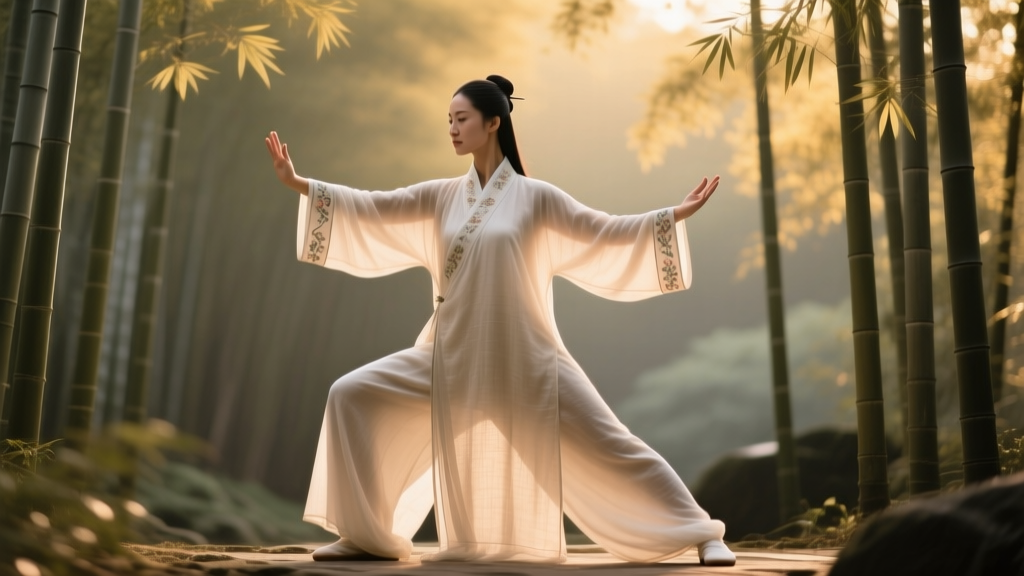
- Guangxiu (广袖): Wide, flowing sleeves that pool at the wrist. Often seen in formal court wear and ceremonial dress, they project an aura of grace and leisure, indicating the wearer does not perform manual labor.
- Pipa Xiu (琵琶袖): Shaped like a lute (pipa), these sleeves are narrow at the shoulder, widen significantly at the forearm, and taper sharply at the cuff. Popular in the Ming Dynasty, the deep cuff acts as a built-in pocket for carrying small items like fans or handkerchiefs.
- Zhaixiu (窄袖): Narrow, fitted sleeves designed for archery, horseback riding, or daily labor, heavily influenced by nomadic equestrian cultures during the Tang and Yuan periods.
Essential Accessories: Pibo and Yunjian
No Hanfu ensemble is complete without its accompanying accessories. The Pibo (帔帛) is a long, sheer silk shawl draped over the arms and shoulders, iconic to Tang Dynasty women's fashion, adding a kinetic, floating element to the wearer's movement. The Yunjian (云肩), or 'cloud shoulder,' is a highly embroidered, detachable collar piece worn over the shoulders during weddings or festivals to protect the garment and display intricate needlework.
Quick Reference Chart: Essential Hanfu Terminology
| Hanzi Term | Pinyin | English Translation | Function & Context |
|---|---|---|---|
| 交领右衽 | Jiaoling Youren | Right-over-left collar | The foundational rule of Hanfu wrapping; signifies life and respect. |
| 马面裙 | Mamianqun | Horse-face skirt | Pleated skirt with flat front/back panels; Ming dynasty staple. |
| 襦裙 | Ruqun | Jacket and skirt set | The most common two-piece ensemble for women across multiple dynasties. |
| 深衣 | Shenyi | Deep robe | A one-piece robe connecting upper and lower garments; formal/scholarly. |
| 披帛 | Pibo | Silk shawl / sash | Draped over arms; adds elegance, prominent in Tang dynasty art. |
Sourcing Authentic Pieces: Materials and Price Ranges
As the modern Hanfu revival movement (Hanfu Yundong) grows globally, the market has flooded with both authentic artisan pieces and cheap, synthetic 'costumes.' For beginners, understanding fabric composition is vital. Historically, Hanfu was crafted from mulberry silk, ramie, hemp, and linen. Today, high-quality viscose, cupro, and cotton-linen blends are acceptable for daily wear, while polyester brocades should be avoided due to poor breathability and historical inaccuracy.
When sourcing from reputable vendors (many of which operate via specialized Asian e-commerce platforms or dedicated global boutiques), expect the following price tiers in USD:
- Entry-Level / Daily Wear ($35 - $70): Usually made of cotton-linen blends or high-quality polyester blends. Ideal for beginners testing the silhouette. Often features machine embroidery.
- Mid-Tier / Enthusiast ($80 - $180): Features accurate historical patterning, jacquard weaves, and better draping fabrics like chiffon, tencel, or faux silk. Embroidery is denser and more refined.
- Artisan / Ceremonial ($250 - $800+): Genuine mulberry silk, real gold-thread embroidery (Panjin), and hand-woven brocades (Zhuanghua). These are investment pieces meant for weddings, tea ceremonies, or serious cultural preservation.
Institutions like the China National Silk Museum frequently host exhibitions detailing the complex loom technologies required to create these traditional brocades, underscoring why authentic silk Hanfu commands a premium price.
Cultural Respect and the Modern Hanfu Movement
Wearing Hanfu today is an act of cultural reclamation and pride, spearheaded primarily by younger generations seeking to reconnect with pre-Qing Dynasty heritage. As an international enthusiast, approaching Hanfu with respect is paramount. This means adhering to the 'right lapel' rule, avoiding the mixing of Hanfu with Qing-dynasty Manchu accessories (like the Qitou headdress), and understanding the context of the garments you wear.
Furthermore, textile conservationists at the Victoria and Albert Museum emphasize the importance of preserving not just the physical garments, but the intangible cultural heritage of how they are worn and tied. Learning the traditional methods of tying a sash or securing a skirt without modern fasteners is a meditative practice that connects the modern wearer to centuries of ancestral knowledge.
By understanding the distinct hanfu parts—from the foundational Zhongyi to the sweeping Guangxiu sleeves—you transition from merely wearing a historical costume to participating in a living, breathing cultural tradition. Take your time, research the specific dynasty that resonates with you, and embrace the profound elegance of the Han Chinese sartorial legacy.