Hanfu Pants: The Ultimate Occasion & Event Styling Guide
Beyond the Robe: The Hidden History of Hanfu Trousers
When the global community envisions traditional Chinese clothing, the mind immediately drifts toward flowing silk robes, sweeping *mamianqun* (horse-face skirts), and elegant *ruqun* ensembles. However, the modern Hanfu revival movement has increasingly spotlighted a highly practical, historically rich, and deeply versatile category of garments: hanfu pants. Far from being a modern concession to Western clothing, trousers have been an integral component of Han Chinese dress for over two millennia, evolving through military necessity, nomadic influence, and shifting dynastic aesthetics.
Whether you are preparing for an active outdoor lantern festival, a traditional tea ceremony, or a historical martial arts demonstration, understanding the distinct silhouettes of Han trousers is essential. This guide decodes the historical variations of hanfu pants, providing a comprehensive framework for styling, sourcing, and wearing them with cultural authenticity and contemporary flair.
The Evolution of the Silhouette: From *Ku* to *Kun*
To wear hanfu pants correctly, one must first understand their structural origins. In ancient China, particularly prior to the Warring States period, the Han majority primarily wore open-crotch trousers known as ku (袴). These were essentially leg warmers or chaps, designed to protect the lower legs from the cold while being worn beneath the modesty of a long, wrap-around skirt or robe.
The pivotal moment for the integration of true, closed-crotch trousers into Han culture occurred in 307 BCE. King Wuling of Zhao instituted the controversial Hufu Qishe (胡服骑射) policy, commanding his military to adopt the nomadic hufu (胡服) attire of the northern steppes. This included the kun (裈)—tailored, closed-crotch trousers that allowed for astride horseback riding. According to the Metropolitan Museum of Art's Heilbrunn Timeline of Art History, this cross-cultural exchange along the early Silk Road routes permanently altered the trajectory of Chinese garment construction, introducing gussets, tapered ankles, and reinforced seams to the Han wardrobe.
Decoding the Styles: Which Hanfu Pants Suit Your Event?
Navigating the modern Hanfu market requires matching the historical silhouette to your specific event. Here are the three primary styles of hanfu pants you will encounter, along with their ideal occasions.
1. *Songku* (宋裤): Elegance for Tea Ceremonies and Garden Strolls
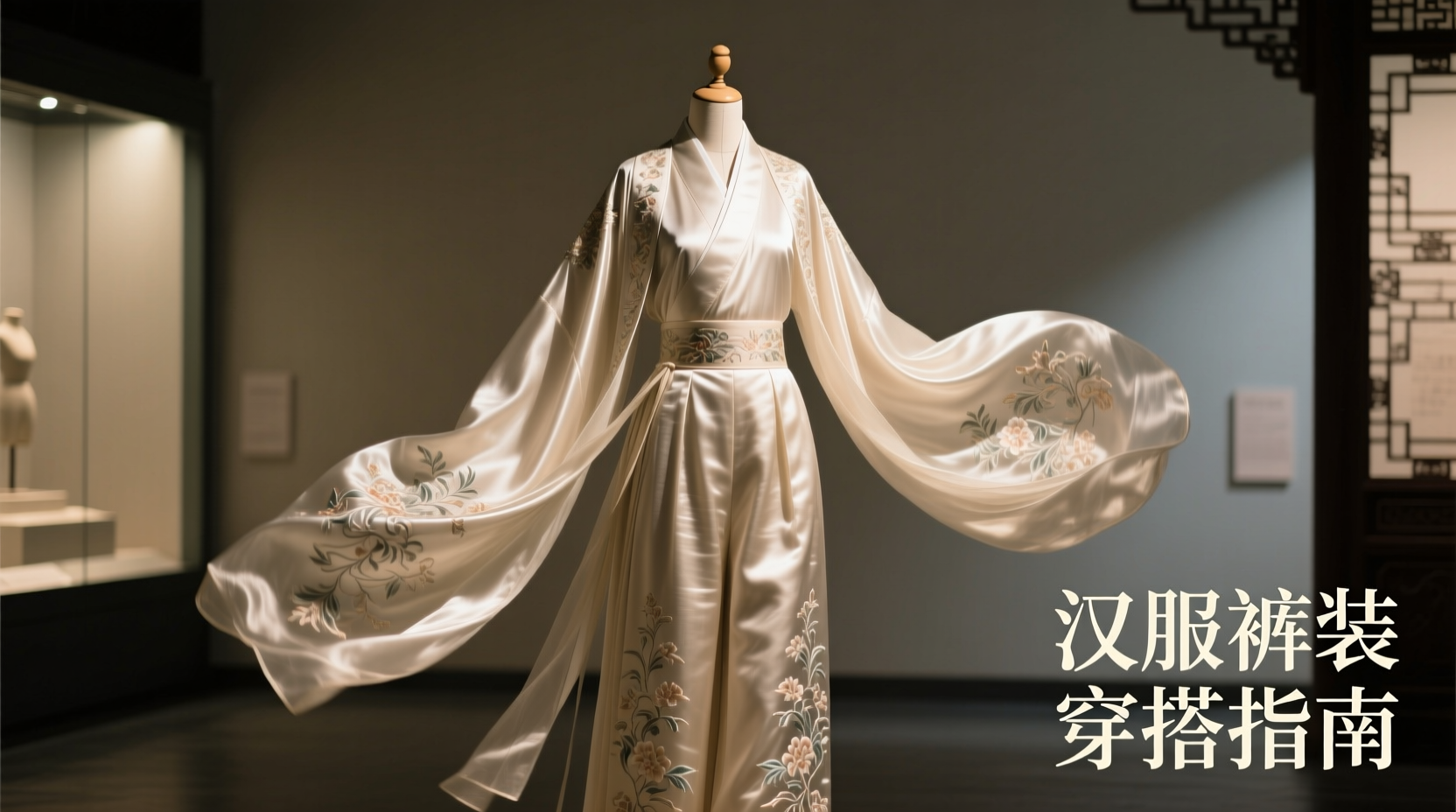
Originating in the Song Dynasty (960–1279 CE), Songku are characterized by their exceptionally wide, flowing legs and high-waisted, multi-layered construction. Often featuring a split-side overlay or worn beneath a sheer overskirt, they mimic the visual drape of a long skirt while providing the mobility of trousers. According to textile archives at the China National Silk Museum, Song dynasty tailoring favored relaxed, unrestrictive silhouettes that reflected the era's scholarly and refined aesthetic.
- Best For: Indoor cultural events, traditional tea ceremonies, botanical garden photography, and low-impact banquet attendance.
- Styling Tip: Pair with a delicate beizi (long open-front coat) and a slender silk waist sash. Footwear should be understated, such as embroidered cloud-toe flats.
2. *Kuzhe* (袴褶): Mobility for Archery, Martial Arts, and Active Festivals
The kuzhe is a two-piece martial and equestrian ensemble consisting of a shorter, fitted tunic (zhe) and tapered trousers (ku). Popularized during the Wei, Jin, and Northern and Southern Dynasties (220–589 CE), this style is the epitome of utilitarian Hanfu. The trousers are typically gathered into leather or cloth boots, ensuring zero fabric drag during vigorous movement.
- Best For: Traditional archery (xiangshe) tournaments, Wushu demonstrations, outdoor hiking in Hanfu, and dynamic parade participation.
- Styling Tip: Utilize leather wrist guards and a functional fabric belt. The trousers should be made of durable, medium-weight cotton or hemp to withstand friction from boots and armor replicas.
3. *Dakouku* (大口裤): Dramatic Flair for Parades and Stage Performances
Translating roughly to "large-mouth pants," dakouku feature massively wide legs that are abruptly cinched at the ankle using silk cords or embroidered cuffs. This creates a billowing, balloon-like effect that catches the wind dramatically. It was highly favored by court officials and nobles during the Tang Dynasty for its striking visual presence.
- Best For: Stage performances, Hanfu street-fashion photography, and evening lantern festivals where dramatic movement is desired.
- Styling Tip: Because the lower half is incredibly voluminous, balance the silhouette with a structured, short-sleeved banbi (half-arm vest) or a tightly fitted upper robe.
Event Planning Matrix: Fabric, Fit, and Budget
Selecting the right fabric is just as crucial as the silhouette. The table below provides a buyer's matrix to help you align your garment choice with your event's physical demands and your budget.
| Silhouette | Historical Era | Ideal Event Type | Recommended Fabric | Avg. Price (USD) |
|---|---|---|---|---|
| Songku | Song Dynasty | Tea ceremonies, elegant dining | Raw silk, chiffon, light linen | $45 - $120 |
| Kuzhe | Wei / Jin / Tang | Archery, martial arts, hiking | Heavy cotton, hemp, canvas | $30 - $85 |
| Dakouku | Tang Dynasty | Parades, dance, photoshoots | Brocade, jacquard, taffeta | $60 - $150 |
| Kun (Laborer) | Ming / Qing | Working festivals, casual wear | Unbleached cotton, ramie | $20 - $40 |
Sartorial Protocols: Layering and Waistband Mechanics
Unlike modern trousers that rely on zippers and buttons, authentic hanfu pants utilize a complex system of ties, sashes, and overlapping waistbands. Mastering these mechanics is vital for both modesty and historical accuracy at public events.
"The integrity of the Hanfu silhouette relies entirely on the tension of the waist ties. A properly secured pair of *Songku* should feel like a gentle, distributed embrace around the natural waist, never relying on elastic or modern fasteners to bear the weight of the fabric." — Contemporary Hanfu Tailoring Guidelines, China Hanfu Association
The Inner Tie System: Most high-quality hanfu pants feature an inner set of cotton ties. These must be secured tightly at the side or front to anchor the garment.
The Outer Sash: The outer waistband is often folded over and secured with a decorative silk sash or a leather belt (in the case of kuzhe). For formal events, ensure the outer ties are knotted symmetrically or tied in a traditional butterfly knot at the side, allowing the tails to drape elegantly alongside the leg.
Sourcing Authentic Pieces: Navigating the Modern Market
As the Hanfu movement has globalized, sourcing authentic, well-constructed hanfu pants has become more accessible, though it requires navigating a tiered market.
Mass-Market and Entry-Level ($20 - $50 USD)
Platforms like AliExpress and Amazon offer entry-level *Songku* and *kuzhe*. While accessible, buyers must scrutinize the fabric composition. Many budget options use polyester blends that trap heat and lack the fluid drape of natural fibers. Look for vendors that explicitly list cotton-linen blends or viscose.
Artisan and Taobao Direct ($60 - $200+ USD)
For museum-quality reproduction and event-ready elegance, purchasing directly from established Hanfu brands on Taobao (via proxy services like Superbuy or Wegobuy) is the gold standard. Brands such as Shisan Yu (十三余) and Zhongling (钟灵记) frequently release seasonal *Songku* collections featuring hand-embroidered hems, natural silk crepe, and historically accurate pleating ratios. When ordering tailored dakouku for a specific performance, these artisan cooperatives often offer custom inseam and waist measurements, ensuring the ankle gathers sit at the precise anatomical point required for safe movement.
Final Thoughts on Cultural Respect and Wearability
Integrating hanfu pants into your event wardrobe is a profound way to honor the multifaceted history of Chinese dress. It challenges the monolithic stereotype of the "imperial robe" and celebrates the dynamic, active lives of historical scholars, soldiers, and laborers. By selecting the appropriate silhouette, respecting the traditional tie systems, and investing in natural textiles, you ensure that your attire is not merely a costume, but a living, breathing continuation of a millennia-old sartorial legacy.