Hanfu Clothing Craftsmanship: Silk, Weaving, and Tailoring

When examining hanfu clothing, it is a common mistake to focus solely on the sweeping silhouettes and elegant drapes. To truly understand this sartorial tradition, which spans over three millennia of Chinese history, one must look closer at the microscopic intersections of warp and weft. Hanfu is not merely a style of dress; it is a profound textile artifact that reflects ancient philosophies, regional sericulture, and mathematical precision on the loom.
For cultural garment enthusiasts and collectors, appreciating hanfu clothing requires a deep dive into its foundational craftsmanship. From the airy leno weaves of summer gauze to the heavy, polychrome brocades of winter court robes, the fabric itself dictates the garment's behavior, cultural significance, and historical authenticity.
The Metaphysics of Warp and Weft
In traditional Chinese textile philosophy, the loom is a microcosm of the universe. The vertical warp threads (jing) represent the unyielding, celestial forces of Heaven, while the horizontal weft threads (wei) represent the terrestrial, receptive forces of Earth. This metaphysical framework meant that the creation of hanfu clothing was considered a sacred act of harmonizing cosmic energies.
According to the Victoria and Albert Museum's archives on Chinese textiles, the earliest silk fragments dating back to the Neolithic Qianshanyang culture (circa 2750 BCE) already demonstrate a sophisticated understanding of sericulture. By the Han Dynasty (202 BCE – 220 CE), the state-sponsored silk workshops had perfected complex draw-looms, allowing for the mass production of intricately patterned silks that would eventually fuel the Silk Road trade.
Decoding Historical Weave Structures
Authentic hanfu clothing relies on specific historical weave structures, each engineered for distinct climates, social classes, and ceremonial functions. Modern mass-market reproductions often substitute these with basic polyester satins, losing the structural integrity of the original garments.
Luo (罗) - The Leno Gauze
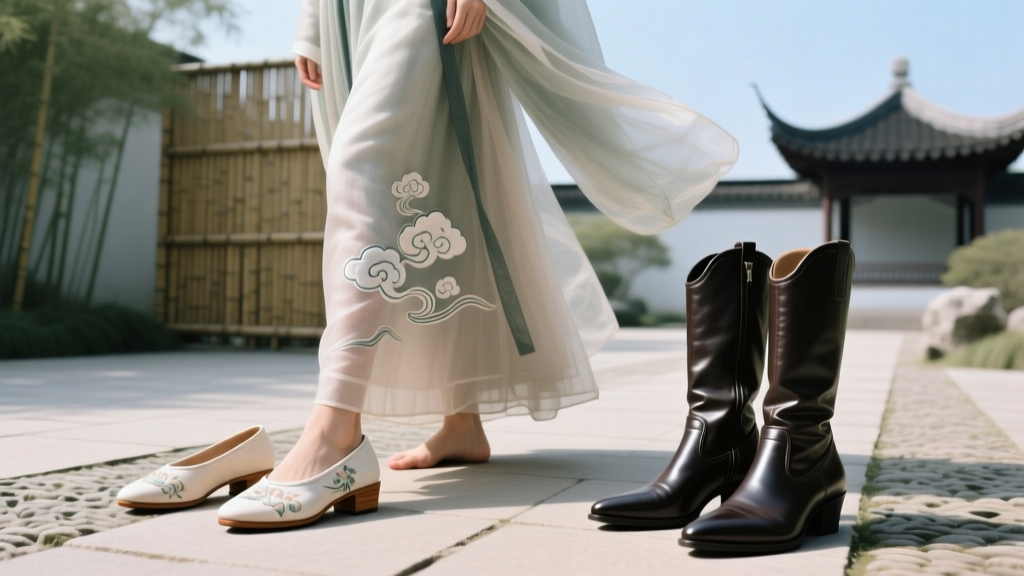
Luo is a leno weave where warp threads are twisted around each other in pairs, interlocking the weft and creating a stable, open-mesh fabric. Highly prized during the Tang and Song dynasties for summer wear, authentic Luo is breathable, lightweight, and possesses a subtle, textured stiffness that allows the fabric to stand away from the skin, promoting air circulation. True heritage Luo weaving, particularly the complex four-warp twist variation, is a protected intangible cultural heritage in Suzhou, requiring master weavers to manipulate thousands of heddles manually.
Qi (绮) and Chou (绸) - Damask and Plain Silk
Qi refers to a damask weave, where patterns are created by contrasting warp-faced and weft-faced twill structures on the same fabric. It catches the light dynamically, revealing hidden motifs only at certain angles. Chou, a plain tabby weave silk, serves as the foundational canvas for embroidery, offering a smooth, tightly woven surface that prevents delicate silk floss from snagging.
Jin (锦) - The Pinnacle of Brocade
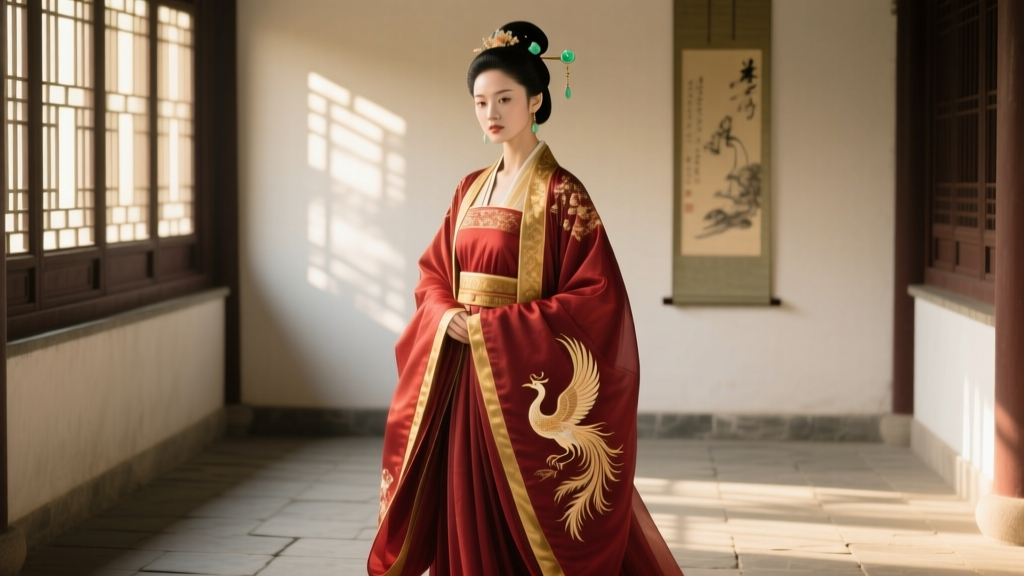
Jin translates to brocade, a heavy, richly decorative fabric woven with multiple colored silk threads, often supplemented with gold or silver metallic strips. The China National Silk Museum in Hangzhou extensively documents the 'Three Great Brocades' of China: Song Jin (Song Brocade), Shu Jin (Sichuan Brocade), and Yun Jin (Nanjing Cloud Brocade). Song Jin, characterized by its geometric frameworks and elegant, subdued color palettes, is particularly favored for the structured outer layers of Ming Dynasty-style Aoqun (jacket and skirt) ensembles.
Regional Embroidery Traditions: The Four Great Schools
While weaving provides the canvas, embroidery (xiuhua) provides the narrative. Hanfu clothing utilizes specific regional embroidery styles, each with distinct needlework techniques and thematic focuses. The 'Four Great Embroideries' of China dictate the visual language of high-end hanfu.
| Embroidery School | Region | Signature Technique | Common Motifs & Application |
|---|---|---|---|
| Su (苏绣) | Suzhou, Jiangsu | Double-sided embroidery (shuangmian xiu); splitting a single silk thread into 1/64th strands. | Koi fish, peonies, subtle gradients. Used on delicate Ming-style collars and cuffs. |
| Shu (蜀绣) | Sichuan | Dense, even stitching with a focus on strong, contrasting outlines and padded relief. | Pandas, dragons, lotus flowers. Common on heavier winter robes and ceremonial Bijia (vests). |
| Xiang (湘绣) | Hunan | Use of velvet-like textures and stark black-and-white ink-wash shading techniques. | Tigers, lions, dramatic landscapes. Applied to bold, statement outer garments. |
| Yue (粤绣) | Guangdong | Gold and silver couching; use of peacock feathers and horsehair wrapped in silk. | Phoenixes, dragons, dense floral bursts. Favored for theatrical and highly ceremonial hanfu. |
The Engineering of Flat-Cutting (Pingmian Caijian)
Perhaps the most radical departure between hanfu clothing and modern Western fashion is the tailoring paradigm. Western tailoring relies on 'three-dimensional cutting'—using darts, curved seams, and shoulder pads to force flat fabric to conform to the body's contours. Hanfu utilizes pingmian caijian (flat-cutting).
In flat-cutting, the fabric is treated as a continuous, unbroken plane. Garments are constructed from whole widths of silk, folded and joined with straight seams. This approach minimizes fabric waste and allows the natural drape and weight of the silk to dictate how the garment moves with the wearer's body.
The Zhongfeng (Center Back Seam)
A defining characteristic of almost all traditional hanfu upper garments (yi) is the zhongfeng, a prominent seam running straight down the center of the back. Historically, silk looms produced fabric in widths of roughly 50 to 60 centimeters—too narrow to wrap around an adult torso without joining pieces. However, the zhongfeng transcended its structural necessity to become a moral symbol. In Confucian philosophy, the straight center back seam represented moral uprightness, integrity, and the wearer's alignment with the righteous path.
Jiaoling Youren (Cross-Collar, Right Lapel)
The jiaoling youren collar structure is the most recognizable silhouette in hanfu clothing. The left side of the garment crosses over the right, securing at the right side of the torso. This is not merely an aesthetic choice, but a profound cultural marker.
'To wear the cross-collar with the right lapel overlapping the left is to embrace civilization and the living; the reverse is the way of the unwoven barbarian and the deceased.' — Adapted from the Liji (Book of Rites)
As noted by historians at the Metropolitan Museum of Art's Silk Road archives, this sartorial rule was so deeply ingrained that the 'left-over-right' lapel became synonymous with Han Chinese identity itself, distinguishing the agricultural, silk-weaving societies of the Central Plains from the nomadic, leather-wearing tribes of the northern steppes who often favored right-over-left closures for ease of horseback riding and drawing weapons.
Sourcing Authentic Hanfu Clothing: A Buyer's Matrix
For collectors and practitioners seeking authentic hanfu clothing, navigating the modern market requires an understanding of textile quality and artisanal labor costs. The market is broadly stratified into three tiers, each offering vastly different levels of craftsmanship.
- Tier 1: Mass-Market & Cosplay (100 – 350 RMB / $15 – $50 USD)
Fabric: Polyester chiffon, synthetic jacquard, low-grade rayon.
Craftsmanship: Machine-printed patterns mimicking embroidery. Lack of zhongfeng seams. Fused interfacing that degrades after washing. Suitable for casual wear or photography, but lacks historical drape and breathability. - Tier 2: Independent Studios & Premium Silk (800 – 2,500 RMB / $110 – $350 USD)
Fabric: 100% Mulberry silk (16mm to 23mm weight), real silk-cotton blends, authentic linen.
Craftsmanship: Proper flat-cutting, hand-finished hems, and machine-assisted but high-quality embroidery. Studios in this tier often consult historical artifacts from the Ming or Song dynasties to replicate accurate collar angles and sleeve curves (pipa xiu or lute sleeves). - Tier 3: Heritage Artisan & Museum Replicas (5,000 – 20,000+ RMB / $700 – $2,800+ USD)
Fabric: Hand-woven Luo gauze, genuine gold-leaf couching brocade, natural plant-dyed silks (using indigo, madder root, or pagoda tree buds).
Craftsmanship: Entirely hand-stitched or woven on traditional wooden draw-looms. Features master-level Su embroidery requiring hundreds of hours of labor. These are investment-grade cultural artifacts, often commissioned directly from intangible cultural heritage inheritors in Nanjing or Suzhou.
Preserving the Loom: The Future of Hanfu Textiles
The contemporary hanfu movement (Hanfu Yundong) has done more than revive ancient silhouettes; it has single-handedly rescued several endangered weaving techniques from the brink of extinction. A decade ago, the complex mathematical drafts required to weave authentic Song Brocade were held by only a handful of aging artisans. Today, driven by the exacting demands of educated hanfu clothing consumers, a new generation of textile engineers and weavers are digitizing ancient loom patterns while maintaining the tactile superiority of hand-finished silk.
Understanding hanfu clothing through the lens of fabric and craftsmanship transforms it from a mere costume into a living, breathing archive of Asian material culture. Whether it is the whisper of a leno gauze skirt in the summer breeze or the heavy, structured dignity of a winter brocade robe, the true magic of hanfu lies in the thousands of invisible threads that bind history to the present.