Chinese Traditional Clothes for Men: A Fabric & Craft Guide
The Architecture of Menswear: Flat-Cutting and the Right Lapel
When examining Chinese traditional clothes for men, one must first understand the foundational philosophy of their construction. Unlike Western tailoring, which relies on three-dimensional draping, darts, and structured shoulder pads to conform to the body's contours, traditional Chinese garments utilize a system known as flat-cutting (平面裁剪). This technique honors the integrity of the woven textile, minimizing waste and allowing the fabric to drape naturally over the wearer's frame.
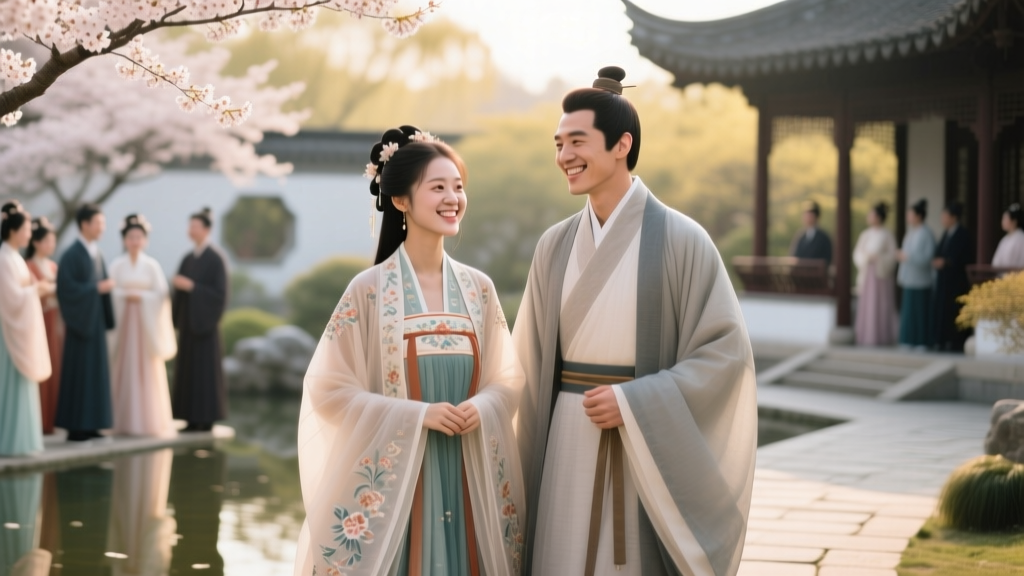
A defining characteristic of Hanfu (the historical dress of the Han people) is the jiaoling youren (交领右衽), or cross-collar wrapping to the right. The left lapel crosses over the right, securing at the waist with ties rather than buttons. This right-over-left orientation is deeply rooted in cultural protocol; historically, wrapping to the left was reserved exclusively for burial garments or considered a mark of 'barbarian' tribes. Furthermore, traditional looms produced silk bolts roughly 50 to 60 centimeters wide. To achieve the expansive, flowing sleeves characteristic of men's scholarly robes, tailors joined multiple fabric panels. This necessity birthed the center-back seam (中缝), which runs straight down the spine. In Confucian philosophy, this unbroken vertical line symbolizes moral uprightness, integrity, and the wearer's connection between heaven and earth.
Core Garments and Their Textile Requirements
The evolution of men's traditional clothing spans millennia, with distinct silhouettes requiring specific fabric weights and weaves to achieve their intended architectural drape.
Daopao (道袍) and Zhiduo (直裰): The Scholar's Robes
Prominent during the Ming Dynasty (1368–1644), the Daopao is a full-length, wide-sleeved robe featuring side slits that reveal hidden internal panels (暗摆). These panels, known as 'bai', prevent the exposure of the inner garments and maintain modesty while walking. To support the structural weight of the hidden panels and the wide sleeves, a Daopao requires a medium-to-heavy silk weave, such as a 19-22 momme twill or a dense crepe de chine. The Zhiduo, similar in silhouette but with an open back slit and no hidden panels, demands a slightly more fluid fabric to allow the back to billow gracefully in the wind.
Lanshan (襕衫): The Hem-Bordered Robe
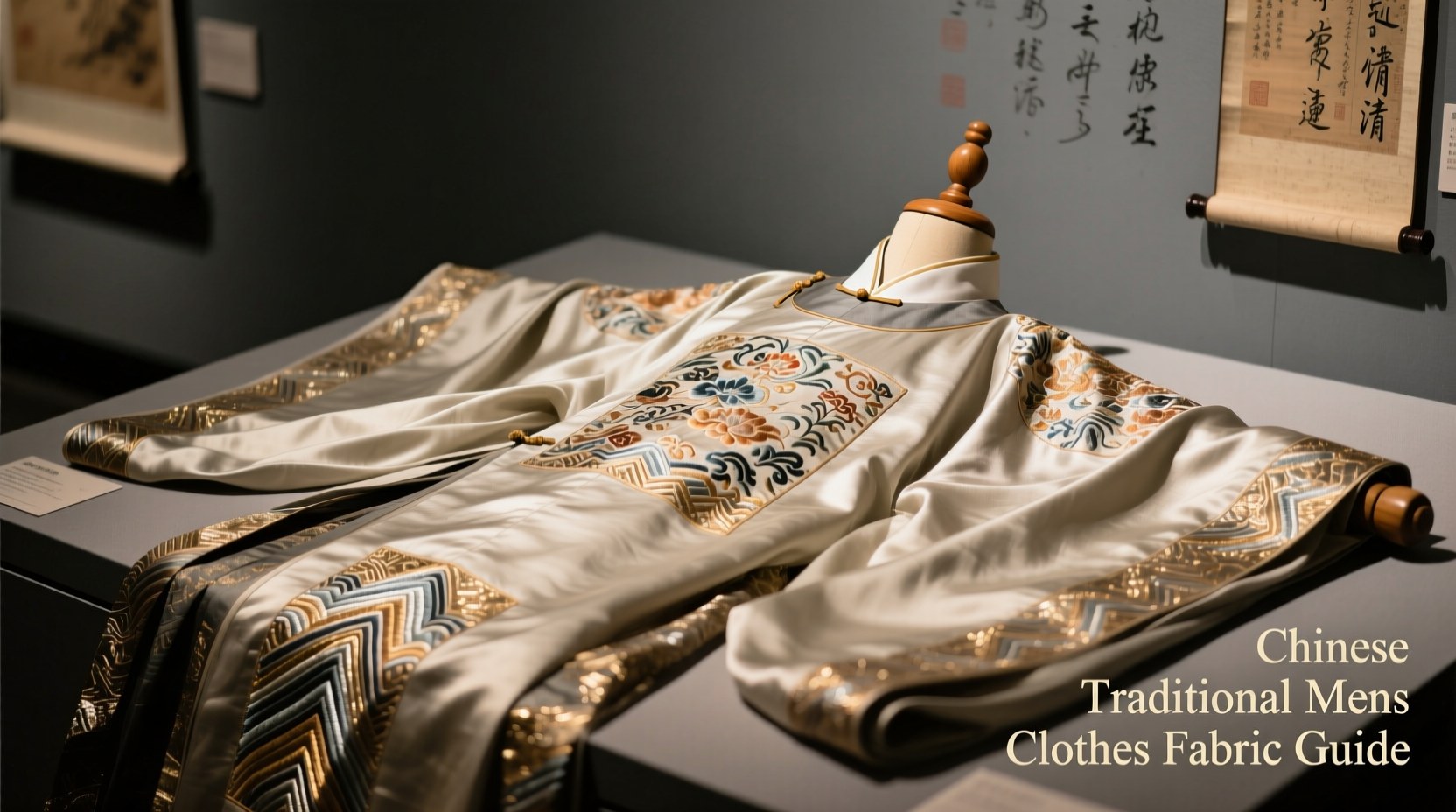
The Lanshan was the standard formal attire for scholars and students during the Tang and Song dynasties. Its defining feature is a wide, dark border sewn along the bottom hem and cuffs. Because the main body of the robe requires a lightweight, breathable drape (often achieved with plain-weave silk gauze or fine linen), while the borders require a heavier, contrasting brocade, constructing a Lanshan is an exercise in balancing disparate fabric weights.
Changshan (长衫) and Magua (马褂): The Qing and Republican Eras
Moving into the Qing Dynasty (1644–1912) and the subsequent Republican era, men's fashion shifted toward the Changshan (long gown) and the Magua (riding jacket). The Changshan features a high Mandarin collar and uses intricate knotted fabric buttons (盘扣). Because the Changshan is cut closer to the body than the Ming-era Daopao, it relies on fabrics with a slight structural crispness, such as Zhangzhou velvet or heavily sized cottons, to maintain its clean, vertical lines without clinging.
Master Weaves: Decoding Chinese Silk for Menswear
The true luxury of Chinese traditional menswear lies in its textiles. As documented in the 17th-century encyclopedic work Tiangong Kaiwu (The Exploitation of the Works of Nature), Chinese silk production involves staggering levels of specialization. Below is a breakdown of the most prestigious weaves used in men's garments today.
| Fabric Name | Origin Region | Characteristics & Craftsmanship | Best Garment Match |
|---|---|---|---|
| Xiangyunsha (香云纱) | Guangdong (Pearl River Delta) | Dyed with shoulang yam juice and coated with iron-rich river mud. Creates a dual-toned, water-resistant fabric with a distinct rustling sound. | Summer Daopao, Changshan |
| Song Jin (宋锦) | Suzhou, Jiangsu | A complex compound weave with a matte finish. Features subtle geometric and floral patterns woven directly into the warp and weft. | Winter outerwear, Lanshan borders |
| Zhang Rong (漳绒) | Zhangzhou, Fujian | A traditional velvet with raised, uncut loops. Offers exceptional thermal retention and a rich, light-absorbing texture. | Cold-weather Magua (jackets) |
| Hua Luo (花罗) | Hangzhou, Zhejiang | An open-weave silk gauze with twisted warp threads, creating a breathable, semi-transparent textile with high tensile strength. | Summer inner layers, Ruqun tops |
'The labor of a single silkworm is fleeting, but the weaver's art transforms its thread into a canvas of eternity. To wear the mud-dyed gauze of the south is to wear the very earth and water of the delta.' — Adapted from regional textile folklore, preserved by the China National Silk Museum.
Xiangyunsha, or Gambiered Canton Gauze, deserves special attention. Recognized as a National Intangible Cultural Heritage, its production is limited to a brief window between April and October when the humidity and sunlight of Guangdong are optimal. The fabric is dipped in yam dye up to 30 times, sun-dried, and finally sealed with river mud. The chemical reaction between the tannins in the yam and the iron in the mud creates a striking black-and-brown patina that softens and develops a beautiful 'crackle' texture over years of wear.
Embellishment: Subtlety in Men's Motifs
While women's traditional garments often feature vibrant, expansive floral embroidery, men's embellishments historically leaned toward subtlety, symbolism, and structural integration. According to the Victoria and Albert Museum's Asian textile archives, men of the literati class preferred 'hidden' luxury.
Instead of loud, contrasting threads, menswear often utilized tone-on-tone embroidery (暗绣). A scholar's robe might feature the 'Four Gentlemen'—plum blossom, orchid, bamboo, and chrysanthemum—embroidered in silk thread that perfectly matched the base fabric color. The motifs would only reveal themselves when the light caught the texture of the stitches. When color was employed, it was usually restricted to the Magua or the inner linings of a sleeve, flashing briefly when the wearer moved. Imperial garments, conversely, utilized the kesi (cut silk) tapestry technique, weaving gold and peacock-feather threads directly into the fabric to create the iconic five-clawed dragon motifs.
Sourcing and Pricing: Buying Authentic Garments Today
The modern Hanfu movement and the revival of Republican-era tailoring have created a robust market for Chinese traditional clothes for men. However, navigating the market requires an understanding of fabric composition, momme weight (the measure of silk density), and regional artisan hubs. Below is a practical buying framework for collectors and enthusiasts.
Tier 1: Entry-Level and Daily Wear ($40 – $120 USD)
- Fabrics: Cotton-linen blends, polyester-cotton mixes, and low-momme (12-14mm) machine-woven silk.
- Craftsmanship: Machine-stitched seams, fused interlinings for collars, standard synthetic knotted buttons.
- Best For: First-time buyers, casual streetwear, and tea-house attire. Look to manufacturers in Hangzhou and Chengdu for reliable quality at this price point.
Tier 2: Artisanal and Heritage Weaves ($180 – $600 USD)
- Fabrics: Genuine Xiangyunsha (verify the distinct earthy scent and dual-tone coloring), 19-22 momme mulberry silk, pure linen.
- Craftsmanship: Hand-rolled hems, traditional flat-cutting with no shoulder seams, hand-braided silk knot buttons (pankou).
- Best For: Serious practitioners of tea ceremonies, martial arts, and cultural events. Sourcing directly from Guangdong-based Xiangyunsha cooperatives ensures authenticity.
Tier 3: Bespoke and Heirloom ($1,000 – $4,000+ USD)
- Fabrics: Master-woven Song Brocade, Zhangzhou velvet, and custom-dyed silks using traditional botanical dyes (indigo, safflower, acorn).
- Craftsmanship: Hand-embroidered Su or Yue embroidery motifs, custom tailoring to the wearer's exact arm-span and posture, fully finished internal seams (no raw edges).
- Best For: Grooms, collectors, and formal diplomatic or cultural banquets. The Metropolitan Museum of Art's records on Chinese silk highlight the historical precedence of bespoke weaving, where a single bolt of brocade could take a master weaver six months to complete.
Final Thoughts on Preservation and Wear
Investing in Chinese traditional clothes for men is not merely an exercise in fashion; it is an act of cultural preservation. When purchasing these garments, prioritize natural fibers and traditional construction methods over modern, mass-market shortcuts. A well-made Daopao or Changshan, crafted from authentic Xiangyunsha or Song Brocade, is designed to outlast its wearer, developing a rich patina and serving as a tangible link to the philosophical and artistic heritage of Asian civilizations.