Chinese Traditional Men's Wear: Regional Guide

Beyond the Monolith: Mapping China's Menswear Heritage
When discussing the chinese traditional men set, Western observers often default to a singular image: the Qing-era Changshan (long shirt) or the modernized Tangzhuang jacket. However, China’s sartorial history is a vast tapestry woven across diverse climates, topographies, and dynasties. Historically, the foundational concept of Chinese menswear was rooted in the Yi (upper garment) and Shang (lower skirt or trousers) system, which eventually evolved into one-piece robes like the Shenyi (deep robe) and layered ensembles. Today, the contemporary Hanfu revival movement (Hanfu Yundong) and regional heritage preservation efforts have brought these distinct substyles back into the spotlight.
To truly understand and curate an authentic Chinese traditional men set, one must look through a geographic lens. The heavy, structured brocades of the northern plains contrast sharply with the breathable, flowing silks of the southern water towns. This guide explores the profound regional variations in Chinese menswear, offering a deep dive into construction, fabric composition, and cultural protocols.
The Northern Silhouette: Structured Layers and Cold-Weather Pragmatism
Northern China, encompassing regions like Beijing, Shandong, and the broader Central Plains, experiences harsh, freezing winters and dusty springs. Consequently, the traditional men set from this region prioritizes thermal retention, structural integrity, and layered modesty. During the Ming Dynasty (1368–1644), the northern scholarly and official classes favored the Daopao (Daoist robe) and the Yisan (a pleated, waist-cinched robe with Mongol influences).
A classic northern Ming-style menswear set typically features a cross-collar right lapel (jiaoling youren), wide sleeves with structured cuffs, and heavy inner lining. Fabrics were predominantly thick silk damasks, wool blends, and heavily padded cottons. The color palette leaned toward deep, saturated hues—indigo, crimson, and ochre—dyed using robust mineral and plant pigments that could withstand the intense northern sun and frequent washing. The silhouette is distinctly A-line and voluminous, designed to trap body heat while allowing the wearer to layer multiple inner garments (zhongyi) without restricting movement.
The Qing-Era Shift: Changshan and Magua
Following the Manchu establishment of the Qing Dynasty (1644–1912), northern menswear underwent a radical transformation. The traditional Han Chinese robes were largely replaced in public life by the Manchu Changshan (a long, fitted gown with side slits) and the Magua (a short, riding-style jacket). A formal northern Qing menswear set consisted of a silk Changshan worn beneath a contrasting Magua, often featuring intricate Kesi (cut silk) tapestry weaving. This structured, narrow-sleeved silhouette remains highly influential in modern ceremonial wear, particularly for weddings and Lunar New Year celebrations in northern provinces.
Jiangnan Elegance: Breathable Fabrics and Flowing Lines
Traveling south to the Jiangnan region (the Yangtze River Delta, including Suzhou and Hangzhou), the climate shifts to humid, subtropical warmth. Here, the Chinese traditional men set transforms into an exercise in fluid elegance and masterful textile engineering. Jiangnan has been the epicenter of China’s silk production for millennia, and the local menswear reflects an intimate relationship with the loom.
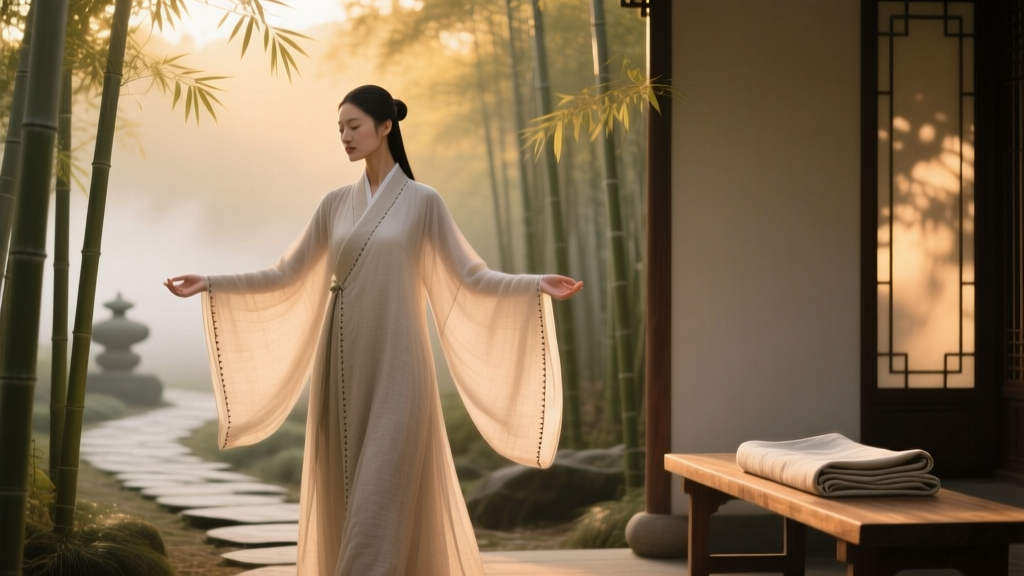
The Song Dynasty (960–1279) aesthetic heavily influences modern Jiangnan-inspired Hanfu sets. Unlike the bold, heavy Ming styles, the Song-style men's set favors the Beizi (a long, open-front coat) worn over a delicate inner robe and wide-leg trousers. The defining characteristic of a Jiangnan set is its drape. Artisans utilize lightweight silk gauze (luo), crepe, and finely woven ramie. The colors are famously subdued, drawing from the region's misty landscapes: celadon, slate grey, pale bamboo, and ink wash black. The construction relies on minimal seaming, allowing the natural bias of the fabric to create a cascading, waterfall-like silhouette that promotes air circulation in the humid summers.
Lingnan and the Subtropical Adaptations: The Magic of Xiangyunsha
In the deep south, encompassing Guangdong, Fujian, and Guangxi (the Lingnan region), the heat and humidity demand radical sartorial adaptations. A traditional Lingnan men set often abandons long robes entirely in favor of practical, short-hemmed jackets (duanshan) paired with loose, wide-leg trousers made of hemp or summer-weight linen. However, the crown jewel of Lingnan textile heritage is Xiangyunsha (gambiered Guangdong silk).
Xiangyunsha is a highly specialized, labor-intensive fabric where silk is dyed with the tannin-rich juice of the薯莨 (Dioscorea cirrhosa) yam and then coated with iron-rich river mud. The result is a dual-toned textile—glossy black on one side, rich brown on the other—that is naturally water-resistant, insect-repellent, and incredibly cooling against the skin. A premium Lingnan menswear set crafted from authentic Xiangyunsha is a prized possession, characterized by a distinct, subtle rustling sound when the wearer moves, often referred to poetically as 'the sound of wind through bamboo.'
Comparative Breakdown: Northern vs. Southern Menswear Sets
| Feature | Northern Plains (Ming/Qing Influence) | Jiangnan (Song/Ming Aesthetic) | Lingnan (Subtropical / Heritage) |
|---|---|---|---|
| Primary Silhouette | Voluminous, A-line, or structured & fitted (Qing) | Straight, flowing, open-front layers | Short-hemmed, practical, wide trousers |
| Key Garments | Daopao, Changshan, Magua | Beizi, Shenyi, Ruqun (trouser sets) | Duanshan, Xiangyunsha sets |
| Dominant Fabrics | Heavy brocade, wool, padded cotton, damask | Silk gauze (Luo), crepe, fine ramie | Gambiered silk, hemp, raw linen |
| Color Palette | Deep indigo, crimson, ochre, gold accents | Celadon, ink black, pale jade, muted tones | Earth tones, dual-tone brown/black, natural hemp |
| Climate Focus | Thermal retention, wind protection | Humidity management, elegant drape | Maximum breathability, sweat-wicking |
Ethnic Minority Intersections: Beyond Han Dominance
A comprehensive study of the Chinese traditional men set must acknowledge the profound contributions of China’s ethnic minorities, whose garments often blur the lines between daily wear and high ceremonial art. In the southwestern provinces of Guizhou and Yunnan, the Miao and Dong peoples have perfected the art of indigo dyeing and intricate embroidery.
A traditional Miao menswear festival set includes a heavily pleated indigo-dyed skirt or wide trousers, paired with a short jacket adorned with geometric cross-stitch embroidery that chronicles clan history and migration myths. Meanwhile, the Zhuang people of Guangxi are renowned for their Zhuang Brocade (Zhuang Jin), a vibrant, cotton-and-silk blend woven on traditional bamboo looms. A Zhuang men's set typically features a mandarin-collar tunic with subtle, tonal brocade patterns, representing a masterful intersection of indigenous weaving techniques and broader Sinitic tailoring influences. According to the Victoria and Albert Museum's Asian textile archives, these regional minority textiles were highly sought after along the ancient Tea Horse Road, influencing broader Asian sartorial trends.
Sourcing and Styling a Regional Chinese Traditional Men Set Today
For modern enthusiasts, historians, and grooms looking to acquire an authentic Chinese traditional men set, navigating the market requires an understanding of tiered manufacturing and regional artisan hubs. The modern Hanfu market has exploded, but quality varies wildly.
Curating Your Wardrobe: Price Tiers and Artisan Cooperatives
- Entry-Level / Mass-Produced ($40 – $90 USD): Mostly found on global e-commerce platforms. These sets are typically made from polyester blends or synthetic jacquards. While they capture the general silhouette of a Ming Daopao or a Changshan, they lack breathability and historical accuracy in their seaming. Best for casual cosplay or brief theatrical use.
- Mid-Tier / Boutique Hanfu Brands ($150 – $350 USD): Brands based in Hangzhou and Chengdu offer historically informed sets using natural fibers like linen, cotton-linen blends, and mid-grade mulberry silk. These sets feature proper jiaoling youren (right-over-left) closures, internal ties, and historically accurate sleeve proportions. This is the recommended tier for cultural festivals, tea ceremonies, and weddings.
- Heritage Artisanal / Bespoke ($600 – $2,500+ USD): True investment pieces. This tier includes authentic Xiangyunsha sets from Guangdong cooperatives, or hand-loomed Kesi silk jackets from Suzhou. The China National Silk Museum frequently highlights the painstaking processes behind these heritage fabrics, where a single yard of gambiered silk can take months of sun-baking and mud-coating. Bespoke tailors in Beijing’s historic Qianmen district also offer custom-fitted Qing-style Changshan sets using imported wools and traditional hand-stitched button knots (pankou).
Styling Protocols and Cultural Respect
When wearing a Chinese traditional men set, observing cultural protocols is paramount. The most critical rule in Han Chinese dress is the jiaoling youren—the left side of the garment must always cross over and cover the right side. Reversing this (right over left) is historically reserved for the deceased and is considered highly inauspicious. Furthermore, when styling a Ming-inspired scholar's set, the inclusion of a traditional headwear piece, such as the Wushamao (winged hat) or a simple scholar's cap (Rujin), elevates the ensemble from mere clothing to a complete cultural presentation.
Understanding the regional DNA of these garments transforms the way we interact with them. A heavy northern brocade robe commands a different posture and presence than a whisper-light Jiangnan silk Beizi. By selecting a Chinese traditional men set that aligns with a specific regional heritage, wearers do more than adopt a historical aesthetic; they become active participants in the preservation of Asia's most complex and enduring sartorial narratives. For further research into court and regional dress, the Palace Museum in Beijing offers extensive digital archives detailing the precise textile regulations and regional variations of the Ming and Qing dynasties.