Chinese Traditional Haircut Symbolism

The Paradox of the Chinese Traditional Haircut
When modern enthusiasts and researchers search for a Chinese traditional haircut, they are often met with a fascinating historical paradox: for the vast majority of China’s imperial history, cutting one’s hair was strictly forbidden. In the context of traditional Asian garments and cultural aesthetics, hair was never merely a stylistic choice; it was a profound moral, political, and spiritual statement. To understand the silhouette of historical Chinese dress—from the flowing sleeves of Hanfu to the structured collars of Qing dynasty robes—one must first understand the deeply rooted philosophy governing the hair that crowned it.
The Classic of Filial Piety and the Uncut Ideal
The foundation of Han Chinese hair culture is rooted in the Xiaojing (Classic of Filial Piety), a foundational Confucian text. The text famously declares: "Our bodies—to every hair and bit of skin—are received by us from our parents, and we must not presume to injure or wound them. This is the beginning of filial piety."
Consequently, both men and women grew their hair long throughout their lives. A literal "haircut" was historically associated with Kun (髡), a humiliating penal punishment where a criminal’s hair was shaved off to mark them as an outcast. Therefore, the traditional Han aesthetic relied entirely on elaborate updos, braiding, and the strategic use of hair ornaments, rather than cutting or layering.
Rites of Passage: The Capping and Hairpinning Ceremonies
Because hair was never cut, the act of tying it up marked the definitive transition from childhood to adulthood, directly influencing how traditional garments were worn.
- Guan Li (Capping Ceremony): At age 20, a Han Chinese man would undergo the Guan Li. His long hair was gathered into a topknot and secured with a guan (cap) and a hairpin. Only after this ceremony was he permitted to wear the formal, wide-sleeved robes of an adult scholar or official.
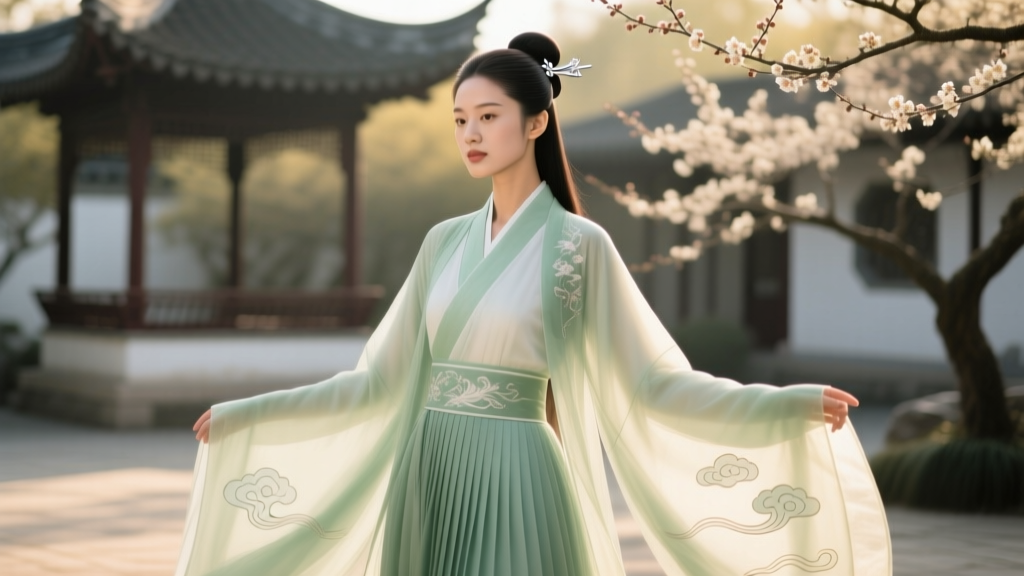
- Ji Li (Hairpinning Ceremony): At age 15, a young woman’s hair was styled into an intricate updo and secured with a ji (hairpin). This signaled her eligibility for marriage and her transition into wearing adult female Hanfu silhouettes, which required a balanced, elevated hairstyle to complement the crossed collars (jiaoling youren).
Anatomy of Historical Hair Ornaments
Since the hair was not cut, the artistry of the traditional Chinese aesthetic was channeled into hair accessories. According to the Smithsonian National Museum of Asian Art, Ming and Qing dynasty hair ornaments were masterclasses in metallurgy and jade carving, designed to signify rank, wealth, and marital status.
| Accessory Name | Pinyin | Description & Symbolism | Garment Pairing |
|---|---|---|---|
| Zan | 簪 | A single-pronged hairpin used to secure the topknot. Often carved from jade, bone, or wood. Symbolized singular devotion or scholarly focus. | Ming dynasty Aoqun (jacket and skirt) |
| Chai | 钗 | A double-pronged hairpin. Often given by lovers as a token of affection; breaking a chai in half and sharing it symbolized eternal bond. | Tang dynasty Ruqun (high-waisted dress) |
| Buyao | 步摇 | "Step-shake" dangling ornaments. Made of gold filigree and pearls, they swayed with the wearer's steps, demanding a graceful, measured walk. | Formal court dress and Qungua |
| Shubi | 梳篦 | Decorative combs inserted into the updo. Often made of sandalwood or tortoiseshell, featuring carved motifs of phoenixes or peonies. | Song dynasty Beizi (open-front coat) |
The Tifa Yifu Edict: The Trauma of the Qing Queue
The closest historical event to a mandated "Chinese traditional haircut" occurred in 1645, following the Manchu conquest of the Ming Dynasty. The Qing regent Dorgon issued the brutal Tifa Yifu (Shave the hair, change the clothes) edict. The ultimatum was stark: "Keep your hair and lose your head, or keep your head and cut your hair."
The Bianzi (Queue) as Political Submission
Han Chinese men were forced to adopt the Manchu bianzi (queue). This required shaving the front half of the scalp (the qiantou) and braiding the remaining back hair into a long plait.
Historical Evolution of the Queue:
- Early Qing (The "Money Rat Tail"): The shaved area was extensive, leaving only a patch of hair the size of a coin, braided into a thin, short tail.
- Late Qing (The "Ox Tail"): By the 19th century, the shaved portion had receded, and men grew the back hair much longer, weaving it into a thick, heavy braid, often extending it with black silk threads to reach the ground.
This forced haircut was deeply traumatic, as it violated core Confucian tenets. However, over 250 years, the queue became normalized. When the Qing dynasty fell in 1911, the newly formed Republic of China mandated the cutting of the queue, leading to mass, highly emotional public hair-cutting ceremonies as men embraced modern, Western-style short haircuts.
Ethnic Minority Traditions: Beyond the Han and Qing
China’s sartorial landscape is vastly diverse, and ethnic minority groups maintain distinct, living hair traditions that are integral to their traditional garments.
- The Yao Women of Huangluo: In Guangxi province, Red Yao women are famous for their floor-length, uncut black hair, which they only cut once in their lifetime at age 18. The hair is wrapped in elaborate, turban-like styles atop their heads, symbolizing longevity, wealth, and fertility. It is an essential component of their vibrant red and black embroidered tunics.
- The Miao Silver Crowns: Miao women in Guizhou province do not rely on jade or gold, but on massive, intricate silver horn crowns and combs. The hair is padded with wool or extra braids to support heavy silver headdresses that can weigh up to 10 kilograms, worn during the Lusheng festival alongside heavily pleated, indigo-dyed batik skirts.
Modern Hanfu Movement: Sourcing and Styling
Today, the Hanfu revival movement has sparked a renewed interest in historical updos. Because modern hair is often cut and layered, enthusiasts use hairpieces (jiafa) and silk wraps to recreate the voluminous silhouettes required to balance traditional garments. The Palace Museum in Beijing frequently exhibits Qing and Ming hairpins that serve as direct references for modern artisan silversmiths and jade carvers.
Buying Guide: Authentic Hair Accessories (2026 Market Guide)
If you are styling traditional garments and seeking authentic accessories, avoid cheap plastic replicas. Here is a guide to sourcing traditional materials, with estimated price ranges:
- Genuine Hetian Jade Zan (Hairpins): Sourced from Xinjiang. Look for a creamy, mutton-fat white or celadon green hue with natural inclusions. Price Range: $150 – $1,500+ USD (1,000 – 10,000+ RMB).
- Sandalwood Carved Combs (Shubi): Authentic Tanxiang sandalwood retains a natural, woody scent for decades and prevents static in silk garments. Price Range: $40 – $120 USD.
- Enamel and Silver Filigree Buyao: Look for traditional Diancui (kingfisher feather art) alternatives made with blue silk or cold enamel, set in oxidized silver. Price Range: $60 – $250 USD.
- Silk Hair Wraps and Ribbons: Essential for binding modern, layered hair into a cohesive historical topknot. Look for Suzhou silk embroidery. Price Range: $15 – $45 USD.
Conclusion: Hair as the Crown of Cultural Dress
The concept of a "Chinese traditional haircut" is ultimately a story of preservation, rebellion, and identity. From the sacred, uncut locks of the Han dynasty scholars to the politically charged queues of the Qing era, and the breathtaking silver and jade ornaments that adorned them, hair in traditional Chinese culture was the ultimate canvas. As the Metropolitan Museum of Art's Heilbrunn Timeline notes regarding Ming dynasty aesthetics, the harmony between a garment's textile and the wearer's coiffure was paramount. To wear Hanfu, Qipao, or indigenous dress today with cultural accuracy is to honor the profound weight that every strand of hair carried in Asian history.