Chinese Traditional Clothing: A Symbolism Guide

The Core Answer: Navigating Chinese Sartorial Terminology
When enthusiasts, historians, or curious travelers ask, what is Chinese traditional clothing called, the answer is rarely a single word. Unlike some cultures with one universally recognized national garment, China’s vast history and diverse ethnic landscape have produced a complex wardrobe. However, the global lexicon generally categorizes Chinese traditional clothing into three distinct pillars: Hanfu (the historical dress of the Han majority), the Qipao (the modernized, form-fitting silhouette of the 20th century), and the Tangzhuang (the festive, Qing-inspired jacket).
To understand these garments is to understand Chinese cosmology. In traditional Chinese philosophy, clothing was never merely functional; it was a canvas for universal order, social hierarchy, and auspicious wishes. Below, we decode the profound symbolism woven into the fabric of China’s most iconic garments.
Quick Reference: The Three Pillars of Chinese Dress
| Garment | Native Term | Historical Origin | Primary Symbolic Focus |
|---|---|---|---|
| Hanfu | 汉服 | Han Dynasty (202 BCE) | Cosmic order, etiquette, Five Elements |
| Qipao | 旗袍 | Qing Dynasty / 1920s Shanghai | Auspicious nature motifs, modern femininity |
| Tangzhuang | 唐装 | Qing Dynasty (Magua jacket) | Festive joy, longevity, unity |
Hanfu (汉服): The Cosmic Geometry of the Han Majority
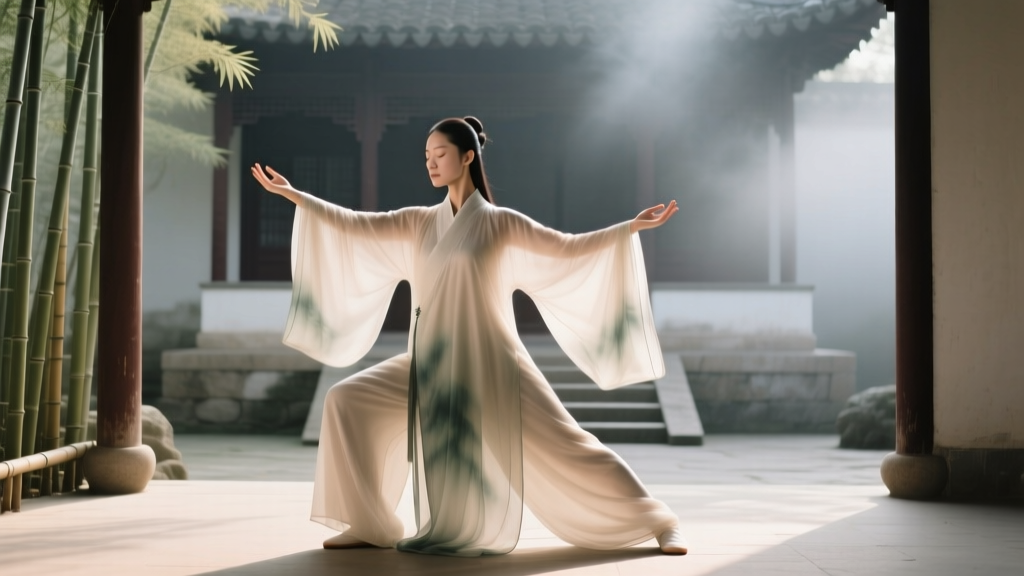
Hanfu translates literally to 'Han clothing.' It represents the traditional dress of the Han Chinese people, spanning from the legendary Yellow Emperor to the end of the Ming Dynasty (1644 CE). According to the Victoria and Albert Museum's Asian Collections, Hanfu is defined not just by its silhouette, but by its strict adherence to ritual propriety (li).
Construction and the 'Right Over Left' Rule
The most critical defining feature of Hanfu is Jiaoling Youren (交领右衽)—the intersecting collar where the left side of the garment crosses over the right. This is deeply symbolic. In traditional Chinese cosmology, the left represents the east, the sun, and life (Yang), while the right represents the west, the moon, and death (Yin). Therefore, wrapping the left over the right honors the living. Conversely, Zuoren (left-over-right) is strictly reserved for dressing the deceased. Wearing it in daily life is considered a severe cultural faux pas and an omen of bad luck.
The Shenyi and the Twelve Months
The Shenyi (深衣), or 'deep robe,' is a classic Hanfu style that connects the upper and lower garments into one piece. A historically accurate Shenyi is constructed using exactly 12 separate fabric panels, symbolizing the 12 months of the lunar year and the 12 earthly branches of the Chinese zodiac. The sleeves are round to represent the heavens, while the collar is squared to represent the earth, physically wrapping the wearer in the harmony of the universe.
Color Symbolism and the Five Elements (Wuxing)
Hanfu colors are historically dictated by the Wuxing (Five Elements) theory. While modern Hanfu enthusiasts wear every color imaginable, historical ceremonial dress adhered to strict elemental codes:
- Qing (Cyan/Green): Represents Wood, spring, and benevolence.
- Chi (Red): Represents Fire, summer, and propriety.
- Huang (Yellow): Represents Earth, late summer, and imperial centrality (reserved for the Emperor during later dynasties).
- Bai (White): Represents Metal, autumn, and mourning.
- Hei (Black): Represents Water, winter, and wisdom (highly revered in the Qin and early Han dynasties).
The Qipao (旗袍): Modernity Woven with Auspicious Motifs
Often known in the West as the cheongsam, the Qipao is the most globally recognized Chinese garment. However, its origins are rooted in the changpao (long robe) worn by the Manchu Eight Banners during the Qing Dynasty (1636–1912). It was in the cosmopolitan hub of 1920s Shanghai that the Qipao was radically tailored, incorporating Western darts and set-in sleeves to celebrate the female form.
Decoding the Embroidery: More Than Just Decoration
Authentic Qipaos are masterpieces of Su Xiu (Suzhou silk embroidery). The motifs chosen are never random; they are visual puns and homophones designed to manifest destiny. The Metropolitan Museum of Art's Heilbrunn Timeline notes that Qing and Republican-era textiles relied heavily on rebus symbolism:
- The Bat (Fu): The Chinese word for bat (fu) is a homophone for 'good fortune.' A Qipao embroidered with five bats represents the 'Five Blessings' (longevity, wealth, health, virtue, and a natural death).
- The Peony (Mudan): Known as the 'King of Flowers,' it symbolizes wealth, honor, and feminine beauty.
- The Gourd: Represents fertility and a sprawling, multi-generational family lineage due to its many seeds.
Xiangyunsha: The Fabric of Whispers
High-end Qipaos are frequently crafted from Xiangyunsha (gambiered Canton gauze). This luxurious silk is dyed using the juice of the Dioscorea cirrhosa plant and coated in iron-rich river mud, then baked in the sun. The result is a dark, crackled fabric that rustles softly when the wearer moves. It is highly prized, water-resistant, and can cost upwards of $150 to $300 USD per yard.
Tangzhuang (唐装): The Misnomer and Its Festive Meanings
Despite its name, which translates to 'Tang Dynasty Suit,' the Tangzhuang has almost nothing to do with the Tang Dynasty (618–907 CE). The garment is actually a modern adaptation of the Magua (horse jacket) worn during the late Qing Dynasty. It was popularized globally when world leaders wore matching Tangzhuang jackets at the 2001 APEC Summit in Shanghai.
The Pankou (Frog Fasteners)
The defining feature of the Tangzhuang is the Pankou, or frog fastener. These intricate, hand-woven silk knots serve as both functional buttons and potent talismans. The complexity of the knot denotes the formality of the garment. Common symbolic knots include:
- The Plum Blossom Knot: Symbolizes resilience and endurance, as the plum blossom blooms in the harsh winter snow.
- The Shou (Longevity) Knot: Woven into the shape of the Chinese character for longevity, often worn by elders during milestone birthdays.
- The Pan Chang (Endless) Knot: A continuous loop with no beginning or end, representing the eternal cycle of life and Buddhist teachings.
A Buyer’s Guide to Authentic Symbolic Garments in 2026
As the global appreciation for Asian traditional garments grows, the market in 2026 offers options ranging from mass-produced costumes to museum-quality restorations. Here is how to navigate the market with cultural respect and financial savvy.
Sourcing Hanfu: The 'Restoration' vs. 'Studio' Divide
When buying Hanfu, buyers must distinguish between 'studio photography' Hanfu (often made of cheap polyester, historically inaccurate, priced between $20–$60 USD) and 'historical restoration' Hanfu. Brands like Minghuatang and Shisan Yu lead the restoration movement. A historically accurate Ming Dynasty Mamianqun (horse-face skirt) woven with genuine metallic threads and authentic brocade patterns will typically cost between $150 and $600 USD. For bespoke, hand-woven silk Zhuanghua (brocade), expect to pay $1,000+ USD.
Commissioning a Qipao
While ready-to-wear Qipaos are available globally, the true magic lies in custom tailoring. In Shanghai's South Bund Fabric Market or high-end boutiques like Shiatzy Chen, a custom Qipao requires over 20 distinct body measurements. A silk-blend custom Qipao starts around $250 USD, while a hand-embroidered, Xiangyunsha silk masterpiece from a master tailor can easily exceed $2,500 USD.
Cultural Protocols and Wearing Etiquette
Wearing traditional Chinese clothing requires an understanding of its ceremonial weight. To honor the The Palace Museum (Forbidden City) archives and living traditions, observe these protocols:
- Avoid Mourning Colors for Celebrations: Unadorned, pure white or stark black garments are traditionally associated with funerals and mourning. If wearing white or black, ensure it is heavily embroidered with colorful, auspicious motifs to offset the somber base.
- Respect the Collar: Always double-check that your Hanfu or Qipao collar crosses left-over-right. Many modern, cheaply manufactured 'costume' versions get this wrong, inadvertently turning a festive garment into burial shrouds.
- Mind the Hemline: In traditional Hanfu, the hem should graze the top of the foot or pool slightly on the floor, symbolizing a grounded connection to the earth and a dignified, measured pace of walking.
Conclusion: A Living Tapestry
So, what is Chinese traditional clothing called? It is called Hanfu, Qipao, and Tangzhuang, but more accurately, it is called a philosophy. From the 12 panels of the Shenyi representing the lunar year to the homophonic bats embroidered on a Shanghai Qipao, these garments are wearable prayers. They are a testament to a civilization that views humanity not as separate from nature, but as an active, harmonious participant in the cosmic order.