Regional Variations of the Traditional Chinese Hanfu Dress

When exploring the traditional Chinese hanfu dress, it is a common misconception to view it as a single, static silhouette. In reality, Hanfu (汉服) represents a vast, living ecosystem of sartorial traditions that evolved across diverse climates, topographies, and dynastic eras over three millennia. From the sheer, sweeping silks of the humid southern river deltas to the heavily layered, structured brocades of the northern plains, regional geography has been the ultimate tailor of Chinese historical dress.
Understanding these regional variations and substyles is essential for historians, textile collectors, and modern Hanfu enthusiasts seeking authenticity. This guide deconstructs the geographical and chronological substyles of Hanfu, detailing construction techniques, regional textile hubs, and modern sourcing frameworks.
The Geography of Hanfu: How Climate Shaped Silhouettes
Before examining specific dynastic substyles, one must understand the North-South divide that fundamentally dictates Hanfu construction. Northern China, characterized by harsh, dry winters and dusty plains, necessitated garments with narrow sleeves (to retain heat and prevent wind intrusion), high collars, and heavy, multi-layered fabrics like wool blends and thick brocades. Conversely, the Southern regions—particularly south of the Yangtze River (Jiangnan)—experience high humidity and sweltering summers. Southern Hanfu substyles prioritize breathability, featuring wide, flowing sleeves, sheer gauze overlays, and lightweight, unlined garments designed to promote air circulation.
Chronological and Regional Substyles Defined
Tang Dynasty Ruqun (襦裙): The Silk Road and Southern Aesthetics
The Tang Dynasty (618–907 CE) is renowned for its cosmopolitan wealth, heavily influenced by the Silk Road trade. The quintessential substyle of this era is the Ruqun, specifically the high-waisted Qixiong Ruqun (chest-high skirt). While the Tang capital was in the northern city of Chang'an, the textile supply chain relied heavily on Southern silk hubs like Sichuan and the lower Yangtze.
- Construction: A short, fitted upper garment (ru) tucked into a voluminous, floor-sweeping skirt (qun) tied above the bust.
- Regional Fabric Influence: Tang nobility favored Luo (gauze) and Ling (twill) silks produced in the humid South, allowing for the lightweight, translucent layering that defined the era's romantic aesthetic.
- Cultural Context: According to the Metropolitan Museum of Art's Asian textile archives, Tang silks frequently incorporated Central Asian motifs, such as pearl roundels and confronting beasts, reflecting a northern, cross-cultural fusion.
Song Dynasty Beizi (褙子): Minimalist Elegance of Jiangnan
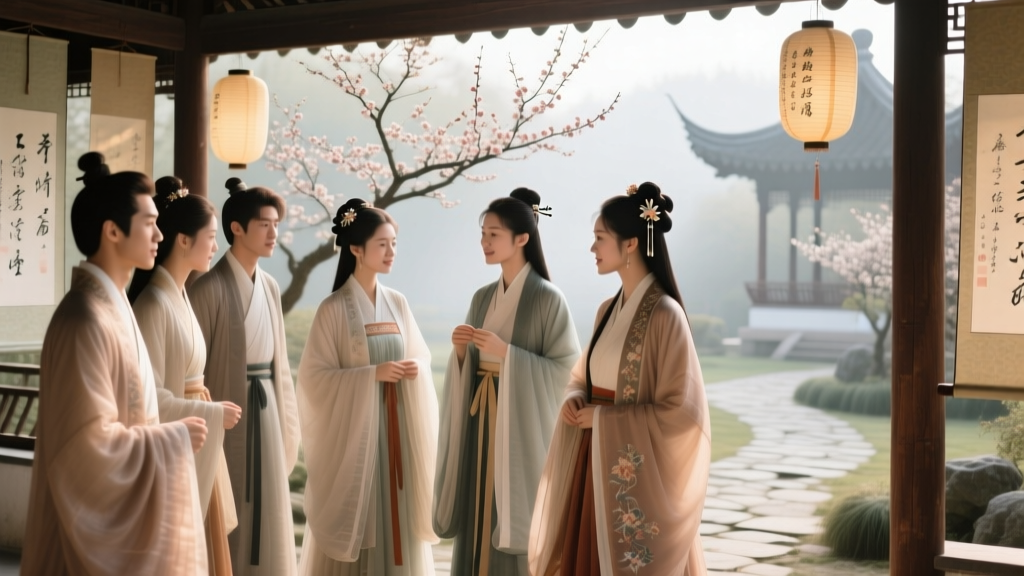
As the political and economic center of gravity shifted southward during the Song Dynasty (960–1279 CE), the Hanfu silhouette became more restrained, reflecting the rise of Neo-Confucianism. The Beizi emerged as a defining substyle of the Jiangnan region.
- Construction: A long, open-front coat with parallel lapels (Duijin) and dramatic side slits that extend up to the armpit. It is worn open over an inner top and skirt, creating a vertical, elongating line.
- Regional Fabric Influence: Song artisans in Hangzhou and Suzhou perfected subtle, monochromatic weaves. Instead of loud brocades, they utilized Keisi (Kesi) tapestry techniques and lightly patterned damasks that caught the soft, diffused light of the southern misty climate.
Ming Dynasty Mamianqun (马面裙): The Northern Structured Pleat
The Ming Dynasty (1368–1644 CE) saw the codification of many Hanfu garments that survive in modern museum collections. The most iconic substyle to emerge from this era, heavily influenced by northern equestrian needs, is the Mamianqun (horse-face skirt).
- Construction: The skirt consists of two overlapping flat panels (the "horse faces") at the front and back, with densely pleated sides. A standard artisanal Mamianqun features 12 to 16 knife pleats per side, mathematically calculated to allow the skirt to fall completely flat when standing, but expand dramatically when walking or riding.
- Regional Fabric Influence: The Ming court relied on Nanjing's legendary Yunjin (Cloud Brocade). This heavy, structurally rigid silk jacquard, woven with peacock feathers and gold thread, provided the necessary weight to hold the complex pleats of the Mamianqun in place against northern winds.
- Authoritative Insight: Exhibits at The Palace Museum in Beijing showcase Ming Mamianqun featuring intricate "Zhuanghua" (woven floral) motifs, demonstrating the zenith of northern loom technology.
Lingnan Region: Xiangyunsha (香云纱) Mud-Silk of the South
In the deep south, the Lingnan region (modern-day Guangdong) developed a highly specialized textile to combat extreme heat and humidity: Xiangyunsha, or Gambiered Canton Gauze. This is not just a fabric, but a regional substyle of summer Hanfu that remains highly prized today.
- The Dyeing Process: Mulberry silk is repeatedly soaked in the astringent juice of the Dioscorea cirrhosa plant, then coated with iron-rich river mud from the Pearl River Delta, and baked in the sun. This requires over 30 manual steps.
- Garment Application: Because the fabric is slightly stiff, water-resistant, and produces a distinct rustling sound, it is typically cut into loose, unlined Shenyi (deep robes) or wide-sleeved summer tops that do not cling to sweating skin.
Regional Textile Hubs and Fabric Composition
To accurately source or replicate regional Hanfu substyles, one must understand the historical textile hubs that produced them. The China National Silk Museum extensively documents these regional specialties.
| Region / Hub | Primary Fabric | Characteristics | Ideal Hanfu Substyle |
|---|---|---|---|
| Suzhou (Jiangsu) | Song Brocade / Kesi | Soft, intricate, matte finish | Song Beizi, Ruqun overlays |
| Nanjing (Jiangsu) | Yunjin (Cloud Brocade) | Heavy, metallic threads, stiff drape | Ming Mamianqun, winter Ao |
| Hangzhou (Zhejiang) | Hua Luo (Patterned Gauze) | Sheer, breathable, leno weave | Tang/Song summer inner layers |
| Shunde (Guangdong) | Xiangyunsha (Mud Silk) | Water-resistant, crisp, rustling | Lingnan summer Shenyi |
Modern Sourcing: Price Ranges and Artisan Cooperatives
For collectors and enthusiasts looking to purchase an authentic traditional Chinese hanfu dress, the market is segmented by material authenticity and weaving techniques. Beware of mass-produced polyester marketed as "vintage silk." Here is a practical buying framework based on current market rates:
- Entry-Level / Mass Market ($40 – $90 USD): Machine-made polyester or synthetic chiffon. These garments mimic the silhouettes of Tang Ruqun or Ming Aoqun but lack the drape, breathability, and historical accuracy of natural fibers. Suitable for casual cosplay or introductory wear.
- Mid-Tier / Commercial Silk ($120 – $280 USD): Garments made from standard mulberry silk, silk-cotton blends, or machine-jacquard brocades. Sourced primarily from Shengze (a major modern textile hub in Jiangsu). These offer excellent drape and are ideal for daily Hanfu wear and cultural festivals.
- High-End / Artisan Heritage ($400 – $1,500+ USD): Hand-woven Nanjing Yunjin, authentic Shunde Xiangyunsha, and hand-embroidered Suzhou silk. These pieces are often produced by heritage cooperatives and intangible cultural heritage (ICH) inheritors. A genuine, hand-loomed Mamianqun using real gold-wrapped thread can easily exceed $2,000 USD and is considered an investment-grade textile.
Cultural Protocols for Wearing Regional Hanfu
Wearing Hanfu requires adherence to specific cultural protocols, regardless of the regional substyle you choose. The most critical rule involves the collar orientation.
Jiaoling Youren (交领右衽): The left side of the collar must always cross over the right side, securing on the wearer's right side. In traditional Chinese cosmology, the left represents Yang (life, light, and the living), while the right represents Yin. Reversing this (right over left) is strictly reserved for dressing the deceased for burial. Wearing it incorrectly is considered deeply disrespectful and inauspicious.
Furthermore, when styling a Ming Dynasty Mamianqun, ensure the waistband is tied securely using the traditional knotting methods, hiding the ties within the pleats to maintain the clean, flat front panel. For Tang Dynasty garments, the use of a Pibo (silk shawl) draped over the arms is historically accurate and adds the necessary fluid movement characteristic of the era's southern-influenced court dress.
By understanding the profound impact of regional geography on textile production and garment construction, enthusiasts can move beyond superficial aesthetics. Whether donning the structured elegance of a northern Ming skirt or the breathable grace of southern Song gauze, wearing the traditional Chinese hanfu dress becomes an act of profound cultural preservation and historical embodiment.