Chinese Clothing Names: Symbolism and Hanfu Meanings

To understand traditional Chinese dress is to understand the philosophy, cosmology, and social structures of one of the world's oldest continuous civilizations. When scholars, designers, and cultural enthusiasts explore chinese clothing names, they quickly discover that these terms are not mere descriptive labels. Instead, the nomenclature of Hanfu (汉服) and subsequent historical garments serves as an architectural blueprint, a philosophical statement, and a historical record woven into the very fabric of the language.
This guide decodes the symbolism, etymology, and structural meanings behind essential Chinese garment terminology, offering a deep dive into how language and dress intertwine to reflect the harmony of heaven, earth, and humanity.
The Cosmology of the Wardrobe: Yi (衣) and Chang (裳)
At the foundational level of ancient Chinese sartorial language is the concept of Yi Chang (衣裳). In modern Mandarin, this compound word simply means 'clothes.' However, in the context of ancient Zhou dynasty (c. 1046–256 BCE) ritual dress, the two characters represent a profound cosmological duality.
- Yi (衣): The upper garment or jacket. It symbolizes Heaven (Qian), which is unformed, dynamic, and enveloping.
- Chang (裳): The lower skirt. It symbolizes Earth (Kun), which is structured, yielding, and supportive.
Wearing the Yi over the Chang was a physical manifestation of the universe's natural order. To reverse or disrupt this layering was considered a violation of cosmic harmony, a concept deeply embedded in Confucian ritual propriety (Li).
Decoding the Silhouette: Ruqun (襦裙) vs. Aoqun (袄裙)
As we trace the evolution of chinese clothing names through the Tang (618–907 CE) and Ming (1368–1644 CE) dynasties, the distinction between upper garments becomes highly specific, reflecting both climate adaptation and social status.
The Ru (襦) and the Qun (裙)
The Ruqun is the quintessential silhouette of the Tang dynasty. The Ru is a short, unlined or lightly lined jacket, typically ending at the waist or just below the bust. The Qun is the high-waisted skirt. The name itself dictates the proportion: a short top emphasizing a long, flowing lower half, creating the ethereal, elongated silhouette favored by Tang aristocrats. According to the Metropolitan Museum of Art's Heilbrunn Timeline of Art History, Tang textiles and garments were renowned for their vibrant silks and cosmopolitan influences, which the flowing Ruqun perfectly showcased.
The Ao (袄) and Structural Modesty
By the Ming dynasty, the nomenclature shifted toward the Aoqun. The Ao is a lined, often padded or quilted jacket that extends past the hips, worn over the skirt. The name Ao implies warmth, substance, and protection. This shift in naming reflects not only the colder climate of the Ming capital in Beijing but also a return to conservative, structured Confucian ideals, contrasting with the sheer, body-revealing styles of the Tang era.
The Mamianqun (马面裙): Anatomy of the 'Horse-Face' Skirt
Perhaps no term in the lexicon of chinese clothing names causes more confusion for Western observers than the Mamianqun, literally translated as the 'horse-face skirt.' The name has nothing to do with equestrian motifs; rather, it is a brilliant piece of structural engineering named after ancient Chinese city wall defenses.
In ancient fortification architecture, a 'horse-face' (mamian) was a protruding, flat, rectangular bastion on a city wall designed to eliminate blind spots and allow defenders to shoot at attackers from multiple angles. The skirt mimics this architecture through its unique paneling.
| Component Name | Chinese Term | Structural Function | Symbolic Meaning |
|---|---|---|---|
| Mamian (马面) | Horse-Face Panel | The flat, unpleated front and back panels. | Stability, modesty, and a canvas for auspicious embroidery (e.g., phoenixes, peonies). |
| Zhe (褶) | Pleats | The densely pleated side panels that allow for movement. | Fluidity, the flow of water, and the hidden dynamics of life beneath a calm exterior. |
| Yaobian (腰边) | Waistband | The sturdy cotton or linen band that anchors the silk skirt. | Grounding and practicality; hidden beneath the jacket, representing inner virtue over outward show. |
Today, the Mamianqun has experienced a massive renaissance in contemporary Chinese fashion. Authentic Ming-reproduction Mamianqun woven from genuine mulberry silk brocade typically range from $150 to $400 USD, while modern daily-wear versions in polyester jacquard can be purchased for $40 to $90 USD from specialized Hanfu artisans in Hangzhou and Suzhou, as documented by the China National Silk Museum.
Collar Cosmology: Jiaoling Youren (交领右衽)
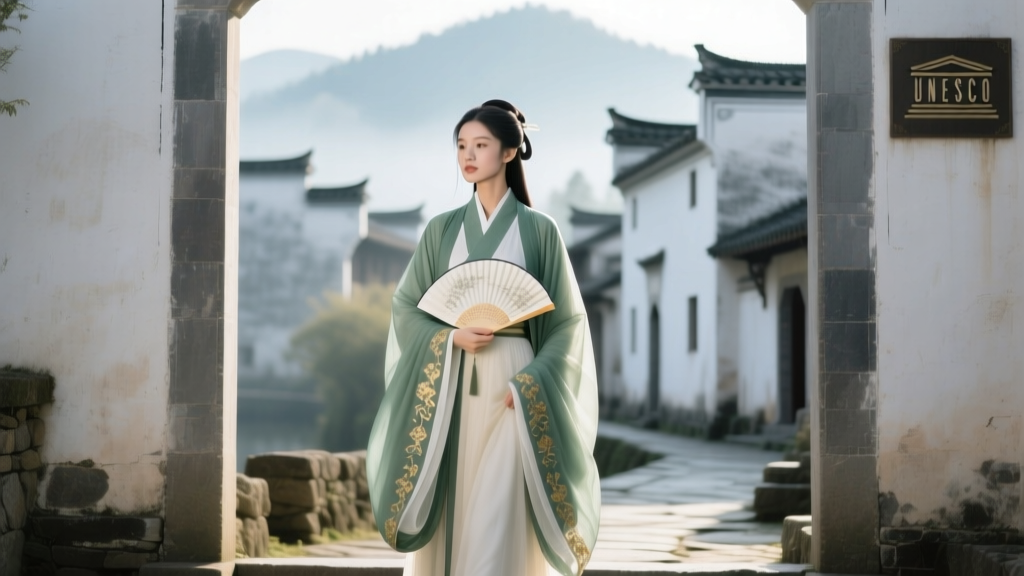
When examining the names of garment components, the collar construction holds immense cultural weight. The term Jiaoling Youren translates to 'crossed collar, right lapel.' This means the left side of the garment crosses over the right side, and the right lapel is hidden beneath.
'The right lapel (youren) is the defining characteristic of Huaxia (Chinese) civilization. To wear the left lapel over the right (zuoren) was strictly reserved for the deceased or considered the mark of foreign tribes.' — Curatorial notes on Chinese dress, Victoria and Albert Museum.
This nomenclature is rooted in Yin-Yang philosophy. The left represents Yang (life, the sun, the masculine), and the right represents Yin (death, the moon, the feminine). By wrapping the Yang (left) over the Yin (right), the living wearer harnesses the energy of life. Reversing this to Zuoren (left lapel) was the sartorial protocol for dressing the dead for burial, ensuring their safe passage into the Yin realm. Thus, the name of the collar style is a literal boundary between life and death.
Dynastic Shifts: From Hanfu to Qipao (旗袍)
The evolution of chinese clothing names also maps the turbulent history of China's borders and ethnic integrations. The term Hanfu (汉服) literally means 'clothing of the Han people,' a retrospective term popularized in the early 2000s to describe the pre-Qing indigenous dress of the Han ethnic majority.
Following the Manchu conquest and the establishment of the Qing dynasty (1636–1912 CE), the ruling class enforced the Tifa Yifu (剃发易服) edict, demanding Han men adopt the Manchu queue hairstyle and Manchu clothing. The Manchu banner system gave rise to the Qipao (旗袍) or Cheongsam (长衫), translating to 'banner robe' or 'long shirt.'
While the original Qing Qipao was a loose, floor-length, heavily embroidered garment designed to conceal the figure and denote Manchu ethnic identity, the name remained when 1920s Shanghai tailors radically re-engineered it. They introduced Western darting, high slits, and set-in sleeves, transforming the 'banner robe' into the form-fitting, modern icon of Chinese femininity. The name survived, but the structural meaning was entirely rewritten by modernity.
Practical Buying Guide: Navigating Markets by Terminology
For collectors, cosplayers, and cultural enthusiasts looking to purchase authentic garments, understanding these names is crucial for avoiding mass-produced, historically inaccurate costumes. Use this framework when shopping from specialized artisans or platforms like Taobao and dedicated Hanfu boutiques:
- Verify the Fabric Name: Look for Zhen Si (真丝 - genuine mulberry silk) or Shu Jin (熟锦 - mature brocade). Avoid listings that only say 'silk-like' or 'ice silk' (a synthetic viscose blend) if you want historical accuracy.
- Check the Construction Terms: A true Mamianqun should list the number of pleats (e.g., 12-zhe or 24-zhe). If the skirt is simply gathered at the waist without flat front panels, it is a Western-style dirndl, not a Mamianqun.
- Understand the Embroidery Nomenclature: Su Xiu (苏绣) refers to Suzhou embroidery, known for its fine, delicate, double-sided stitching. Gu Xiu (顾绣) is a highly prized, painting-like embroidery style. Garments featuring genuine hand-done Su Xiu will easily exceed $500 USD and require months of lead time.
- Collar Specifications: Ensure the product description explicitly states Youren (right lapel). Many fast-fashion manufacturers mistakenly produce Zuoren (left lapel) garments due to mirrored photography or lack of cultural knowledge, which is highly offensive in traditional contexts.
The Living Lexicon of Chinese Dress
The study of chinese clothing names reveals that traditional Asian garments are not static relics of the past. They are living, breathing texts. Every pleat in a Mamianqun, every crossed lapel in a Ruqun, and every shift from Yi to Ao tells a story of philosophical beliefs, architectural ingenuity, and historical resilience. By learning the true names and meanings of these garments, we do more than dress ourselves; we wear the history, cosmology, and enduring spirit of Chinese civilization.