China Hanfu Guide: History, Styles, Culture

Beyond the Qipao: Defining the True China Hanfu
When the world envisions traditional Chinese clothing, the mind often drifts to the form-fitting qipao (cheongsam) or the brocade Tang suit. However, these garments are relatively modern, heavily influenced by Manchu tailoring of the Qing Dynasty (1644–1912) and 1920s Western fashion. The true ancestral dress system of the Han Chinese people—spanning over three millennia—is the China hanfu (汉服). Translating literally to 'Han clothing,' hanfu is not a monolithic costume, but a complex, evolving sartorial ecosystem deeply intertwined with Chinese philosophy, social hierarchy, and textile innovation.
This historical and cultural guide decodes the anatomy, evolution, and modern renaissance of hanfu, offering a comprehensive framework for understanding one of Asia's most significant textile traditions.
The Dynastic Evolution: From Antiquity to the Ming Golden Age
The history of hanfu is generally categorized by dynastic shifts, each introducing distinct silhouettes, textile technologies, and cultural influences. While mythological origins trace back to the Yellow Emperor (Huangdi), archaeological evidence grounds the development of hanfu in the Shang and Zhou dynasties.
Pre-Qin and Han Dynasty: Establishing the Silhouette
During the Zhou Dynasty (c. 1046–256 BCE), clothing became codified through the Zhouli (Rites of Zhou), establishing dress as a marker of cosmic order and social rank. The foundational silhouette was established: the shenyi (deep robe), which connected the upper garment (yi) and lower skirt (chang) into a single piece. The Han Dynasty (202 BCE – 220 CE) refined this, utilizing lightweight, intricately woven silks. The Mawangdui tomb excavations (dated 168 BCE) revealed astonishingly preserved hanfu garments, showcasing the era's mastery of gauze, brocade, and embroidery, as documented by institutions like The Metropolitan Museum of Art's timeline on Chinese Silk.
Tang Cosmopolitanism and Song Minimalism
The Tang Dynasty (618–907 CE) marked a period of immense wealth and Silk Road exchange. Women's hanfu became more liberal and voluminous, featuring high-waisted ruqun (jacket and skirt ensembles), wide sleeves, and the introduction of the banbi (half-sleeved jacket). In stark contrast, the subsequent Song Dynasty (960–1279 CE) favored intellectual minimalism. Garments became slender, understated, and utilized muted, elegant color palettes, reflecting the rise of Neo-Confucianism.
The Ming Dynasty: The Zenith of Artisan Craftsmanship
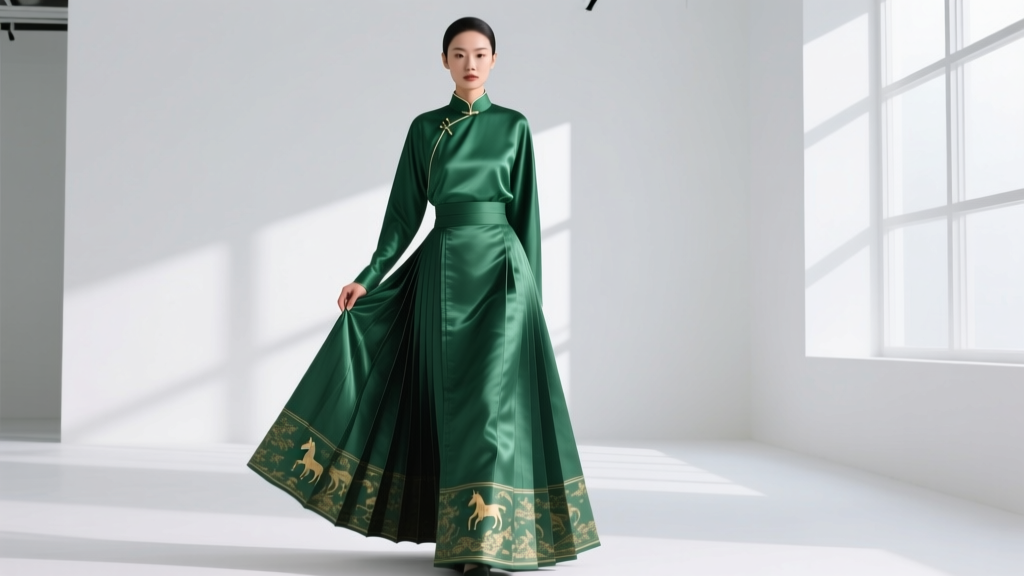
The Ming Dynasty (1368–1644 CE) represents the most critical era for modern hanfu revivalists. Because of the relatively recent timeline and favorable tomb conditions, a vast number of intact Ming garments survive today. This era popularized the aoqun (a lined jacket worn over a skirt) and the iconic mamianqun (horse-face skirt), a wrap skirt featuring flat front and back panels with heavily pleated sides, often woven with metallic gold threads.
Anatomical Breakdown: The Philosophy of Hanfu Construction
Unlike Western tailoring, which relies on darts, curved seams, and structured shoulders to mold fabric to the human body, traditional China hanfu utilizes pingmian jiancai (flat pattern cutting). The fabric is cut in straight lines and folded, prioritizing the drape, flow, and preservation of the textile's integrity.
'The right lapel over the left is the boundary between civilization and the wild, between the living and the deceased.' — Traditional Confucian sartorial philosophy.
Core Structural Elements
- Jiaoling Youren (Cross-Collar, Right Lapel): The most defining feature of hanfu. The left side of the collar crosses over the right, securing on the wearer's right side. Crossing right-over-left was historically reserved for the deceased or considered 'barbarian' dress.
- Xiuzi (Sleeves): Sleeves are cut wide and often feature a curved underarm seam. Formal sleeves can extend past the fingertips, designed to elegantly conceal the hands and create a sweeping, dramatic line during movement.
- Yindai (Ties and Sashes): Traditional hanfu eschews buttons and buttonholes, which were viewed as utilitarian and disruptive to the fabric's flow. Instead, garments are secured using internal and external fabric ties (ji) and wide sashes.
Dynasty-Specific Styles: A Comparative Overview
To understand the diversity within the hanfu umbrella, one must look at the distinct garments favored across different historical epochs. The following table outlines the primary garments associated with major dynastic periods.
| Dynasty | Key Garment Name | Silhouette & Characteristics | Primary Textiles |
|---|---|---|---|
| Han (202 BCE–220 CE) | Shenyi (Deep Robe) | One-piece robe, wrapping right lapel, flowing triangular hem. | Lightweight silk gauze, hemp, ramie. |
| Tang (618–907 CE) | Qixiong Ruqun | Chest-high skirt tied with a sash, paired with wide-sleeved tops. | Heavy silk brocades, patterned damasks. |
| Song (960–1279 CE) | Beizi (Outer Coat) | Long, straight, open-front coat worn over narrow-sleeved inner tops. | Crepe silks, fine linens, subtle weaves. |
| Ming (1368–1644 CE) | Mamianqun (Horse-face Skirt) | Pleated wrap skirt with flat front/back panels, paired with lined Ao jackets. | Zhuanghua (brocade), zari (gold-wrapped thread). |
Fabric, Color Symbolism, and Artisan Techniques
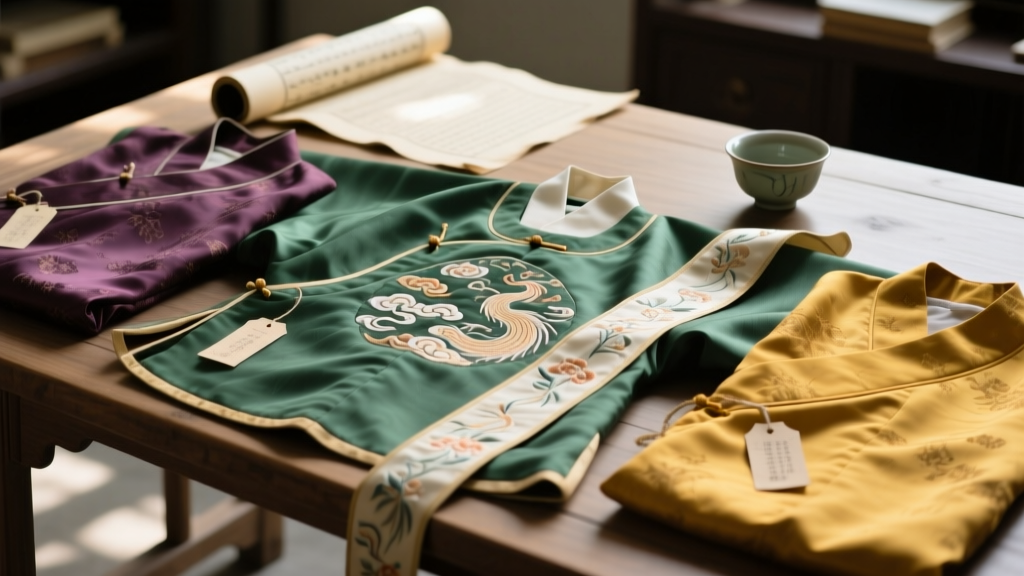
The cultural weight of hanfu extends into its dyeing and weaving techniques. Ancient Chinese color theory was rooted in the Wuxing (Five Elements) philosophy. The five standard colors—Qing (green/blue), Chi (red), Huang (yellow), Bai (white), and Hei (black)—corresponded to wood, fire, earth, metal, and water, respectively.
Imperial yellow was strictly reserved for the Emperor, while vermilion and deep purples denoted high-ranking officials. The extraction of these dyes was a painstaking artisan process. For instance, achieving a true, colorfast crimson required multiple immersions in madder root or safflower extracts. According to the Victoria and Albert Museum's archives on Chinese Textiles, the complexity of Chinese silk weaving—particularly the drawloom technology developed during the Han and Tang periods—laid the groundwork for the global textile trade, heavily influencing Persian and European weaving traditions.
The Modern Hanfu Movement (Hanfu Fuxing)
After the Qing Dynasty mandated the adoption of Manchu dress (leading to the decline of hanfu), the garment largely vanished from daily life for over three centuries. The modern Hanfu Yundong (Hanfu Movement) began in earnest around 2003, sparked by grassroots cultural enthusiasts who began wearing historically reconstructed garments in public spaces. Today, it is a massive cultural phenomenon driven by Gen Z and Millennial demographics, blending historical reverence with modern lifestyle integration.
Navigating Authenticity and Modern Pricing
For collectors, cultural practitioners, and enthusiasts, the market for China hanfu is vast but requires careful navigation to distinguish between historical reconstructions and 'fantasy' wear (often sold as studio photography costumes). Here is a practical pricing and quality framework for purchasing authentic hanfu today:
- Entry-Level / Mass-Produced (150 – 400 RMB / $20 – $55 USD): Typically made from polyester blends or basic cotton. Patterns are machine-embroidered or printed. Suitable for casual wear and beginners, though historically inaccurate in fabric drape.
- Mid-Tier / Enthusiast Grade (500 – 1,200 RMB / $70 – $165 USD): Utilizes natural fibers like linen, ramie, and mulberry silk. Features better tailoring, accurate historical patterning (based on extant artifacts), and intricate jacquard weaving.
- Museum-Grade / Artisan Custom (2,500 – 10,000+ RMB / $350 – $1,400+ USD): Commissioned from specialized artisan cooperatives. Employs traditional hand-loomed silks, real gold-leaf wrapped threads, and hand-embroidery techniques recognized by UNESCO as Intangible Cultural Heritage. These pieces are museum-quality investments.
Cultural Protocols: Wearing Hanfu Today
Wearing hanfu is an act of cultural reclamation, but it comes with specific protocols to maintain respect for the tradition. First, the jiaoling youren (right lapel) rule must never be violated; wearing it left-over-right is considered highly inauspicious and offensive, as it is the traditional dressing method for the deceased.
Second, while historical accuracy in hair and makeup is appreciated, modern wearers often blend hanfu with contemporary aesthetics. However, for formal ceremonies—such as the Guanli (male coming-of-age) or Jili (female coming-of-age), or traditional festivals like the Mid-Autumn Festival (Zhongqiujie)—adhering to dynasty-specific styling, including appropriate headwear like the guan or hairpins (zan), elevates the practice from mere costuming to genuine cultural participation.
By understanding the deep historical roots, structural philosophies, and modern revival of China hanfu, we move beyond superficial fashion trends and engage with a living, breathing testament to Han Chinese heritage and artisan mastery.