Cheongsam vs Qipao: History & Nuance
When exploring the rich tapestry of Asian traditional garments, few silhouettes are as globally recognized—or as frequently misunderstood—as the form-fitting, high-collared gown of China. For collectors, historians, and enthusiasts, a common question arises: what is the exact distinction in the cheongsam dress vs qipao debate? Are they two separate garments, or merely two words for the same iconic dress?
The short answer is that they refer to the same fundamental garment. However, the terms qipao and cheongsam represent entirely different linguistic roots, regional evolutions, and historical eras. To understand the difference is to understand the socio-political shifts of 20th-century China, the diaspora of master tailors, and the fusion of Eastern flat-cutting techniques with Western sartorial structuring.
The Linguistic Divide: Mandarin vs. Cantonese Origins
To untangle the cheongsam dress vs qipao discussion, we must first look at linguistics and geography. The garment’s name changes depending on the dialect of the region that popularized it during specific historical windows.
Qipao (旗袍): The Shanghai and Beijing Standard
In Mandarin, the garment is known as the qipao (pronounced chee-pow), which translates literally to 'banner gown.' This term traces its etymology back to the Qing Dynasty (1644–1912), where the Manchu ruling class organized their society into the 'Eight Banners' system. The traditional Manchu robe was a loose, floor-length, one-piece garment worn by both men and women. When female students and progressive women in 1920s Shanghai began modernizing this loose robe to advocate for gender equality, they retained the Mandarin term qipao. Today, 'qipao' remains the standard academic and colloquial term in mainland China.
Cheongsam (長衫): The Cantonese and Diaspora Evolution
The word cheongsam is the English transliteration of the Cantonese pronunciation of chèuhng sàam (長衫), which simply translates to 'long gown.' As political turmoil engulfed Shanghai in the 1940s, many of the city’s master tailors fled south to Hong Kong. In the Cantonese-speaking hub of Hong Kong, the garment was further tailored, tightened, and popularized throughout the mid-20th century. Because Westerners and the Southeast Asian diaspora were primarily exposed to the garment via Hong Kong and Cantonese immigrants, 'cheongsam' became the globally recognized English term.
Evolution of the Silhouette: A Century of Transformation
The physical differences between what one might call a 'traditional qipao' and a 'mid-century cheongsam' are rooted in the tailoring philosophies of their respective eras.
The 1920s and 1930s: The Golden Era of the Qipao
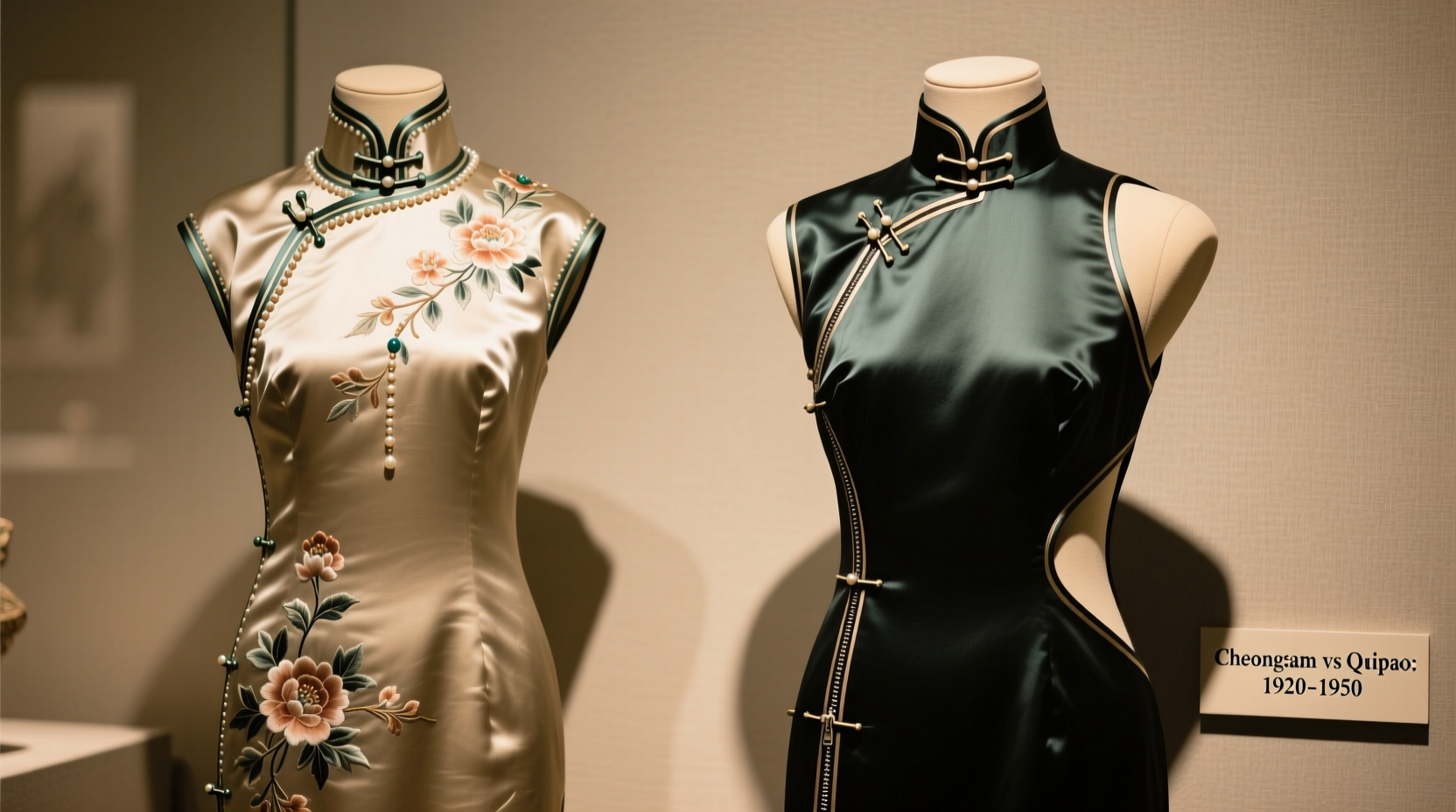
During the May Fourth Movement, Chinese women sought liberation from restrictive, multi-layered Hanfu and Qing-era separates. The early qipao was an A-line, relatively loose garment that obscured the body's natural curves, featuring a high Mandarin collar and side slits for mobility. According to archives at the Victoria and Albert Museum's Asian Collections, the 1930s Shanghai qipao reached its zenith of elegance, utilizing lightweight crepe silks, Art Deco geometric prints, and subtle western draping while maintaining traditional Chinese flat-cutting (pingcai).
The 1950s and 1960s: The Hong Kong Cheongsam
By the time the garment reached mid-century Hong Kong, the silhouette had drastically changed. The 'cheongsam' of the 1950s and 60s was highly structured. Tailors incorporated Western bust darts, waist shaping, and set-in sleeves to create a skin-tight, hourglass silhouette. This era popularized the use of heavy silk brocades, stiff collars, and the iconic, floor-grazing hemlines with dramatic thigh-high slits. This is the version of the dress immortalized by Maggie Cheung in Wong Kar-wai’s cinematic masterpiece In the Mood for Love.
'The transition from the Shanghai qipao to the Hong Kong cheongsam represents a fascinating dialogue between traditional Chinese textile philosophy, which honors the two-dimensional plane of the fabric, and Western tailoring, which seeks to sculpt the three-dimensional human form.' — Notes from the Metropolitan Museum of Art's Heilbrunn Timeline of Art History.
Anatomy and Construction: What Makes an Authentic Gown?
Whether you refer to it as a qipao or a cheongsam, authentic construction requires highly specialized artisan skills that are increasingly rare today.
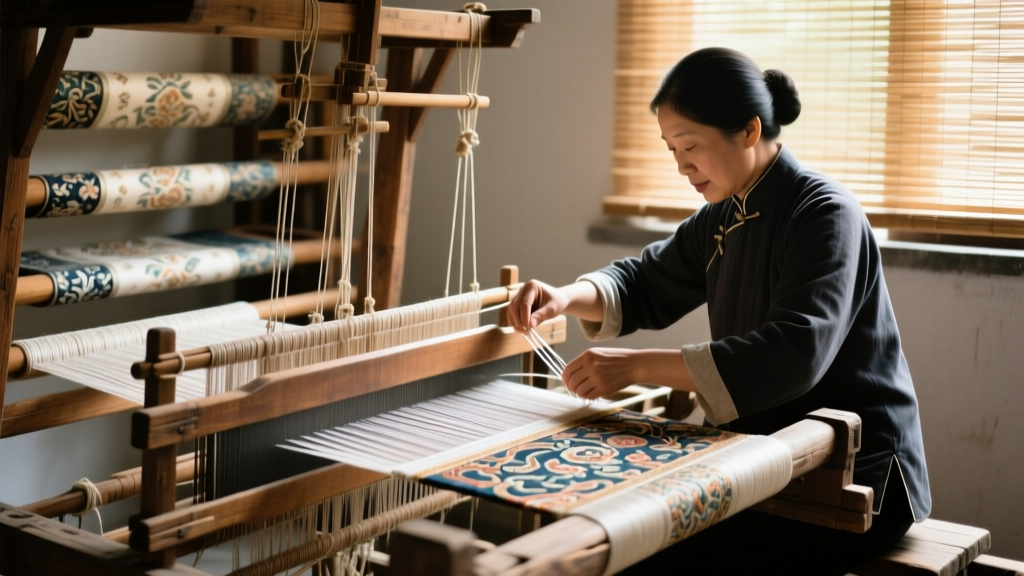
- Pingcai (Flat Cutting): Traditional gowns are cut from a single piece of fabric with minimal seams, meaning the grain of the silk flows uninterrupted across the shoulders and down the back. This requires immense skill to fit properly without Western darts.
- Pan Kou (Frog Fasteners): These are not merely decorative buttons; they are functional, hand-woven silk knots. Artisans spend hours crafting intricate motifs—such as plum blossoms, swallows, or ruyi clouds—using a technique that involves wrapping silk thread around a stiffened core.
- The Collar (Liling): An authentic collar is heavily interfaced to stand perfectly upright, framing the jawline and forcing the wearer into a posture of natural elegance. It should not gap or wrinkle when the wearer turns their head.
- Slits (Kaicha): Originally designed to allow women to ride horses or step into rickshaws, the side slits are meticulously finished with interior silk bindings to prevent fraying and ensure the skirt drapes gracefully when walking.
Data Comparison: Qipao vs. Cheongsam at a Glance
| Feature | Qipao (Mandarin Context) | Cheongsam (Cantonese/Global Context) |
|---|---|---|
| Literal Translation | Banner Gown | Long Gown |
| Primary Cultural Hub | Shanghai & Beijing (1920s–1940s) | Hong Kong & Southeast Asia (1950s–Present) |
| Tailoring Philosophy | Traditional Pingcai (flat-cut), forgiving drape | Western-influenced 3D darting, form-fitting |
| Common Fabrics | Lightweight crepe silk, cotton, wool blends | Heavy silk brocade, jacquard, lace |
| Modern Connotation | Academic, historical, mainland formal wear | Diaspora identity, global fashion, hospitality |
Buying Guide: Sourcing Authentic Garments Today
If you are looking to invest in an authentic piece, understanding where and how to shop is crucial. Mass-produced, fast-fashion 'qipao' costumes often feature zippers running down the entire back and faux frog buttons that are simply sewn over a hidden zipper. A true garment relies on the side-opening wrap closure (dajin) secured by functional pan kou.
Bespoke Pricing and Regional Hubs
Shanghai (The Qipao Capital): For historically accurate, flat-cut qipaos, head to Shanghai’s Changle Road or Maoming South Road, home to multi-generational tailoring houses. Bespoke pricing generally ranges from 3,500 to 15,000 RMB ($500 to $2,100 USD), depending on the complexity of the pan kou and whether you select premium Xiangyunsha (a rare, mud-dyed silk from Guangdong).
Hong Kong (The Cheongsam Capital): For the glamorous, tightly tailored mid-century cheongsam, visit the tailor alleys of Causeway Bay or the historic arcades of Central. Bespoke cheongsams here typically cost between 6,000 and 25,000 HKD ($750 to $3,200 USD). Institutions like the Shanghai History Museum often collaborate with Hong Kong artisans to preserve these specific tailoring techniques.
Ready-to-Wear Alternatives
For those not ready to invest in bespoke, contemporary brands like Blancore or Mukzin offer modernized, ready-to-wear interpretations that respect the garment's structural integrity while adapting it for daily wear, usually priced between $150 and $400 USD.
Cultural Protocols and Modern Etiquette
Wearing a qipao or cheongsam carries significant cultural weight. In mainland China, the qipao is frequently worn by brides (often in red, symbolizing luck and prosperity), diplomats, and hospitality professionals. In the global diaspora, the cheongsam is a powerful symbol of heritage, often worn during Lunar New Year, weddings, and coming-of-age celebrations.
For non-Chinese individuals wishing to wear the garment, the line between appreciation and appropriation relies heavily on context and respect. Avoid wearing cheap, mass-market 'costume' versions that sexualize or caricature the dress. Instead, purchase from authentic Chinese artisans or heritage brands, ensure the fit is modest and structurally correct, and take the time to understand the garment's rich history. Pairing the gown with traditional jade jewelry or hand-embroidered silk shoes elevates the ensemble and demonstrates a genuine respect for the culture that birthed this timeless silhouette.
Conclusion
Ultimately, the 'cheongsam dress vs qipao' debate is not a battle of two different garments, but a celebration of one garment's incredible journey. Whether you use the Mandarin qipao to honor its revolutionary 1920s Shanghai roots, or the Cantonese cheongsam to acknowledge its mid-century Hong Kong glamour, you are participating in a century-old dialogue about femininity, modernity, and Chinese cultural identity. By understanding the nuanced history, construction, and regional variations of this iconic dress, wearers and collectors can help preserve its legacy for generations to come.