Decoding the Cheongsam Collar: Symbolism, History, and Style

The Anatomy of the Standing Band
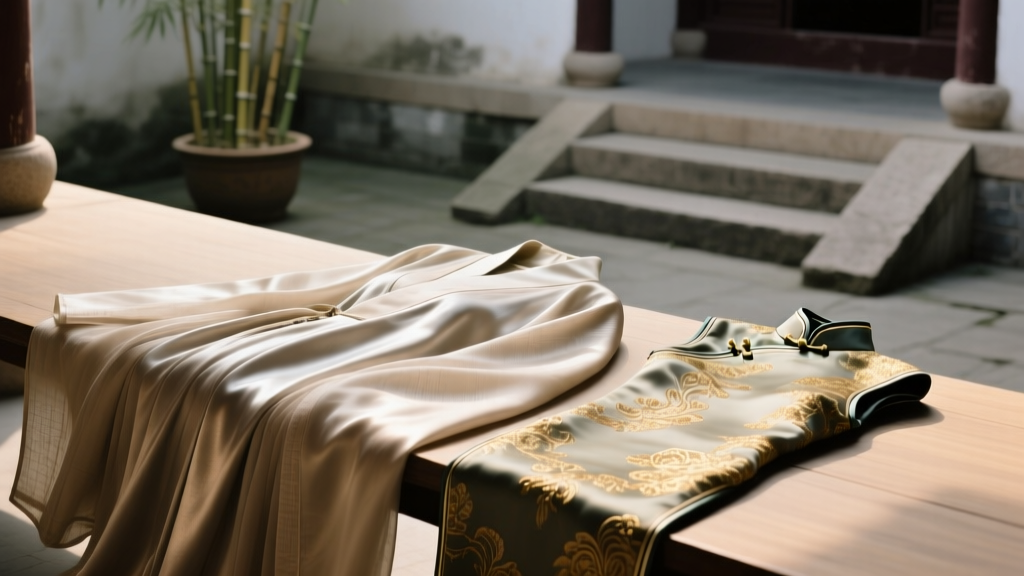
The cheongsam collar (often referred to in Western tailoring as the mandarin collar or standing collar) is far more than a simple neckline finish. In traditional Chinese garment construction, it is known as the ling (领). A masterfully crafted cheongsam collar is a marvel of structural engineering, designed to frame the face, support the neck, and dictate the wearer's posture.
Physically, the modern collar stands between 3.5 cm and 5.5 cm high. It is constructed using an outer fabric shell, an inner lining, and a crucial middle layer of interfacing. While mass-produced garments use fusible synthetic interfacings that may bubble or warp after dry cleaning, traditional master tailors utilize hand-stitched horsehair canvas and layered cotton. This technique, known as pad-stitching, allows the collar to mold to the unique curvature of the wearer's neck over time, creating a bespoke fit that synthetic stiffeners cannot replicate.
The front edges of the collar meet at the center throat, typically secured by one to three pankou (knotted frog closures). The precise angle of the collar's top edge—whether gently curved (yuanling), sharply squared (fangling), or sculpted into a wave (shuihuling)—drastically alters the visual weight of the jawline and the overall formality of the garment.
Historical Evolution: From Banner Dress to Shanghai Glamour
The Qing Dynasty Origins (Qizhuang)
To understand the symbolism of the cheongsam collar, we must trace its lineage to the Qing Dynasty (1644–1912). The precursor to the cheongsam was the qizhuang, the traditional dress of Manchu banner women. During this era, the high-standing collar was often a separate, detachable accessory known as a lingyi. According to historical textile archives preserved by institutions like the Metropolitan Museum of Art, these early collars were heavily embroidered, serving as protectors for the main garment's neckline and as canvases for displaying familial wealth and rank.
The 1920s Shanghai Revolution
The modern iteration of the cheongsam (qipao) emerged in the cosmopolitan hub of 1920s Shanghai. As Chinese women entered universities and the workforce during the May Fourth Movement, they sought clothing that reflected modernity and gender equality. Tailors integrated Western darting and set-in sleeves into the traditional one-piece gown. The collar was permanently attached, raised higher, and stiffened. This haipai (Shanghai-style) collar became a symbol of the 'New Woman'—educated, emancipated, yet deeply rooted in Chinese cultural identity.
Decoding Symbolism: Posture, Modesty, and Status
The cheongsam collar is heavily laden with cultural semiotics. Its primary symbolic function is the enforcement of physical and social grace.
The Architecture of Posture
A properly fitted 5 cm stiff collar physically restricts the wearer from slouching or dropping their chin to their chest. It forces the spine to align, the shoulders to roll back, and the neck to elongate, resulting in a 'swan-like' bearing. In traditional Chinese aesthetics, this upright posture is synonymous with moral integrity, dignity, and inner strength. The collar acts as a physical reminder of one's public persona and social grace.
Modesty vs. Sensuality
Culturally, the high collar serves a dual purpose. On one hand, it adheres to traditional Confucian ideals of modesty by completely concealing the collarbones and the base of the neck. On the other hand, by tightly framing the jawline and exposing the nape of the neck when the hair is pinned up, it introduces a subtle, sophisticated sensuality. This juxtaposition of strict coverage and elegant framing is the hallmark of 1930s Shanghai glamour, a visual language extensively documented in the Hong Kong Museum of History's textile exhibitions.
Regional Variations in Collar Architecture
While the cheongsam is a unified national garment, regional tailoring schools have developed distinct collar philosophies. The table below outlines the primary variations recognized by master tailors and cultural historians.
| Regional Style | Native Term | Typical Height | Stiffness & Structure | Edge Shape & Aesthetic |
|---|---|---|---|---|
| Shanghai (Haipai) | 海派 | 4.5 cm - 5.5 cm | Very stiff; heavy horsehair canvas. Molds tightly to the neck. | Gently curved (yuanling). Sleek, cosmopolitan, and highly formal. |
| Beijing (Jingpai) | 京派 | 3.5 cm - 4.5 cm | Moderate stiffness. Retains more traditional, relaxed draping. | Often squared or slightly wider. Conservative, dignified, and academic. |
| Cantonese (Yuepai) | 粤派 | 3.0 cm - 4.0 cm | Softer, lighter interfacing to accommodate humid subtropical climates. | Lower, sometimes featuring a slight V-notch for breathability. Practical. |
The Pankou Knot: Fastening as Metaphor
The collar is almost always secured by pankou (盘扣), intricately knotted fabric closures. Beyond their mechanical function, these knots are profound symbols. A single knot at the throat represents unity and focus. Three knots along the collar and clavicle represent the harmony of heaven, earth, and humanity.
The motifs woven into the knots carry specific wishes. A butterfly knot (hudie kou) symbolizes romance and joy, often worn by younger women or brides. A plum blossom knot represents resilience and endurance, as the plum blossom blooms in the harsh winter. Crafting a single, complex pankou can take a master artisan up to four hours of meticulous hand-rolling and stitching.
Practical Guide: Fitting, Fabrics, and Pricing
For collectors, brides, or cultural enthusiasts seeking an authentic cheongsam, understanding the nuances of the collar is essential for a successful commission or purchase.
How to Measure for a Bespoke Collar
The most common error in off-the-rack cheongsams is a collar that chokes the wearer or gaps awkwardly. A master tailor measures the neck circumference and adds exactly 1 cm to 1.5 cm of ease. Furthermore, they employ the 'two-finger rule': you should be able to comfortably slide two fingers between the collar and your neck. Crucially, the center front of the collar band should have a microscopic 0.5 cm gap; when the garment is buttoned, the tension pulls it closed, but this gap prevents the stiff fabric from digging into the throat when the head is turned.
Fabric Stiffness and Interfacing
The choice of fabric dictates how the collar behaves. Heavy silk brocades (zhijin) and mud-dyed silks (Xiangyunsha) possess natural body and hold a stiff collar shape beautifully. Conversely, fluid silk crepes or lightweight linens require aggressive internal interfacing to prevent the collar from collapsing, which can result in an unnatural, cardboard-like appearance. When commissioning a garment in lightweight silk, request a 'soft-roll' standing collar, which uses minimal canvas and allows the top edge to gently fold over.
Price Tiers and Artisan Sourcing
Investing in a cheongsam is an investment in intangible cultural heritage. Pricing varies wildly based on the origin and the tailor's pedigree:
- Ready-to-Wear (Commercial): $80 – $250 USD. Collars are fused with synthetic interfacing; edge shapes are standardized. Suitable for casual wear or single-use events.
- Made-to-Measure (Boutique): $400 – $900 USD. Found in specialized boutiques in Hong Kong or Shanghai. Measurements are adjusted, and you can select collar height and pankou styles. Better canvas construction.
- Master Artisan Bespoke: $1,500 – $5,000+ USD. Commissioned from heritage tailors (such as those on Shanghai's Changle Road or Hong Kong's legendary Linva). Includes multiple muslin fittings, hand-stitched horsehair canvas collars, and hand-rolled pankou. As noted by the Victoria and Albert Museum's Asian textile archives, these garments are constructed to be heirloom pieces, with the collar serving as the structural anchor of the entire gown.
Ultimately, the cheongsam collar is a masterclass in sartorial tension. It is restrictive yet empowering, historically rooted yet continuously evolving. To wear a well-crafted cheongsam collar is to wear a piece of living history, one that demands—and rewards—with unparalleled elegance.