Black Hanfu Male Styles: A Historical and Cultural Guide
The Philosophy of Xuan: Black in Chinese Antiquity
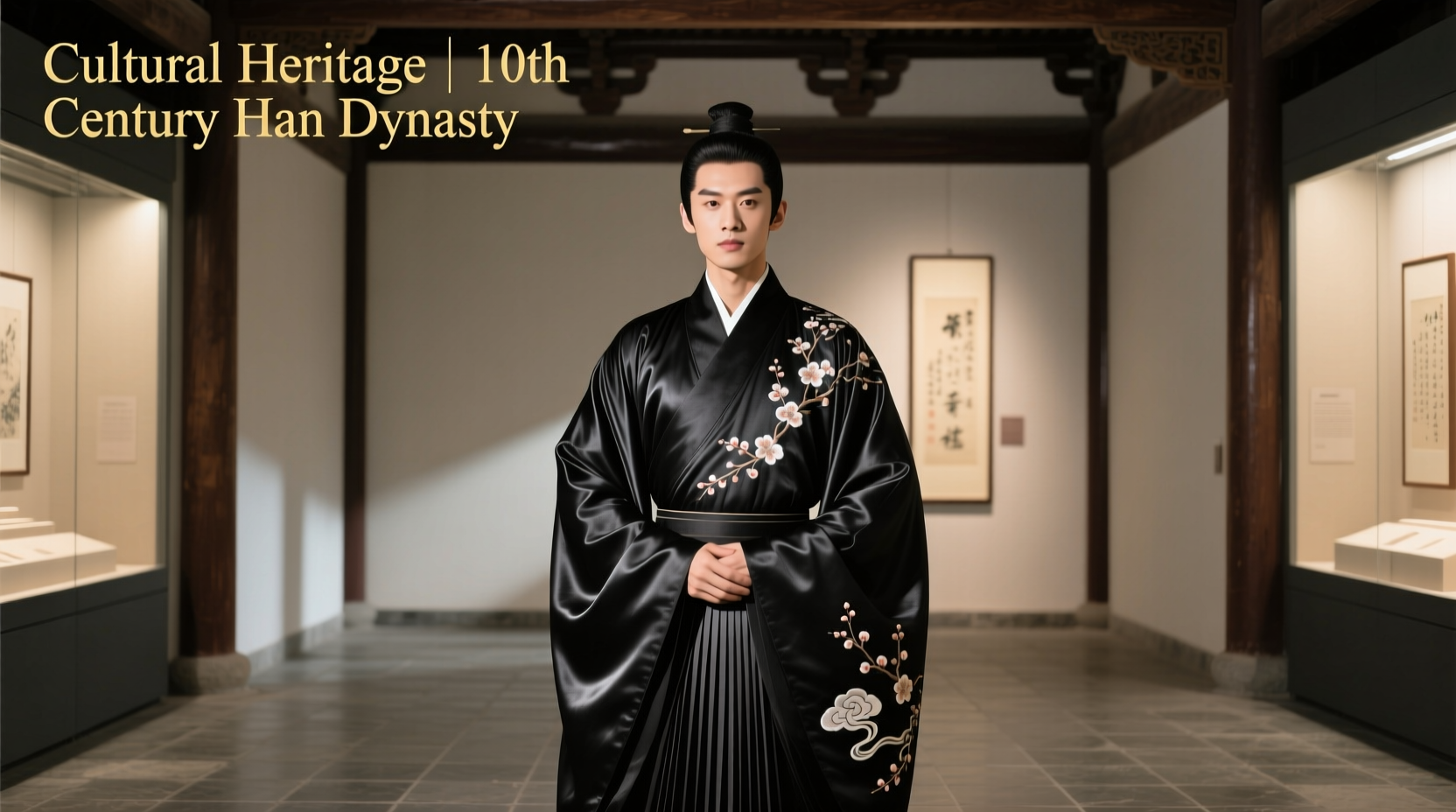
When exploring the traditional wardrobe of East Asia, the black hanfu male aesthetic stands out for its profound philosophical roots and striking visual authority. In Western fashion, black is often associated with mourning or modern minimalism. However, in traditional Chinese culture, black—specifically the deep, resonant shade known as Xuan (玄)—holds a vastly different significance. Xuan translates not merely to the absence of light, but to the profound, mysterious color of the heavens just before dawn. It is the color of the Dao, representing depth, scholarly introspection, and cosmic origin.
Historically, the elevation of black in male attire peaked during the Qin Dynasty (221–206 BCE). Emperor Qin Shi Huang, guided by the Five Elements theory (Wuxing), aligned his rule with the Water element, whose corresponding color is black. Consequently, imperial robes, official banners, and male formal wear were predominantly dyed in deep, dark shades. This established a lasting precedent: while later dynasties introduced vibrant colors for court hierarchies, black remained a foundational color for scholars, philosophers, and men of solemn authority. Today, the black hanfu male wardrobe is a testament to this enduring legacy of intellectual and quiet dignity.
Anatomy of the Black Hanfu Male Wardrobe
The term 'Hanfu' encompasses thousands of years of sartorial evolution. For men seeking authentic black garments, three primary silhouettes dominate the historical and modern landscape, each with distinct construction rules and cultural contexts.
Daopao (道袍): The Scholar's Dark Robe
Despite its literal translation as 'Daoist robe,' the Daopao was the quintessential everyday garment for Ming Dynasty (1368–1644) scholars and literati. When crafted in black or deep indigo, it projects an aura of refined modesty. The defining feature of the Daopao is its anbai (暗摆), or hidden side pleats. These intricate internal folds are sewn into the side seams, allowing the robe to flare gracefully when walking while maintaining modesty and structural integrity. The sleeves are typically wide and curved, and the collar follows the strict Jiaoling Youren (交领右衽) rule—crossing at the front with the left lapel over the right.
Yuanlingpao (圆领袍): The Round-Collared Official Robe
Originating from nomadic influences and fully sinicized by the Tang (618–907 CE) and Song (960–1279 CE) dynasties, the Yuanlingpao is a round-collared robe that served as standard official and formal wear. A black Yuanlingpao, often fastened with a leather or jade-studded belt, was common for mid-to-high-ranking officials during specific ceremonial duties. The garment features side slits (kaicha) for ease of movement, particularly when riding horseback. According to artifacts preserved at the Metropolitan Museum of Art, the cut of the Yuanlingpao evolved from the snug, tailored fits of the Tang era to the broader, more imposing silhouettes of the Ming.
Shenyi (深衣): The Ancient Cross-Collar Classic
The Shenyi is one of the oldest Hanfu styles, dating back to the pre-Qin and Han dynasties. It is a one-piece robe that connects the upper garment (yi) and lower skirt (chang). The most famous variant, the Curved-Hem Shenyi (曲裾), wraps around the body in a spiraling manner. In deep black hemp or early silk, the Shenyi was worn by scholars and officials during rites and sacrifices. The construction traditionally utilizes 12 fabric panels in the lower half, symbolizing the 12 months of the year and aligning the wearer with the cosmic order.
Textile and Dyeing: Crafting the Perfect Black
Achieving a true, colorfast black in antiquity was a labor-intensive process that signified wealth and status. The depth of the black dye directly correlated to the wearer's social standing.
- Xiangyunsha (香云纱): Known as 'fragrant cloud silk,' this is one of the most prestigious fabrics for high-end black Hanfu. Originating from the Pearl River Delta, the silk is dyed with the tannin-rich juice of the Dioscorea cirrhosa yam, then coated with iron-rich river mud. The chemical reaction creates a stunning, dual-toned fabric that is deep black on one side and brown on the other. It is naturally water-resistant, cooling in summer, and possesses a unique crackled texture. The China National Silk Museum frequently highlights Xiangyunsha as a pinnacle of intangible cultural heritage.
- Indigo and Iron Mordants: For commoners and everyday scholars, achieving black required over-dyeing deep indigo with iron-rich mordants (like acorn cups or pomegranate rinds). This created a 'raven black' that held up well to washing but required immense skill to prevent the fabric from degrading due to the harsh iron salts.
- Shu Silk and Zhangzhou Velvet: For winter Daopao and Yuanlingpao, heavy, dark silks and velvets were utilized to provide warmth while maintaining the solemn drape required for formal male attire.
Comparative Guide: Historical Eras and Male Black Hanfu
The perception and application of black in male clothing shifted across China's major dynastic periods. The table below outlines these historical variations.
| Dynasty | Dominant Black Garment | Dyeing & Fabric | Cultural Context |
|---|---|---|---|
| Qin (221–206 BCE) | Imperial Shenyi & Shirts | Hemp, early silk; mineral dyes | Water element; imperial authority; legalism |
| Han (202 BCE–220 CE) | Curved-Hem Shenyi | Woven silk; plant-based over-dyes | Scholarly rites; cosmological alignment |
| Tang (618–907 CE) | Yuanlingpao (Round Collar) | Heavy brocades; indigo bases | Official hierarchy; military and court wear |
| Ming (1368–1644 CE) | Daopao & Yesa | Xiangyunsha, fine gauze, cotton | Literati modesty; everyday scholar wear |
Modern Acquisition: Sourcing and Pricing Authentic Black Hanfu
For modern enthusiasts, sourcing an authentic black hanfu male garment requires navigating a market flooded with costume-grade polyester and historically inaccurate 'fantasy' wear. When evaluating a garment, prioritize natural fibers, accurate collar construction (Jiaoling Youren), and period-accurate sleeve shapes (such as Pipa sleeves for Ming styles).
Price Tiers and What to Expect
- Entry-Level ($50 – $120 USD): Typically made from cotton-linen blends or high-quality polyester. These are suitable for casual wear, introductory Hanfu events, and daily practice. Look for reputable Taobao brands that specialize in 'Hanfu daily wear' (汉元素 or 改良汉服) which may simplify closures but maintain the visual aesthetic.
- Mid-Tier ($150 – $350 USD): This tier offers genuine mulberry silk, pure ramie, and accurate historical patterning based on excavated garments. Brands in this tier often provide detailed citations of the historical artifacts their Daopao or Yuanlingpao are based on, such as those found in the Palace Museum archives.
- Artisan and Bespoke ($600 – $2,500+ USD): Reserved for authentic Xiangyunsha mud-silk, hand-woven Shu silk, and custom-tailored garments. At this level, you are investing in intangible cultural heritage. The dyeing process alone for Xiangyunsha can take weeks, and the fabric ages beautifully, developing a softer luster over time.
Cultural Protocols for Wearing Dark Hanfu Today
Wearing a black Hanfu carries specific cultural protocols that must be respected to avoid historical faux pas. The most critical rule is the direction of the lapel. The left side of the garment must always cross over the right side, securing at the right waist. This is known as Youren (right lapel). Reversing this (Zuoren) is strictly reserved for dressing the deceased in traditional burial rites and is considered highly inauspicious in living culture.
Furthermore, while black is a color of scholarly dignity, entirely unadorned, stark black cotton garments without any subtle embroidery or textural contrast can sometimes be associated with mourning or extreme asceticism. To balance the solemnity of a black Daopao or Shenyi, modern wearers often pair the robe with a contrasting inner garment (Zhongyi) in white or pale blue, allowing a sliver of the lighter color to show at the collar and cuffs. This layering technique, known as Yuanling (edge contrasting), breaks up the darkness and adheres to traditional aesthetic principles of balance and harmony.
Accessorizing a black hanfu male outfit also requires restraint. A simple leather belt with a jade or brass buckle, a traditional folding fan, and a Guan (hair crown) or simple topknot complete the look. By understanding the deep philosophical roots of Xuan and the meticulous construction of garments like the Daopao, modern wearers can honor the profound legacy of traditional Chinese menswear with authenticity and respect.