Traditional Chinese Dress for Women: A Beginner's Guide

When exploring the rich tapestry of Asian sartorial history, few subjects are as captivating or as frequently misunderstood as traditional Chinese dress for women. Far from being a single, static garment, Chinese womenswear represents over three millennia of evolving silhouettes, textile innovations, and profound philosophical symbolism. For beginners stepping into this world—whether for a cultural festival, a wedding, or personal wardrobe enrichment—navigating the terminology and historical contexts can feel daunting.
This comprehensive guide demystifies the primary categories of Chinese womenswear, focusing on the ancient Hanfu and the iconic 20th-century Qipao. We will explore construction details, decode symbolic motifs, and provide a practical framework for purchasing authentic garments in today's market.
The Hanfu Revival: Reclaiming Ancient Han Silhouettes
Hanfu (汉服), literally meaning 'Han clothing', refers to the historical dress of the Han Chinese people, spanning from the mythical Yellow Emperor era (circa 2700 BCE) to the early Qing Dynasty (1644 CE). In the early 2000s, a grassroots movement known as the Hanfu Yundong (Hanfu Movement) sparked a massive cultural revival, bringing these ancient silhouettes back into modern streetwear and formal occasions.
Anatomy of the Hanfu: Jiaoling Youren
The most defining characteristic of traditional Hanfu is the jiaoling youren (交领右衽), which translates to 'cross-collar, right lapel'. The left side of the collar crosses over the right, and the right lapel is tied underneath the left arm. This structural rule is deeply rooted in ancient Chinese philosophy, where the left represents life, yang energy, and the living, while the right represents yin and the deceased. Reversing this to zuoren (left lapel) was historically reserved for burial garments or considered a mark of 'barbarian' tribes.
A standard Hanfu ensemble for women typically consists of an yi (upper garment or blouse) and a chang (lower skirt). One of the most popular styles for beginners today is the Ruqun, a high-waisted blouse-and-skirt combination that flourished during the Tang Dynasty (618–907 CE), characterized by its flowing, romantic lines and vibrant silk color-blocking.
The Mamianqun: The Horse-Face Skirt
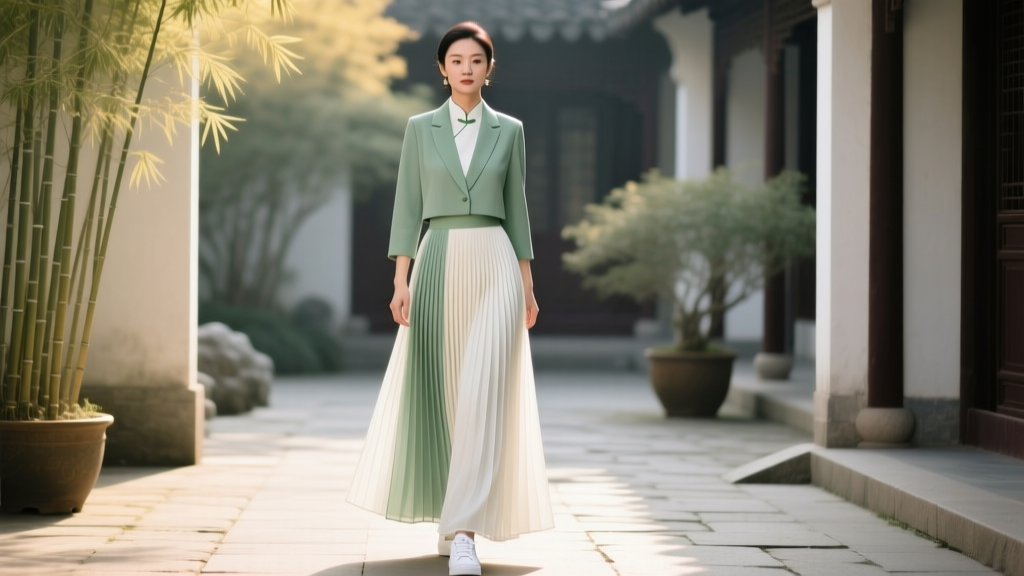
No discussion of Hanfu is complete without the Mamianqun (马面裙), or 'horse-face skirt'. Despite the name, it is not named after an animal's face, but rather the 'horse-face' (mashen) defensive wall structures in ancient Chinese city fortifications, which featured a flat front panel flanked by angled sides. The skirt features two overlapping flat panels at the front and back, with deep, structured pleats on the sides. Originally popularized in the Song and Ming dynasties, the Mamianqun has recently become a staple of modern 'new Chinese style' (Xin Zhongshi) fashion, frequently paired with contemporary blouses or tailored blazers.
The Qipao (Cheongsam): Shanghai Glamour and Structural Tailoring
While Hanfu represents ancient antiquity, the Qipao (旗袍)—known in Cantonese as the Cheongsam—is the undisputed icon of 20th-century Chinese modernity. Originating from the loose, floor-length robes worn by Manchu women during the Qing Dynasty, the Qipao underwent a radical transformation in the 1920s and 1930s in Shanghai.
Haipai vs. Jingpai Tailoring
Beginners should understand the two main schools of Qipao construction:
- Jingpai (Beijing Style): Retains more of the traditional Qing dynasty aesthetic. It is typically looser, more conservative, heavily embroidered, and emphasizes a straight, A-line silhouette that conceals the body's curves.
- Haipai (Shanghai Style): The globally recognized, form-fitting Qipao. Shanghai tailors in the 1930s integrated Western sartorial techniques, such as bust darts, set-in sleeves, and waist suppression, to create a garment that celebrated the natural female form. The Haipai Qipao is characterized by its high mandarin collar, asymmetric diagonal closures, and daring side slits (gaicha).
The Art of Pankou (Frog Closures)
The hardware of the Qipao is entirely fabric-based. Pankou (盘扣) are intricate, hand-rolled silk knots that serve as both functional fasteners and decorative motifs. A master tailor can spend hours crafting a single floral or geometric Pankou. In high-end bespoke Qipao, the knots are never glued; they are tightly rolled and stitched using the same silk brocade as the dress itself, ensuring they soften and mold to the wearer's neck over time.
Comparing Traditional Garments: A Buyer's Matrix
To help you choose the right traditional Chinese dress for women based on your specific needs, refer to the comparison matrix below.
| Garment Type | Historical Peak | Defining Silhouette | Best Suited For | Estimated Price (USD) |
|---|---|---|---|---|
| Tang Dynasty Ruqun (Hanfu) | 7th - 9th Century | High-waisted, flowing, wide sleeves | Summer festivals, photography, casual cultural events | $60 - $150 |
| Ming Dynasty Aoqun (Hanfu) | 14th - 17th Century | Structured collar, pleated Mamianqun | Winter wear, formal ceremonies, weddings | $120 - $400 |
| Haipai Qipao (Short) | 1930s - Present | Knee-length, form-fitting, side slits | Cocktail parties, modern business, dinners | $150 - $800 |
| Jingpai Qipao (Long) | 1920s - Present | Floor-length, relaxed fit, heavy embroidery | Bridal wear, diplomatic events, stage performance | $300 - $2,500+ |
Textile Heritage: Decoding Chinese Fabrics
The soul of any traditional Chinese dress lies in its textile. Synthetic imitations often fail to capture the drape and luster required for authentic silhouettes. When investing in a garment, look for these heritage fabrics:
Xiangyunsha (Gambiered Canton Gauze)
Recognized as a National Intangible Cultural Heritage of China, Xiangyunsha (香云纱) is a marvel of organic chemistry and artisanal patience. Produced exclusively in the Shunde district of Guangdong province, pure mulberry silk is dyed repeatedly with the tannin-rich juice of the Dioscorea cirrhosa plant, then coated in iron-rich river mud and baked in the sun. The result is a dual-toned fabric: a rich, earthy brown on one side and a glossy, leather-like black on the other. It is naturally cooling, antibacterial, and rustles softly when worn. A genuine Xiangyunsha Qipao typically starts at $600 and can exceed $3,000.
Song Brocade (Songjin)
Originating in the Song Dynasty, Songjin is renowned for its complex, multi-layered weaving techniques that create a matte, elegant finish rather than the high-gloss shine of modern jacquard. It is highly prized for Hanfu outerwear (Pibo or Banjia) and formal Qipao, offering structural integrity that holds pleats and collars perfectly in place.
Navigating the Market: Where and How to Buy
The market for traditional Chinese dress for women is vast, but quality varies wildly. Here is a practical framework for purchasing:
- Fast Fashion & Costumes ($20 - $50): Often found on Amazon or generic dropshipping sites. These are usually made of polyester, feature historically inaccurate 'left-over-right' lapels, and use glued-on plastic frog buttons. Avoid these for serious cultural events.
- Entry-Level Authentic Brands ($80 - $200): Brands like Shisanyu (十三余) offer accessible, historically inspired Hanfu using high-quality polyester blends and entry-level silks. They are excellent for beginners and feature accurate structural tailoring.
- Museum-Grade Artisans ($400 - $1,500+): For Ming Dynasty Hanfu replicas, Minghuatang (明华堂) is the gold standard. They utilize authentic weaving looms, real gold thread, and museum-grade silk brocades. For bespoke Qipao, seeking out master tailors in Shanghai's Changle Road district or Hong Kong's Central district ensures a garment cut specifically for your posture and measurements.
Cultural Etiquette and Wearing Protocols
Wearing traditional garments carries an inherent responsibility to respect their origins. Always ensure your Hanfu collar follows the youren (right lapel) rule. When wearing a Qipao, be mindful of the slit height; traditional 1930s slits rarely extended above the mid-thigh, whereas modern stage costumes often push this boundary. Pairing Hanfu with traditional cloth shoes (Yunxie) or embroidered flats elevates the ensemble, while a Qipao is best complemented by low-heeled Mary Janes or classic pumps. Avoid mixing heavily stylized theatrical opera headdresses with everyday traditional dress, as this conflates daily historical wear with stage costuming.
Authoritative Archives and Further Study
To deepen your understanding of Chinese sartorial history, consult the archives of leading global cultural institutions. The Metropolitan Museum of Art's Costume Institute offers extensive digital archives detailing the evolution of Chinese silhouettes and their impact on global fashion. Additionally, the Victoria and Albert Museum's Chinese Collections provides high-resolution imagery of surviving Qing dynasty robes and early 20th-century Qipao, allowing students of dress to study the minute details of embroidery stitches and textile degradation over time.
Embracing traditional Chinese dress is not merely an exercise in vintage fashion; it is a profound engagement with a living, breathing cultural heritage. Whether you are draping a Tang dynasty silk shawl or fastening the final Pankou knot on a Shanghai Qipao, you are participating in a continuous thread of artistry that has spanned the globe for centuries.