Ancient Chinese Clothing: Dynastic Styles Compared

When exploring the vast sartorial history of East Asia, ancient traditional Chinese clothing—collectively known today as Hanfu (汉服)—stands as one of the most complex and philosophically driven garment systems in the world. Spanning over three millennia, from the legendary Yellow Emperor to the late Ming Dynasty, these garments were never merely functional. They were deeply intertwined with cosmology, social hierarchy, and ritual propriety (Li, 礼).
For cultural enthusiasts, historians, and modern practitioners, understanding the nuances between different dynastic styles is essential. This comprehensive guide compares the primary varieties of ancient traditional Chinese clothing, breaking down their unique silhouettes, construction methods, and the cultural contexts that shaped their evolution.
The Core Anatomy and Cosmological Philosophy

Before comparing specific dynastic varieties, one must understand the foundational rules that governed almost all ancient traditional Chinese clothing. The most critical of these is Jiaoling Youren (交领右衽), which translates to 'cross-collar, right lapel.'
'The left lapel crossing over the right represents the triumph of life over death, and the alignment of Heaven and Earth. To wear the right over the left was strictly reserved for the deceased or considered a mark of barbarism.' — Historical records of the Zhou Dynasty礼记 (Book of Rites)
Additional universal elements include Bao Pao (wide, flowing sleeves that often featured hidden pockets), the absence of buttons in early eras (relying instead on silk sashes or Xi), and a flat-pattern cutting technique that conserved fabric and maintained the structural integrity of the woven cloth.
Dynastic Evolution: Comparing Major Hanfu Silhouettes
The silhouette of ancient traditional Chinese clothing shifted dramatically depending on the prevailing philosophy, climate, and trade relations of the ruling dynasty. Below is a comparative analysis of the most prominent historical varieties.
Qin and Han Dynasties (221 BCE – 220 CE): The Shenyi
The hallmark of the Han Dynasty is the Shenyi (深衣), or 'deep robe.' Unlike later two-piece garments, the Shenyi was cut in a way that connected the top and bottom into a single, continuous robe, symbolizing the unity of the cosmos. There were two main varieties:
- Quju (Curved Hem): The lapel wrapped deeply around the body in a spiraling, curved line, creating a modest, cocoon-like silhouette that restricted large strides, enforcing a slow, dignified gait.
- Zhiju (Straight Hem): A more practical, straight-cut robe that became increasingly popular toward the Eastern Han period, often worn by scholars and officials.
Tang Dynasty (618 – 907 CE): The Ruqun and Silk Road Influence
The Tang Dynasty represents the zenith of cosmopolitan exchange along the Silk Road. Ancient traditional Chinese clothing from this era is characterized by its boldness, vibrant colors, and relaxed gender norms. The dominant style for women was the Ruqun (襦裙), consisting of a short, fitted jacket (Ru) and a high-waisted, flowing skirt (Qun).
According to the Metropolitan Museum of Art's Heilbrunn Timeline of Art History, Tang weavers mastered the production of lightweight silk gauze and complex brocades. Women frequently wore the Banbi (半臂), a half-sleeved bolero jacket, and draped silk shawls (Pibo) over their arms, reflecting heavy Persian and Central Asian influences.
Song Dynasty (960 – 1279 CE): Minimalism and the Beizi

In stark contrast to Tang opulence, Song Dynasty aesthetics were heavily influenced by Neo-Confucianism, favoring restraint, intellectualism, and understated elegance. The defining garment of this era is the Beizi (褙子), a long, open-front jacket with side slits that extended to the knee or calf. It was worn over a narrow-sleeved inner garment and a pleated skirt. The silhouettes were slender, vertical, and utilized muted, monochromatic palettes like celadon, pale yellow, and ink-black.
Ming Dynasty (1368 – 1644 CE): The Aoqun and Mamianqun
The Ming Dynasty saw a revival and codification of Han traditions after the Mongol-led Yuan Dynasty. The quintessential women's ensemble was the Aoqun (袄裙), featuring an Ao (a lined, longer jacket with wide sleeves) worn over the famous Mamianqun (马面裙), or 'horse-face skirt.' The Mamianqun is a masterpiece of structural engineering: it features flat, unpleated front and back panels (the 'horse faces') with heavily pleated side panels, allowing for ease of movement while maintaining a structured, architectural front profile.
Comparative Guide: Garment Varieties at a Glance
To summarize the structural and historical differences, refer to the comparison chart below:
| Garment Name | Pinyin | Peak Dynasty | Defining Silhouette & Features | Modern Replica Price (USD) |
|---|---|---|---|---|
| Deep Robe | Shenyi (深衣) | Han | One-piece, cross-collar, curved or straight hem, wide sleeves. | $80 - $250 |
| Jacket & Skirt | Ruqun (襦裙) | Tang | High-waisted pleated skirt, short inner/outer jacket, silk gauze shawls. | $60 - $300 |
| Open Jacket | Beizi (褙子) | Song | Knee/calf-length open-front coat, side slits, narrow sleeves, minimalist. | $90 - $200 |
| Lined Jacket & Skirt | Aoqun (袄裙) | Ming | Longer lined jacket, standing collar (late Ming), Mamianqun skirt. | $120 - $450 |
| Commoner Tunic | Shuhe (裋褐) | Multi-Dynastic | Short cross-collar jacket, narrow sleeves, tied trousers for laborers. | $50 - $120 |
Fabric Composition and Sumptuary Laws
The materiality of ancient traditional Chinese clothing was strictly regulated by sumptuary laws. The Smithsonian Magazine notes that historical accuracy in modern Hanfu requires understanding these class divides.
- Silk (丝绸): Reserved primarily for the nobility, royalty, and wealthy merchants. Varieties included Zhijin (gold-woven brocade), Luo (gauze for summer), and Duan (satin for winter).
- Ramie (苎麻) and Hemp: The daily wear of commoners. Ramie was highly valued for its breathability in the humid southern provinces and was woven into fine, linen-like textiles known as 'summer cloth.'
- Cotton: Did not become widespread in China until the late Song and early Ming dynasties, eventually replacing hemp as the primary fabric for commoner winter wear.
Color also denoted rank. During the Tang and Ming dynasties, bright yellow and crimson were strictly reserved for the Emperor and high-ranking imperial family members, while lower officials wore greens, blues, and earth tones.
Sourcing Authentic Replicas in the Modern Market
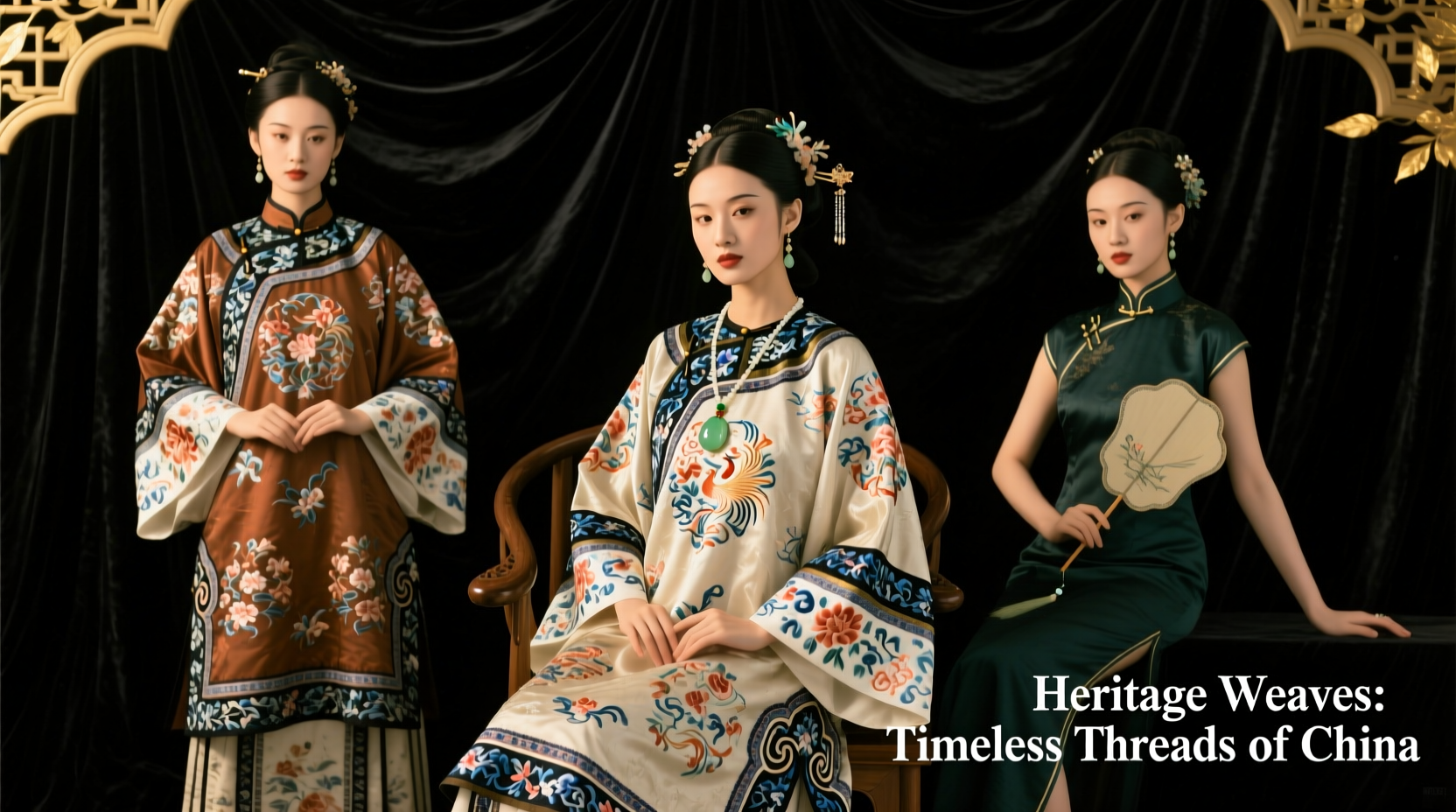
The contemporary Hanfu movement has sparked a massive revival, but the market is flooded with 'costume-grade' garments made from cheap polyester. For those seeking authentic ancient traditional Chinese clothing, consider the following buying frameworks:
1. Verify the Fabric Composition
True historical replicas should utilize natural fibers. Look for 100% mulberry silk, raw silk, linen, or ramie. Avoid high-sheen polyesters, which lack the drape and breathability of historical textiles. High-quality Ming Dynasty Aoqun replicas utilizing genuine silk brocade and metal-pressed buttons typically range from $250 to $600 USD.
2. Check the Pattern Cutting
Authentic Hanfu is cut using a flat, geometric pattern that utilizes the full width of the fabric bolt (historically around 60cm wide). If a garment features modern darts, curved armholes, or shoulder seams, it is a modernized 'Han-element' garment (Hanyuansu), not a historical replica.
3. Seek Out Specialized Artisans
While mass-market hubs like Caoxian in Shandong province produce affordable entry-level garments ($40–$80), serious collectors should seek out specialized ateliers in Hangzhou and Suzhou. These artisans collaborate with institutions like the China National Silk Museum to recreate museum-grade textiles using traditional jacquard looms and natural plant dyes.
The Living Legacy of Ancient Garments
Studying the varieties of ancient traditional Chinese clothing is not merely an exercise in historical nostalgia; it is an engagement with a living, breathing cultural renaissance. Whether it is the spiraling elegance of a Han Dynasty Shenyi, the cosmopolitan flair of a Tang Ruqun, or the architectural brilliance of a Ming Mamianqun, these garments offer a profound window into the philosophy, artistry, and daily lives of the civilizations that crafted them. By understanding their distinct varieties and construction, modern wearers and collectors can honor the profound legacy of Asian sartorial traditions with accuracy and deep cultural respect.