Ancient Chinese Clothing: A Historical Guide to Hanfu Styles
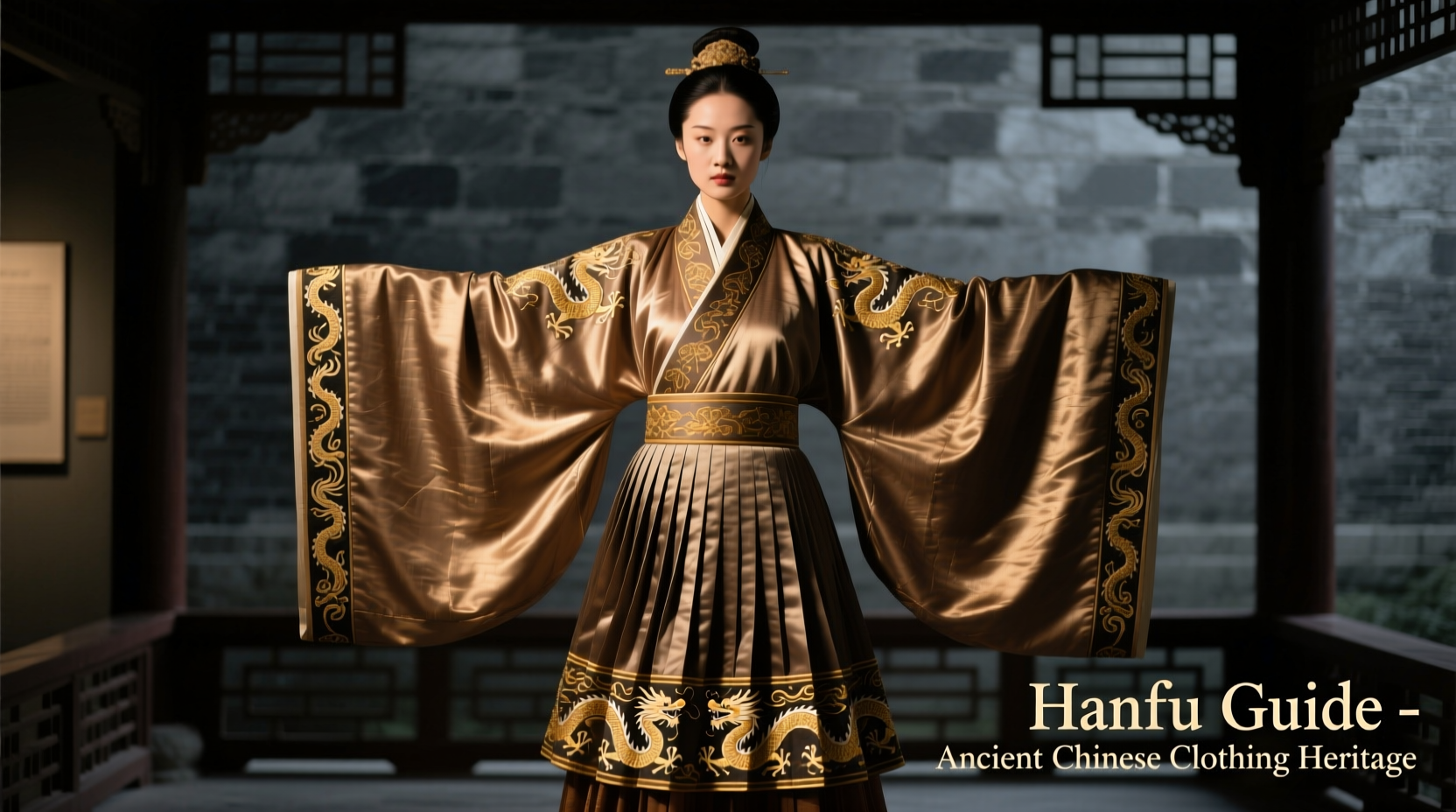
When exploring the vast tapestry of Asian dress, ancient Chinese clothing stands out for its profound philosophical underpinnings, structural elegance, and millennia-long evolution. Often mistakenly conflated with the Manchu-influenced garments of the later Qing dynasty (such as the qipao or tang suit), the true indigenous dress of the Han Chinese is known as Hanfu (汉服). Spanning from the legendary Yellow Emperor (circa 2700 BC) through the Ming dynasty (1368–1644 AD), Hanfu is not merely a historical costume; it is a woven reflection of Chinese cosmology, social hierarchy, and aesthetic ideals.
Unlike Western tailoring, which traditionally cuts fabric to follow the body’s three-dimensional curves using darts and seams, ancient Chinese clothing was rooted in the philosophy of Tian Ren He Yi (天人合一)—the harmony between humanity and the universe. Garments were constructed using flat pattern cutting. Woven cloth was respected as a complete entity, cut into rectangular panels, and draped over the body, creating a fluid, structural silhouette that moved with the wearer.
The Core Anatomy of Hanfu Construction
To understand ancient Chinese clothing, one must first understand its foundational components and the strict cultural protocols that governed its assembly. The basic wardrobe was historically divided into the Yi (衣), the upper garment, and the Shang (裳), the lower skirt. Over time, these evolved into one-piece robes and complex layered ensembles.
Jiaoling Youren: The Cross-Collar Rule
The most defining visual characteristic of Hanfu is the Jiaoling Youren (交领右衽), or the cross-collar worn with the left side overlapping the right. This was not an arbitrary fashion choice, but a strict cosmological mandate. In traditional Chinese philosophy, the left represents Yang (life, the sun, the east), while the right represents Yin (death, the moon, the west). Therefore, wrapping the left lapel over the right symbolized the triumph of life and civilization. Dressing in the opposite manner (Zuoren) was strictly reserved for dressing the deceased for burial or was used to describe the dress of unconquered nomadic tribes.
The Shenyi and the Ruqun
Among the earliest formal garments was the Shenyi (深衣), or 'deep robe.' Popularized during the Zhou and Han dynasties, the Shenyi was cut in two pieces (upper and lower) but sewn together into a single, flowing robe that completely concealed the body, reflecting Confucian ideals of modesty and propriety. Conversely, women frequently wore the Ruqun (襦裙), a combination of a short, cross-collared jacket (Ru) tucked into a high-waisted, pleated skirt (Qun), a silhouette that would remain a staple of women's ancient Chinese clothing for centuries.
Dynastic Evolution: A Millennium of Shifting Silhouettes
Ancient Chinese clothing was never static. Each imperial dynasty introduced new silhouettes, fabrics, and foreign influences, particularly via the Silk Road. The table below outlines the primary shifts in Hanfu across major dynastic periods.
| Dynasty | Era | Signature Garment | Dominant Fabrics & Motifs | Silhouette Characteristics |
|---|---|---|---|---|
| Han | 202 BC – 220 AD | Shenyi (Deep Robe) | Hemp, Ramie, Early Silk; Cloud motifs | Flowing, floor-length, wide sleeves |
| Tang | 618 – 907 AD | Banbi (Half-sleeve), Pibo (Shawl) | Polychrome Silk, Brocade; Floral & Persian motifs | High-waisted, voluminous, daring necklines |
| Song | 960 – 1279 AD | Beizi (Long Jacket) | Monochrome Silk, Gauze; Subtle botanical weaves | Slender, understated, straight lines |
| Ming | 1368 – 1644 AD | Aoqun (Jacket & Skirt), Mamianqun | Heavy Brocade, Kesi (Cut Silk); Auspicious beasts | Structured, high collars, heavily pleated skirts |
The Tang Dynasty: Cosmopolitan Opulence
The Tang dynasty is widely considered the golden age of ancient Chinese clothing. Due to the vast reach of the Silk Road, Tang fashion absorbed influences from Persia, Sogdia, and India. Women’s fashion became remarkably bold; garments featured lower necklines, and it was fashionable to wear the Banbi (a short half-sleeved jacket) over a long-sleeved inner robe, draped with a Pibo (a long, sheer silk shawl). According to the China National Silk Museum, Tang weavers mastered the production of vibrant, polychrome weft-faced brocades, allowing for the large, lush floral roundels that defined the era's aesthetic.
The Ming Dynasty: Structured Formality
Following the expulsion of the Mongol-led Yuan dynasty, the Ming emperors sought to restore 'pure' Han Chinese traditions. Ming dynasty clothing became highly structured. The introduction of the standing collar (often fastened with gold or jade buttons) and the iconic Mamianqun (马面裙), or 'horse-face skirt,' defined women's fashion. The Mamianqun features flat, unpleated panels at the front and back, with deep, sharp pleats on the sides, allowing for ease of movement while maintaining a rigid, architectural front profile.
Materials, Dyes, and the Art of Kesi
While the elite draped themselves in silk, the vast majority of the population in ancient China wore garments woven from hemp (ma) or ramie. However, it is silk that defines the legacy of Chinese textiles. Beyond standard satin and damask, ancient artisans developed Kesi (缂丝), or 'cut silk.' This painstaking tapestry-weave technique involves turning the weft threads back at the edges of color blocks, creating tiny slits in the fabric. Kesi was so labor-intensive that it was said that 'one inch of Kesi is worth an ounce of gold.' The Metropolitan Museum of Art's Asian Art Collection houses exquisite Ming dynasty Kesi dragon robes that demonstrate the近乎 painterly quality of this weaving method.
Color in ancient Chinese clothing was derived from nature and governed by the Five Elements theory (Wuxing). True reds were extracted from safflower (Carthamus tinctorius), deep blues from fermented indigo leaves, and imperial yellows from the buds of the pagoda tree. Mordants like alum and iron were used to shift the hues, creating a complex palette that signified everything from marital status to political rank.
Sumptuary Laws and Cultural Protocols
In imperial China, clothing was a legal identifier. Sumptuary laws strictly dictated what colors, fabrics, and motifs commoners and officials were permitted to wear. During the Ming dynasty, the Buzi (补子), or rank badge, was introduced. These embroidered squares were affixed to the front and back of an official's robe. Civil officials wore badges featuring birds (e.g., the crane for first-rank officials, the golden pheasant for second-rank), while military officials wore beasts (e.g., the qilin or the lion). Wearing a motif above one's station was a punishable offense.
'Clothing is the architecture of the body and the mirror of the state. In ancient China, to wear the correct garment was to maintain the very order of the cosmos.' — Historical Textiles and Dress of China, Victoria and Albert Museum Archives.
Experiencing the Legacy Today
Today, the study and revival of ancient Chinese clothing have moved beyond museum glass. The modern Hanfu movement, which began in the early 2000s, has seen millions of young Chinese people researching historical texts, examining tomb murals, and recreating accurate garments for daily wear and festivals. Institutions like the Victoria and Albert Museum (V&A) and the China National Silk Museum continue to conserve fragile textile artifacts, providing the empirical data needed for modern artisans to accurately replicate historical weaving techniques, natural dye recipes, and flat-cutting patterns.
Understanding ancient Chinese clothing requires looking past the surface beauty of the silk and embroidery. It is an intricate system of philosophy, engineering, and social order woven into every seam, pleat, and cross-collar. Whether studying the flowing Shenyi of the Han dynasty or the structured Mamianqun of the Ming, one is engaging with a living, breathing archive of Asian cultural history.