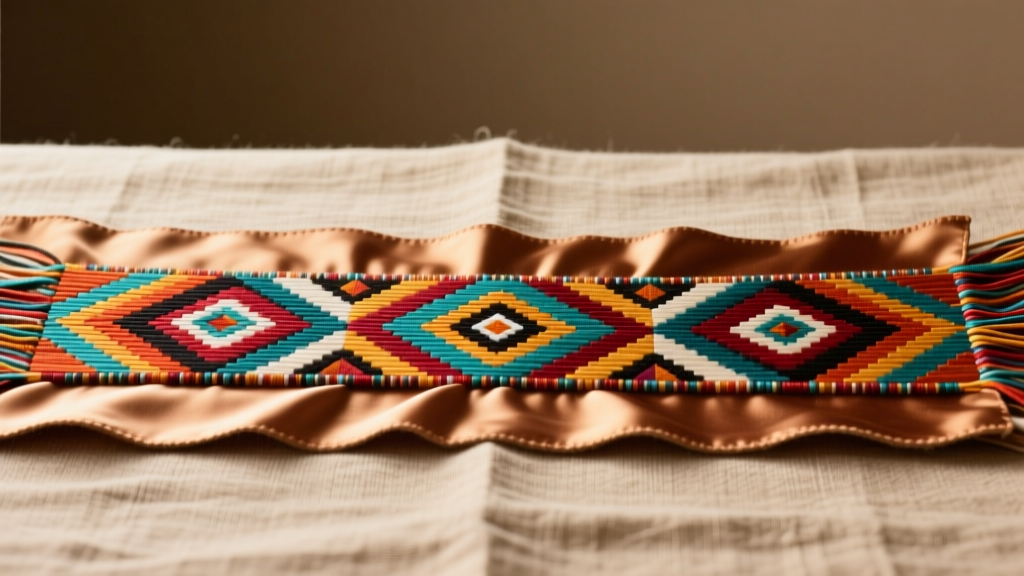
Ribbon Work Dress: Native American Art
Ribbon Work: A Vibrant Native American Textile Art
Ribbon work is a distinctive appliqué technique developed by Great Lakes and Prairie Native American tribes in the 18th and 19th centuries. Using silk ribbons obtained through trade with European merchants, indigenous artists created bold, layered designs that transformed imported materials into uniquely Native expressions of identity and artistry.
Historical Origins
Before European contact, Native women decorated garments with porcupine quillwork, paint, and shells. When silk ribbons became available through French and British trade networks, artists quickly adapted the material to their aesthetic sensibilities. By the 1800s, ribbon work had become a defining art form of the Potawatomi, Miami, Kickapoo, Osage, and Delaware nations.
Techniques
- Reverse appliqué: Layers of different-colored ribbons are stacked. Cutouts in upper layers reveal the colors beneath, creating multi-colored geometric patterns.
- Straight-edge ribbon work: Ribbons are folded and sewn in parallel lines to create striped borders on skirts, leggings, and blanket strips.
- Proximate appliqué: Narrow ribbons are sewn closely together to form solid color blocks, then cut into curves and angles for complex designs.
Design Language
Common motifs include diamond shapes, hourglasses, double curves, and floral forms that reflect both pre-contact symbolic traditions and post-contact innovations. Color choices are bold and high-contrast: hot pink on black, bright green on navy, orange on purple. These combinations were intentionally chosen to be visible from a distance during dances and ceremonies.
Contemporary Practice
Ribbon work is experiencing a renaissance among Native artists. Vanessa Jennings (Kiowa/Pima) and Jamie Oxendine (Lumbee) are among the leading practitioners teaching younger generations. Ribbon work adorns modern regalia at powwows, and museums like the Smithsonian's NMAI hold significant historic collections that inspire contemporary artists.