Mayan Huipil: Woven Identity in Guatemala

Mayan Huipil: Woven Identity in Guatemala
The huipil (pronounced wee-PEEL) is a handwoven blouse worn by Indigenous women throughout Mesoamerica, but it reaches its most extraordinary expression in the highlands of Guatemala. Each huipil is a textile autobiography, encoding the wearer's community, status, marital availability, and cosmological beliefs in its patterns and colors.
Structure and Technique
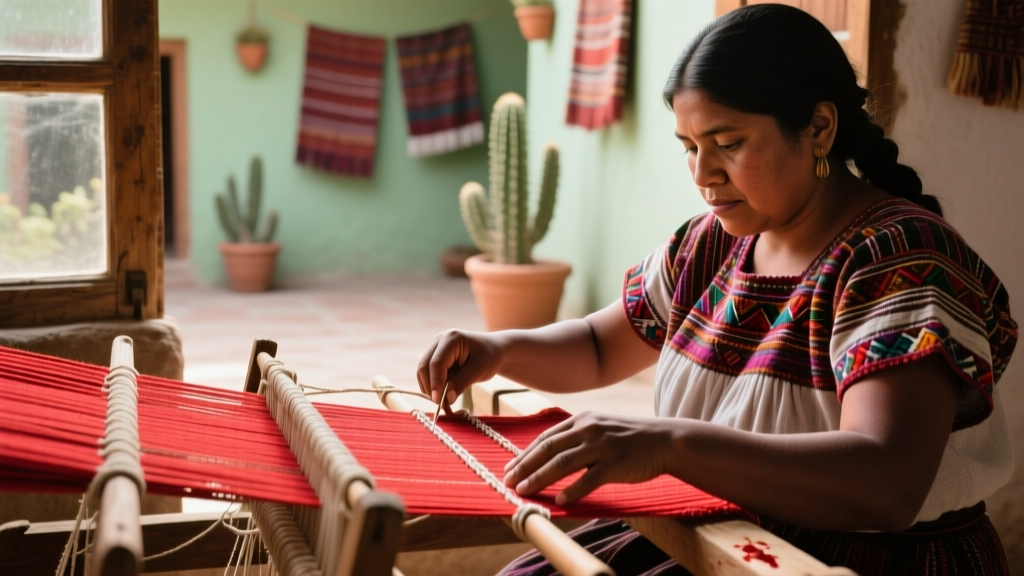
A huipil is constructed from one to three rectangular panels of backstrap-loom woven fabric, joined with decorative randa stitching. The backstrap loom, unchanged for millennia, connects one end to a fixed point and the other to the weaver's body via a strap around her lower back. The weaver's body becomes part of the loom, controlling tension through subtle shifts of posture.
Community Identification
Each Maya community has distinctive huipil designs that allow knowledgeable observers to identify a woman's home village at a glance. The huipil from Todos Santos Cuchumatán features bold red-and-white stripes with elaborate brocaded collars. San Juan Cotzal huipils display geometric birds and diamonds in vivid magenta and turquoise. Chichicastenango designs center on radiating sun patterns in purple and gold.
Cosmological Symbols
Common motifs carry deep spiritual meaning:
- Diamonds: The four corners of the universe, the sun's daily path
- Double-headed eagle: Looking to the past and future simultaneously
- Quetzal birds: Liberty and spiritual elevation
- Tree of life: Connection between the underworld (Xibalba), earth, and sky
Threats and Preservation
Mass-produced imitation huipils from factories in China and Guatemala City threaten the livelihoods of Indigenous weavers. Organizations like the Weaving Futures cooperative and the Trama Textiles collective work to preserve traditional techniques while ensuring fair compensation for weavers. The debate over cultural appropriation of huipil designs by international fashion brands continues to draw attention to Indigenous intellectual property rights.