How Did the Maya Dress? Ancient Roots & Modern Heritage

Tracing the Continuum: How Did the Maya Dress?
When historians, anthropologists, and textile collectors ask how did the Maya dress, the answer requires bridging a continuum of over three millennia. Maya clothing is not a static historical artifact confined to Pre-Columbian stone carvings; it is a living, breathing language of identity, cosmology, and resistance. From the ancient elite adorned in quetzal feathers and jade to contemporary indigenous women weaving the cosmos into their daily tunics, Maya dress represents one of the most complex and enduring textile traditions in the Americas.
To understand Maya garments, one must look through the dual lens of ancient archaeological evidence and the vibrant, living practices of modern Maya weavers in Guatemala, Chiapas (Mexico), Belize, and Honduras. This cultural heritage guide decodes the anatomy, history, and modern marketplace of Maya textiles, offering a respectful framework for understanding and sourcing these masterworks.
The Pre-Columbian Wardrobe: Status, Climate, and Cosmology
Long before European contact, Maya clothing was deeply stratified by social class, dictated by the tropical climate, and imbued with spiritual significance. The fundamental garment for both men and women was a draped or woven cotton textile, but the execution varied wildly between commoners and the elite.
Commoner Attire vs. Elite Regalia
For the working class, men typically wore a simple cotton loincloth known as a maxtlatl (a Nahuatl term widely adopted in Mesoamerican studies, though the Maya had distinct linguistic equivalents like the Yucatec ex). Women wore wrapped skirts secured with a woven sash. These garments were functional, breathable, and suited to the humid lowlands and temperate highlands. Commoners primarily utilized naturally colored cotton (ixcaco) in shades of brown, green, and cream, dyed occasionally with local botanicals.
In stark contrast, elite Maya dress was a spectacular display of wealth and divine proximity. Rulers and nobles layered their garments with jaguar pelts, intricate jade beadwork, and the iridescent green tail feathers of the resplendent quetzal bird. The elite huipil (tunic) was often heavily brocaded with complex geometric and zoomorphic motifs using the supplementary weft technique, a method that remains a hallmark of Maya weaving today.
The Anatomy of Modern Maya Dress
Following the Spanish conquest in the 16th century, Maya clothing absorbed European influences—such as the introduction of sheep's wool, silk threads, and the treadle loom—while fiercely retaining its indigenous soul. Today, the traditional Maya woman's wardrobe is a masterclass in symbolic construction, primarily consisting of three core elements.
The Huipil (Po't): A Woven Cosmogram
The huipil (derived from the Nahuatl huipilli, but known in Kaqchikel Maya as po't) is a loose-fitting tunic made from two or three panels of hand-woven cloth joined by intricate randa (embroidered seams). The huipil is far more than a garment; it is a cosmogram. The center of the fabric often aligns with the wearer's heart or navel, representing the axis mundi or the sacred Ceiba tree that connects the underworld (Xibalba), the earthly plane, and the heavens.
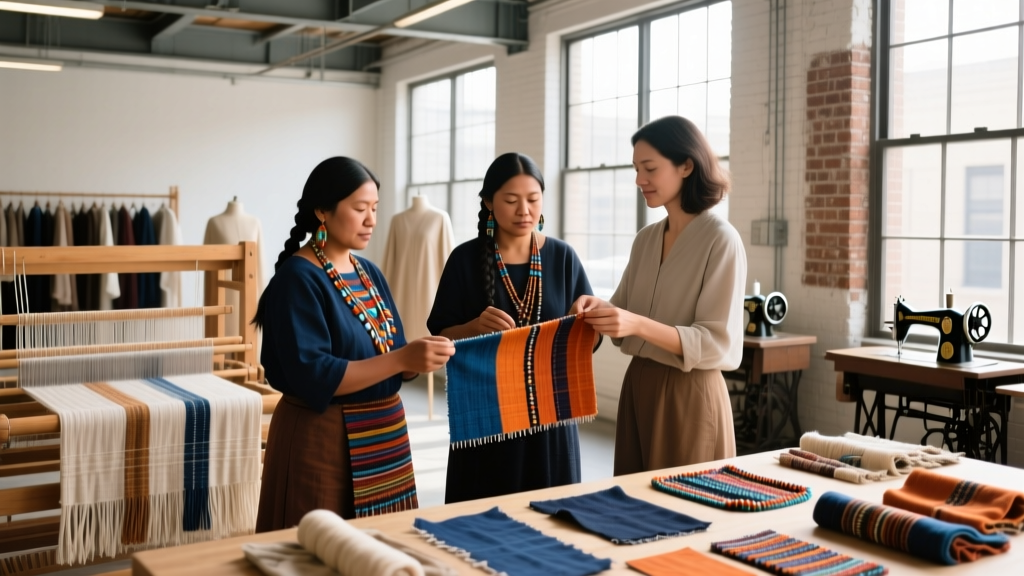
Weaving a fine huipil on a traditional backstrap loom (telar de cintura) can take anywhere from three to eight months. The weaver uses a supplementary weft brocade technique (trama suplementaria) to create raised, embroidery-like patterns that are integrated directly into the fabric's structure, rather than stitched on afterward.
The Corte and Faja: Grounding the Garment
While the huipil is woven on the backstrap loom, the corte (skirt) is typically woven on a Spanish-introduced treadle loom by male weavers. The corte is a massive length of fabric, often measuring up to 10 yards long and 40 inches wide, which is wrapped and pleated around the waist. It is secured by a faja (sash or belt), which can be heavily brocaded with protective motifs like diamonds (representing the sun and the four cardinal directions) and serpents (representing the earth and fertility).
'The loom is not merely a tool; it is an extension of the weaver's body and spirit. When a Maya woman weaves, she is weaving time, memory, and the protection of her community into every thread.' — Textile archives of the Museo Ixchel del Traje Indígena.
Regional Textile Map: Motifs and Markets
One of the most remarkable aspects of Maya dress is its hyper-localization. Historically, a weaver's specific town could be identified instantly by the color palette, motifs, and layout of her huipil. While modern migration and commercialization have blurred some of these lines, regional identity remains fiercely protected.
| Region / Community | Signature Garment Traits | Dominant Motifs | Artisan Price Range (USD) |
|---|---|---|---|
| Chichicastenango, Guatemala | Deep red/maroon base, heavy geometric brocade, velvet appliqué. | Sun faces, double-headed eagles, floral rosettes. | $150 - $450 (Ceremonial) |
| San Juan Atitán, Guatemala | Purple and white striped base, distinctive purple wool embroidery. | Geometric stars, local flora, stylized birds. | $120 - $280 |
| Nahualá, Guatemala | Heavy, warm fabric with prominent yellow, red, and blue bands. | Large zoomorphic figures (birds, horses), bold diamonds. | $90 - $220 |
| Zinacantán, Chiapas, Mexico | White cotton base with dense, vibrant floral and avian embroidery. | Flowers, quetzals, saints, heavily embroidered necklines. | $80 - $180 |
Note: Prices reflect direct-to-artisan or cooperative purchasing. Buying through international boutiques or vintage dealers will significantly increase the cost, with antique, museum-quality ceremonial huipils fetching upwards of $1,500.
Ceremonial Regalia and the Cofradía System
To fully answer how the Maya dress for sacred occasions, one must examine the Cofradía system—a syncretic religious brotherhood system blending Catholic saints with ancient Maya earth-lord deities. The ceremonial garments worn by Cofradía leaders are among the most magnificent textiles in the Americas.
These regalia include the tzute (a multipurpose ceremonial cloth worn on the head or over the shoulder to carry sacred objects), and specialized heavy wool jackets adorned with silver or brass coins, mirrors, and intricate silk embroidery. The rodillera, a heavily padded and embroidered kneeling sash, is worn around the knees during long ritual prayers. These garments are considered living entities; they are ritually cleansed, stored in cedar chests to protect them from insects, and passed down through generations of spiritual leaders.
Ethical Sourcing: Buying Authentic Maya Textiles
As global interest in indigenous fashion grows, so does the exploitation of Maya designs. Fast-fashion brands frequently appropriate the sacred motifs of the po't, printing them onto synthetic fabrics without compensating the communities that developed these patterns over centuries. As a cultural heritage enthusiast, ethical sourcing is paramount.
How to Identify Authentic Hand-Woven Textiles
- Examine the Reverse Side: True supplementary weft brocade (trama suplementaria) will show the pattern on the back of the fabric, often with long, floating threads that are meticulously managed by the weaver. Screen-printed or machine-embroidered knockoffs will have a flat back or a messy, uniform bobbin thread.
- Look for the Selvedge: Hand-woven backstrap loom fabrics have finished, natural edges (selvedges) on both sides. If the fabric has been cut and hemmed by a machine, it is likely pedal-loom or factory-made.
- Feel the Weight and Texture: Authentic highland Maya huipils are woven with tightly spun cotton or acrylic blends, resulting in a dense, heavy, and slightly stiff fabric that softens beautifully with age.
Supporting Living Artisans and Cooperatives
To ensure your purchase directly supports Maya women and preserves the transmission of weaving knowledge to younger generations, buy directly from established artisan cooperatives. Organizations like Trama Textiles and the Maya Traditions Foundation operate on fair-trade principles, providing weavers with living wages, microloans, and educational scholarships while maintaining strict quality and cultural authenticity standards.
The Enduring Legacy of the Maya Weaver
Understanding how the Maya dress is an exercise in reading the history of the Americas through fiber and dye. Every diamond motif represents the sun's journey; every color shift denotes a shift in a village's history; and every thread pulled tight on the backstrap loom is an act of cultural survival. By respecting the protocols of these garments and supporting the living artisans who create them, we help ensure that the Maya textile tradition continues to weave the future just as it has preserved the past.