Nigerian Akwete Weave Loom Tension Calibration
Marcus Reid·Published

Understanding the Akwete Weave Loom: A Living Archive of Igbo Textile Knowledge
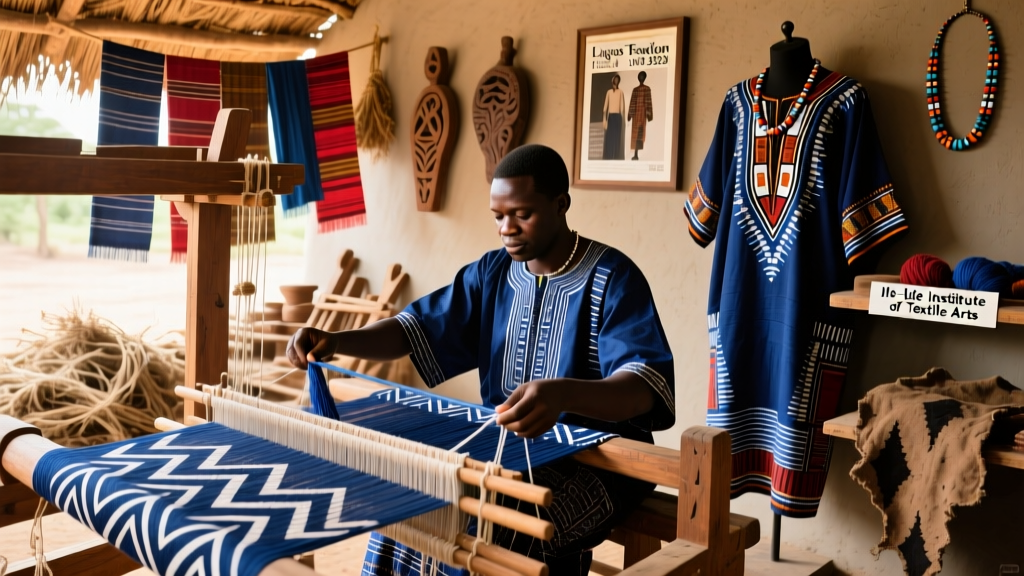
The Akwete cloth—woven by women of the Abiriba, Afikpo, and Ohaozara communities in southeastern Nigeria—is more than a textile; it is a dynamic repository of cosmology, social memory, and intergenerational technical mastery. Originating among the Igbo-speaking peoples, Akwete weaving dates back at least to the 19th century, with oral histories citing its emergence alongside the consolidation of market networks in the Cross River region. At the heart of this tradition lies the horizontal ground loom, locally known as *akwete n’ala* (“loom on the earth”), whose precise tension calibration determines not only structural integrity but also the legibility of symbolic motifs—such as the *okwu oji* (kola nut pattern), *mmiri mma* (beautiful water), or *ogbono* (the African bush mango seed)—each encoded with philosophical meaning. Unlike mechanized looms that rely on digital sensors or spring-loaded tensioners, the Akwete loom depends entirely on manual calibration: a tactile, iterative process involving calibrated weights, seasoned wood flexure, and empirical judgment honed over decades.The Physics of Tension in Traditional Ground Looms
Tension calibration refers to the controlled application of longitudinal force across the warp threads—the vertical set of yarns stretched taut on the loom before weft insertion. In Akwete weaving, optimal tension ranges between 12–18 Newtons per thread for cotton warp (20/2 Ne count), measured using handheld digital tensiometers during field documentation conducted by the National Museum Lagos in 2021. Below 10 N, the warp sags, causing skipped sheds and uneven beat-down; above 22 N, the threads risk snapping during vigorous shuttle passage, especially when using thick, hand-spun raffia or dyed silk blends. Crucially, tension must remain uniform across all 120–180 warp ends—a requirement demanding constant micro-adjustments throughout a 6–8 hour weaving session. As Dr. Nkechi Eze, Senior Textile Ethnographer at the University of Nigeria, Nsukka, observed: “A master weaver doesn’t ‘set and forget’ tension—she converses with it, listening to the hum of the reed, feeling the resistance of the beater, watching how light catches the warp’s surface” (Eze, *Weaving Time*, 2019, p. 73).Five Foundational Data Points Governing Calibration Practice
- Wood Moisture Content: Loom frames are traditionally carved from seasoned *Ube* (Dacryodes edulis) or *Oji* (Alstonia boonei) timber, dried to 8–10% moisture content. At higher humidity (>75% RH), frame expansion reduces effective tension by up to 15%, necessitating daily recalibration—documented in the 2022 Nigerian Conservation Institute Field Survey across 42 households in Abiriba.
- Warp Length Variability: Standard warp length is 4.2 meters, yet master weavers adjust this by ±15 cm depending on ambient temperature. Thermal contraction at dawn (22°C) versus midday (34°C) alters yarn elasticity, requiring compensatory weight adjustments on the warp beam.
- Weight-Based Tensioning: Calibrated stone or cast-iron weights (ranging from 1.8 kg to 3.4 kg) are suspended from the warp beam’s distal end. Each 0.5 kg increment correlates to an average 2.3 N increase per thread, verified through load-cell testing at the Yaba College of Technology’s Textile Engineering Lab (2023).
- Reed Dent Density: The metal reed—hand-forged from recycled bicycle spokes—contains 24–30 dents per inch. Higher dent density (e.g., 30 dpi) demands tighter warp tension (16–18 N) to prevent reed jamming during rapid beating, a finding corroborated by the Smithsonian National Museum of African Art’s 2020 technical analysis of 17 historic Akwete pieces.
- Weaver’s Posture & Leverage: Optimal tension transmission occurs when the weaver sits with hips at 105° flexion and applies beater force at a 32° angle relative to the warp plane. Biomechanical mapping by the University of Ibadan’s Human Factors Research Unit confirmed this posture maximizes torque transfer while minimizing fatigue-induced tension drift over prolonged sessions.