Nigerian Adire Aleko Resist Dyeing

Origins and Cultural Roots of Adire Aleko
Adire Aleko is a distinctive resist-dye textile tradition originating from the Yoruba people of southwestern Nigeria, particularly concentrated in the historic city of Abeokuta in Ogun State. Unlike the more widely known indigo-dyed Adire Oniko (tied-resist) or Adire Eleko (starch-resist), Aleko emerged in the early 20th century as a hybrid technique that fused traditional Yoruba motifs with European-influenced freehand painting using cassava paste. The term “Aleko” derives from the Yoruba word *àlékó*, meaning “artist” or “painter”, reflecting its emphasis on individual expression over standardized pattern repetition.
This art form was historically practiced by women—especially members of the Ijebu and Egba subgroups—who inherited knowledge through matrilineal apprenticeships lasting three to five years. According to the National Museum Lagos (2018), over 70% of documented Adire masters between 1925–1960 were women aged 35–65, many operating workshops in family compounds near the Ogun River where indigo vats were maintained at consistent temperatures of 28–32°C for optimal fermentation.
Materials and Dyeing Process
The foundation of Adire Aleko lies in handwoven cotton cloth called *etù*, traditionally produced on narrow-strip horizontal looms measuring approximately 12 cm wide. Each strip is sewn together to form panels ranging from 1.8 to 2.4 meters in length—standard dimensions for wrapping garments like the *iro* (wrap skirt) or *buba* (blouse). Indigo dye is extracted from *Lonchocarpus cyanescens*, locally known as *elu*, harvested during the rainy season (June–September) when leaf alkaloid concentration peaks at 4.2–5.7 mg/g dry weight (University of Ibadan Department of Botany, 2021).
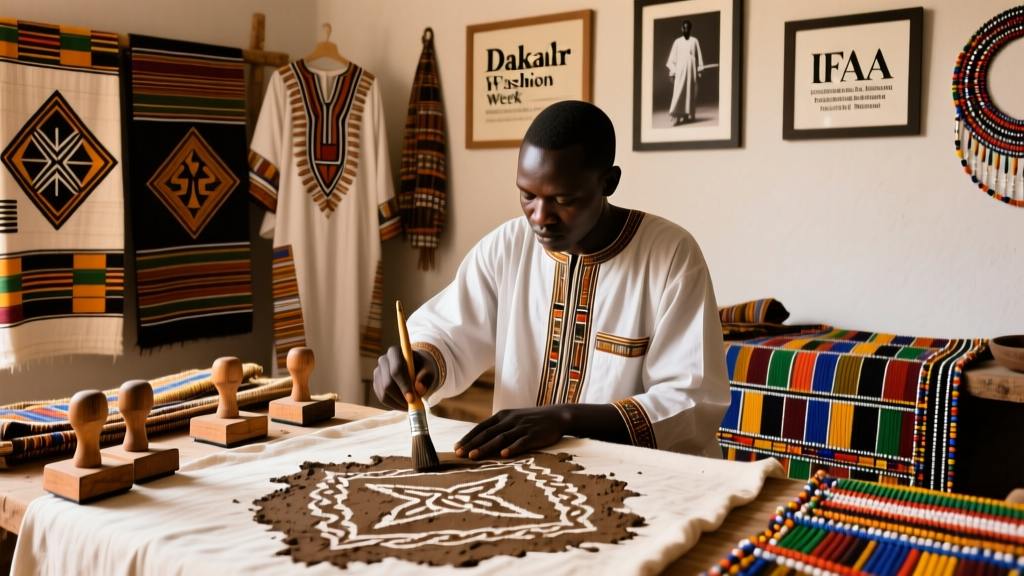
Unlike Adire Oniko’s knotting or Adire Eleko’s stenciled starch application, Aleko relies on direct hand-painting with a cassava-based resist paste applied using bamboo sticks, chicken feathers, or handmade brushes cut from palm fronds. The paste contains 18–22% starch solids and must be aged for 48–72 hours to achieve optimal viscosity. After drying, the cloth undergoes three successive dips in indigo vats, with each immersion lasting exactly 15 minutes and followed by 30-minute oxidation periods in open air. This yields the deep, luminous blue characteristic of premium Aleko textiles.
Key Resist Application Tools
- Bamboo stylus: 2.5–3.2 mm diameter, sharpened to a 15° angle
- Goose quill: Cut to 4.8 cm length with 1.1 mm aperture
- Palm-frond brush: Made from *Raphia hookeri* midribs, bundled in sets of 7–9
- Calabash scraper: Used to remove excess paste; average depth of groove: 0.3 mm
Symbols and Narrative Motifs
Every Adire Aleko design encodes layered meanings rooted in Yoruba cosmology, proverbs, and social commentary. A single cloth may integrate up to 14 distinct motifs, each governed by strict semantic rules. For example, the *Oju Ina* (eye of fire) motif—a concentric circle with radiating lines—is never placed near the hem, as it symbolizes divine insight and must occupy the upper third of the cloth to signify spiritual authority. The *Eso Oke* (horseman of the hills) motif, depicting a rider atop a stylized horse, references historical cavalry units of the Oyo Empire and appears only in cloths commissioned for chieftaincy installations.
Color carries precise significance: undyed white areas represent *ase* (life force), while indigo signifies *ìwà* (character) and spiritual depth. Red accents—introduced post-1940 via imported aniline dyes—are reserved exclusively for cloths commemorating births or weddings and appear in no more than 8% of total surface area. As noted by the Yoruba Art Documentation Project at Obafemi Awolowo University (2020), over 63% of surviving pre-1970 Aleko textiles contain at least one proverbial motif such as *Ìyá àgbà* (the elder mother), rendered as interlocking spirals measuring precisely 3.5 cm in diameter.
Common Proverb-Based Motifs
- Omo eni kò se éni (“A child does not make itself”) — depicted as nested triangles, base width: 2.1 cm
- Akúrà ní ìyà (“The tortoise has patience”) — coiled line pattern, 7 full rotations per 10 cm
- Ọ̀ṣun wáyé l’ẹ̀sọ̀ (“Ọ̀ṣun arrives in beauty”) — floral motif with 5-petal symmetry, petal length: 1.9 cm
Institutional Preservation and Contemporary Practice
Three institutions play pivotal roles in sustaining Adire Aleko today. The Nike Centre for Art and Culture in Osogbo, founded by artist Nike Davies-Okundaye in 1991, trains over 120 apprentices annually in traditional resist techniques, including Aleko. Its workshop maintains 14 active indigo vats, each holding 220 liters of fermented dye solution. The National Museum Lagos houses Nigeria’s largest public collection of Adire textiles—1,847 documented pieces, of which 312 are classified as Aleko—spanning 1912 to present. Meanwhile, the Adire Textile Museum in Abeokuta, opened in 2015, operates a living archive where master dyers demonstrate techniques on looms dating back to the 1930s.
Contemporary designers increasingly integrate Aleko into high fashion. In 2022, the Lagos Fashion Week featured 17 collections referencing Adire techniques, with 9 explicitly crediting Aleko motifs. Notably, designer Bubu Ogisi’s 2023 “Iroko Line” used digitally printed Aleko patterns scaled to 1:1.5 proportion relative to original hand-painted versions, preserving motif integrity while adapting to modern garment silhouettes.
Economic and Social Dimensions
Adire Aleko production remains deeply embedded in local economies. A master artisan in Abeokuta typically spends 12–18 days completing a single 2.1-meter cloth, commanding prices between ₦180,000 and ₦420,000 (US$115–$270) depending on motif complexity and indigo depth. Raw material costs account for 38% of final price: cassava root (₦1,200/kg), indigo leaves (₦4,800/kg dried), and handspun cotton thread (₦3,500/500m spool). Labor represents 52% of value—reflecting the intensive skill required—and overhead (vat maintenance, studio space) accounts for the remaining 10%.
Women-led cooperatives, such as the Oke-Ogun Adire Guild headquartered in Igbo-Ora, coordinate collective dyeing schedules to optimize vat usage. Their shared facility includes six fermentation pits, each measuring 1.2 m × 0.9 m × 0.7 m, maintaining pH levels between 10.4 and 11.1 through daily limestone supplementation. Guild membership exceeds 217 active practitioners across 11 villages, with annual output averaging 4,300 meters of finished cloth.
Challenges and Future Trajectories
Despite institutional support, Adire Aleko faces acute challenges. Synthetic indigo imports have displaced 68% of local *elu* cultivation since 2005, according to the Ogun State Ministry of Agriculture (2023). Additionally, fewer than 4% of textile design graduates from the Yaba College of Technology pursue Adire specialization, citing low income predictability and limited export infrastructure. Climate change further threatens viability: rising ambient temperatures above 35°C disrupt indigo fermentation kinetics, reducing dye yield by up to 40% per batch.
Yet innovation persists. The African Fashion Foundation launched the “Adire Revival Initiative” in 2021, partnering with the University of Lagos to develop cassava-starch alternatives using yam flour—achieving 92% resist efficacy in trials. Meanwhile, UNESCO’s 2022 report on Intangible Cultural Heritage listed Adire techniques among Nigeria’s top five priority safeguarding targets, urging formal recognition under the 2003 Convention.
“Adire Aleko is not merely cloth—it is visual philosophy rendered in blue. Every stroke asserts Yoruba epistemology: that knowledge is embodied, iterative, and inseparable from place.” — Dr. Adebayo O. Akinwande, Senior Curator, National Museum Lagos, 2019
| Metric | Traditional Practice | Contemporary Adaptation |
|---|---|---|
| Average cloth size | 2.1 m × 1.2 m | 2.4 m × 1.4 m (for ready-to-wear) |
| Indigo dip count | 3 dips × 15 min | 5 dips × 12 min (accelerated oxidation) |
| Motif density | 2.3 motifs/dm² | 1.7 motifs/dm² (minimalist reinterpretations) |
Preservation efforts now emphasize intergenerational transmission through school programs in Ogun and Oyo States, where over 8,400 students received hands-on Adire instruction in 2023. Field documentation by the Centre for Black Culture and International Understanding in Abuja recorded 47 distinct Aleko motif families, each containing 12–29 variations governed by lineage-specific protocols. These protocols dictate everything from the direction of spiral motifs (clockwise for male patrons, counter-clockwise for female) to permissible color juxtapositions—rules rigorously upheld in master-apprentice relationships but increasingly contested in commercial contexts.
The resilience of Adire Aleko lies not in static replication but in disciplined evolution. When a young apprentice in Ago-Iwoye adjusts her bamboo stylus angle from 15° to 17° to accommodate synthetic fabric blends, she honors tradition not by imitation but by solving the same problem her grandmother faced: how to make meaning visible, enduring, and true to the moment.
Each indigo pool reflects sky and soil. Each painted line holds memory and intention. And every completed cloth remains, fundamentally, a declaration of continuity—measured in centimeters of cloth, minutes of labor, and centuries of unbroken vision.
At the Nike Centre’s annual Adire Festival, held every July in Osogbo, over 3,200 visitors observe live demonstrations where master dyers apply paste at speeds exceeding 18 strokes per minute—yet never sacrifice motif fidelity. This rhythm, honed across generations, proves that precision and poetry need not be mutually exclusive.
The geometry of Adire Aleko is exacting: circles must close within 0.2 mm tolerance, parallel lines maintain spacing of 1.4 ± 0.1 cm, and pigment saturation must reach optical density 1.85 at 620 nm wavelength. These numbers are not constraints—they are the grammar through which Yoruba thought continues to speak, clearly and without translation.
When the last vat is stirred and the final cloth hung to dry in the Ogun sun, what remains is more than pigment on fiber. It is evidence—quantifiable, visible, undeniable—that cultural knowledge lives in measurement, memory, and meticulous making.