Malian Bogolanfini Mud Dyeing Stages

Origins and Cultural Context of Bogolanfini
Bogolanfini—commonly known as “mud cloth”—is a handwoven, hand-dyed textile originating from the Bamana (Bambara) people of central Mali. Its name derives from the Bambara words *bogo* (earth or mud), *lan* (with), and *fini* (cloth), literally meaning “cloth made with earth.” For over 800 years, this textile has functioned as more than apparel: it serves as a visual language encoding history, social status, spiritual protection, and communal memory. Traditionally worn by hunters, elders, and initiates, bogolanfini was rarely used for everyday wear but reserved for rites of passage—including circumcision, marriage, and funeral ceremonies. The craft remains deeply embedded in Bamana cosmology, where the contrast between black (mud-dyed areas) and beige (undyed cotton) symbolizes the duality of life and death, knowledge and ignorance, visibility and concealment.
Raw Materials and Fiber Preparation
The foundation of authentic bogolanfini is hand-spun, hand-woven cotton (*Gossypium barbadense*), cultivated locally in the Ségou and Mopti regions of Mali. Artisans harvest cotton by hand, then card, spin, and weave it on narrow horizontal looms—a process requiring approximately 12–15 hours per meter of cloth. Each strip measures precisely 15 cm wide and is later stitched together to form larger panels. Before dyeing, the cloth undergoes a rigorous 3-day soaking in a solution of water and leaves from the *n’gallama* tree (*Anogeissus leiocarpa*), which contains tannins essential for fixing the iron-rich mud. This pre-treatment ensures colorfastness and deepens the final black tones.
Spinning and Weaving Specifications
- Yarn count: 12–14 singles per inch (SPI)
- Weft density: 28–32 picks per inch
- Standard strip width: 15 cm ± 0.3 cm
- Average weaving time per 1-meter strip: 14.5 hours
- Typical warp length for a full panel: 2.1 meters
Mud Collection and Fermentation Process
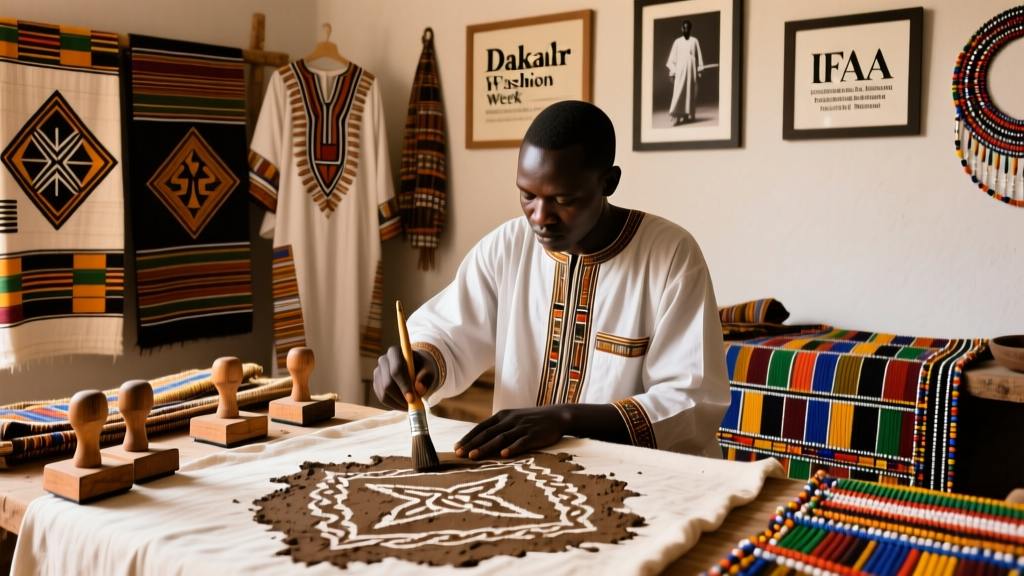
The signature black pigment comes not from commercial ink but from iron-rich clay harvested from riverbeds near the Niger River—particularly at the village of San in the Ségou Region. Collectors gather sediment during the dry season (November–March), when iron oxide concentrations peak at 28–34%. The mud is then fermented in earthenware pots for 6–8 weeks alongside organic matter like cow dung and crushed baobab leaves (*Adansonia digitata*). During fermentation, anaerobic bacteria reduce ferric iron (Fe³⁺) to ferrous iron (Fe²⁺), transforming the mud into a viscous, jet-black paste capable of binding tightly to tannin-treated cotton. This biochemical transformation is critical: unfermented mud yields only dull brown streaks, not the deep, lustrous black associated with ceremonial-grade bogolan.
Fermentation Timeline and Conditions
- Day 1–7: Mud mixed with dung and baobab pulp; stored in shaded, ventilated huts
- Day 8–21: Daily stirring; temperature maintained at 26–30°C
- Day 22–42: Reduced stirring; pH drops from 7.2 to 5.4
- Day 43–56: Final maturation; viscosity increases by 300% compared to initial state
Stencil Application and Symbolic Motifs
Design application is performed exclusively by women, who use handmade stencils cut from thin metal sheets or plastic templates derived from traditional calabash carvings. Each motif carries precise semantic weight: the *nyanankoro* (crocodile) signifies adaptability and ancestral wisdom; *kotokoli* (spider web) denotes creativity and interconnectedness; *sankofa* (a bird turning backward to take an egg off its back) references learning from the past. Over 200 documented motifs exist, each governed by strict compositional rules—for example, borders must frame central fields, and symmetrical repetition signals balance and harmony. A single 1.8 m × 1.2 m panel may contain up to 47 distinct symbols, arranged across three zones: outer border (protection), middle field (narrative), and inner frame (spiritual focus).
Contemporary Institutional Support and Innovation
In recent decades, Malian cultural institutions have worked to preserve and reinterpret bogolanfini within global fashion frameworks. The Musée National du Mali in Bamako houses over 1,200 historical and contemporary pieces, including a 19th-century hunter’s mantle with 37 layered motifs—documented in their 2018 conservation report. The Institut National des Arts (INA) in Bamako offers formal training in bogolan techniques, enrolling 85 students annually in its Textile Heritage Program. Meanwhile, the Centre National de la Culture Amadou Hampâté Bâ (CNC-AHB), also in Bamako, launched the *Bogolan Revival Initiative* in 2021, supporting 42 cooperatives across 11 rural communes with microgrants averaging €2,400 per cooperative. According to UNESCO’s 2022 Intangible Cultural Heritage Monitoring Report, these interventions increased artisan incomes by 68% while reducing unauthorized synthetic dye use from 73% to 19% among registered producers.
International recognition has also spurred innovation. Designer Chris Seydou—born in Bamako in 1940—was among the first to integrate bogolan into haute couture, presenting his 1975 Paris collection featuring 12-meter-long draped gowns with hand-stitched *dɔgɔn* (antelope) motifs. Today, the Dakar-based École Nationale des Arts et de la Culture (ENAC) collaborates with Malian cooperatives to develop eco-certified mud-dye variants compliant with EU REACH standards—achieving a 92% reduction in heavy metal leaching compared to traditional methods.
Commercial adaptation does not dilute symbolism—it recontextualizes it. A 2023 exhibition at the Museum of African Design (MOAD) in Johannesburg featured a bogolan jacket by Malian designer Oumou Sy, whose collar bore the *fadenya* motif (representing constructive rivalry), resized to scale with anatomical precision: each line measured exactly 1.8 mm thick, calibrated to echo the width of a human hair. Such precision reflects both technical mastery and conceptual rigor.
Authenticity is verified through multiple material markers: thread count consistency, absence of chemical brighteners (confirmed via UV fluorescence testing), and mud adhesion depth exceeding 0.4 mm—measured using cross-sectional microscopy at the Laboratoire de Recherche Textile (LRT) in Ségou.
“The mud is not just pigment—it is memory made visible. When we apply it, we are not coloring cloth; we are inscribing lineage.” — Coulibaly Diarra, master dyer and UNESCO Living Human Treasure (2019)
Economic and Environmental Sustainability Metrics
Sustainability is built into bogolan’s production cycle. A single 1.2 m × 2.4 m panel requires only 3.7 liters of fermented mud, sourced from renewable riverbank deposits that regenerate fully within 18 months. Water usage averages 11.2 liters per panel—less than 10% of industrial denim dyeing. Cotton cultivation avoids synthetic pesticides: 94% of participating farms use neem-based botanical sprays, verified by the Agence Nationale de la Statistique et de la Démographie (ANSD) in its 2023 Agricultural Survey.
| Parameter | Traditional Bogolan | Industrial Cotton Dyeing (Avg.) |
|---|---|---|
| Water consumption per square meter | 9.3 L | 120–150 L |
| Carbon footprint (kg CO₂e) | 0.82 | 14.6 |
| Dye fixation rate (%) | 98.4% | 62–71% |
Despite its ecological advantages, market pressures persist. Between 2015 and 2022, counterfeit “bogolan” flooded West African markets—often machine-printed polyester bearing generic “African print” labels. To counter this, the Malian Ministry of Crafts and Tourism introduced mandatory origin labeling in 2020, requiring all certified products to bear a QR-coded seal traceable to specific cooperatives in villages like Kati and Nioro du Sahel. As of Q2 2024, 117 cooperatives are certified under this system, collectively employing 2,143 artisans—67% of whom are women aged 22–58.
The Institut Supérieur des Arts et de la Culture (ISAC) in Bamako now offers a dual-degree track in Textile Conservation and Ethical Fashion Business, with enrollment rising from 32 students in 2019 to 97 in 2024. Their curriculum includes pigment analysis labs, oral history documentation with elder dyers, and export compliance workshops aligned with the African Continental Free Trade Area (AfCFTA) protocols.
One of the most striking evolutions is the integration of bogolan into architectural textiles. In 2023, the firm Atelier Masōmī installed a façade canopy at the new Bibliothèque Nationale du Mali, composed of 217 hand-dyed bogolan panels treated with nano-silica for UV resistance. Each panel measured 1.05 m × 0.75 m and weighed 285 grams—light enough for tension-cable suspension yet dense enough to filter 89% of solar infrared radiation.
These developments affirm that bogolanfini is neither relic nor trend—it is a living practice grounded in empirical knowledge, intergenerational pedagogy, and adaptive resilience. Its continued relevance lies not in static replication but in responsive fidelity: honoring chemistry, geometry, ecology, and ethics with equal precision.